Moving a home gym comes down to three things: a plan, the right order of work, and enough hands for the heavy pieces. Plates, dumbbells and benches are simple but heavy. Treadmills, power racks and cable machines are awkward, hard on floors and easy to damage. Done well, you unplug, loosen, wrap, label and carry in a sensible sequence, and you reassemble in the new space within a day or two.
This guide covers each type of equipment, how to protect your floors and stairs, and when it makes sense to hand the job to a crew. We are a moving company in Abbotsford, so we also cover what matters locally: condo elevators, Fraser Valley driveways and longer moves within BC.
TL;DR
- Start with a written plan: list every piece, note which ones come apart, and measure doorways, stairwells and the new room before moving day.
- Treadmills, racks and cable machines need photos of the setup, labelled hardware bags and the original manual if you still have it.
- Weight plates and dumbbells go in small, sturdy boxes or crates, never in one huge box. Protect floors and stair edges.
- Check Health Canada's recall database for your models before you move them or pass them on.
- For treadmills, full racks, stacked cable machines or any move involving stairs or an elevator, a trained crew is safer for you and your equipment.
Table of Contents
- Start with a plan and an inventory
- The order of work that saves time
- Moving a treadmill
- Racks, benches and strength machines
- Weights, plates and dumbbells
- Protect your floors, stairs and walls
- Condos, apartments and stairs
- Garage gyms, driveways and Fraser Valley houses
- DIY, hire help, or a mix
- Our perspective: what we see on gym moves
- How we can help with your gym move
- Moving day checklist
- Setting up again in the new place
- FAQ
- Sources
Start with a plan and an inventory
Every fitness equipment move begins the same way. One technician guide from the fitness-service trade puts it bluntly: have a plan, even for what looks like a quick treadmill move. That means knowing where each piece is now and exactly where it will go.
Walk through your gym with a notepad or phone and record:
- Each piece, with brand and model. You will need this for recall checks, manuals and quotes.
- Approximate weight and size. Check the label or manufacturer page. A loaded barbell, a rack and a bench are very different jobs from a folding treadmill.
- What comes apart. Racks usually unbolt. Benches may fold. Cable machines often split into frame, weight stack and pulleys.
- What you will not move. Be honest about the old bench with torn upholstery or the machine you stopped using two years ago.
Then measure. Doors, hallway corners, stair turns and the basement entry are where large machines get stuck. Measure the destination room too, including ceiling height if you own a power rack or a cable tower. A rack that fit in a garage may not fit under a basement ceiling.
Check for recalls before you move or sell
Fitness equipment is regularly recalled in Canada. Health Canada has posted notices for a functional trainer whose cables could break, a folding treadmill that could change speed unexpectedly, treadmills with a fire hazard and a Smith press. Search your brand and model on the recalls site before the move. If a machine is recalled, stop using it and follow the notice's instructions. The Canada Consumer Product Safety Act prohibits selling or even giving away recalled products, so a recalled machine should not end up on a marketplace listing as part of your clear-out.
The order of work that saves time
A home gym move goes faster when you work in a fixed sequence. This is the order we suggest:
- Photograph everything. Take wide shots and close-ups of cable routing, pulley positions, bolt locations and any wiring on consoles.
- Gather manuals. Find the original assembly instructions, or download them from the manufacturer using your model number.
- Clear small items first. Collars, bands, grips, mats, accessories and the rack of dumbbells you can empty into crates.
- Disassemble what comes apart. Put bolts in labelled zip bags and tape each bag to the piece it belongs to.
- Wrap and pad. Moving blankets on frames, corner protection on uprights, stretch wrap to keep moving parts closed.
- Load heavy items low and centred. Plates go in the truck first, close to the cab-side wall, so weight sits low and does not shift.
- Reassemble in the new room. Start with the largest piece, then work out to accessories.
The photo and labelling step is not busywork. Moving crews generally do not take responsibility for whether electronics work after a move, and owners are often expected to supply assembly instructions for complex machines like power racks and cable systems. A government pre-move booklet for relocating households makes that division of responsibilities clear. Photos of wiring and labelled hardware bags save you from guessing at reassembly.
Moving a treadmill
Treadmills are the piece people search for most, and with good reason: they are heavy, bulky, and have a motor and electronics inside.
Before you lift:
- Unplug the machine and let it sit. Coil the power cord and tape it down, or secure it so it cannot drag or get pinched.
- Remove the safety key and keep it somewhere you will not lose it, such as taped inside a labelled bag with the manual.
- Lower the incline to its flattest position if your manual says to.
- If the deck folds, fold it and lock the latch. Many guides also suggest securing the folded position with a moving strap. Check your manual, because not every model is designed to fold the same way.
- Wrap the console or cover it with a blanket so it does not scratch or take a knock.
Moving it:
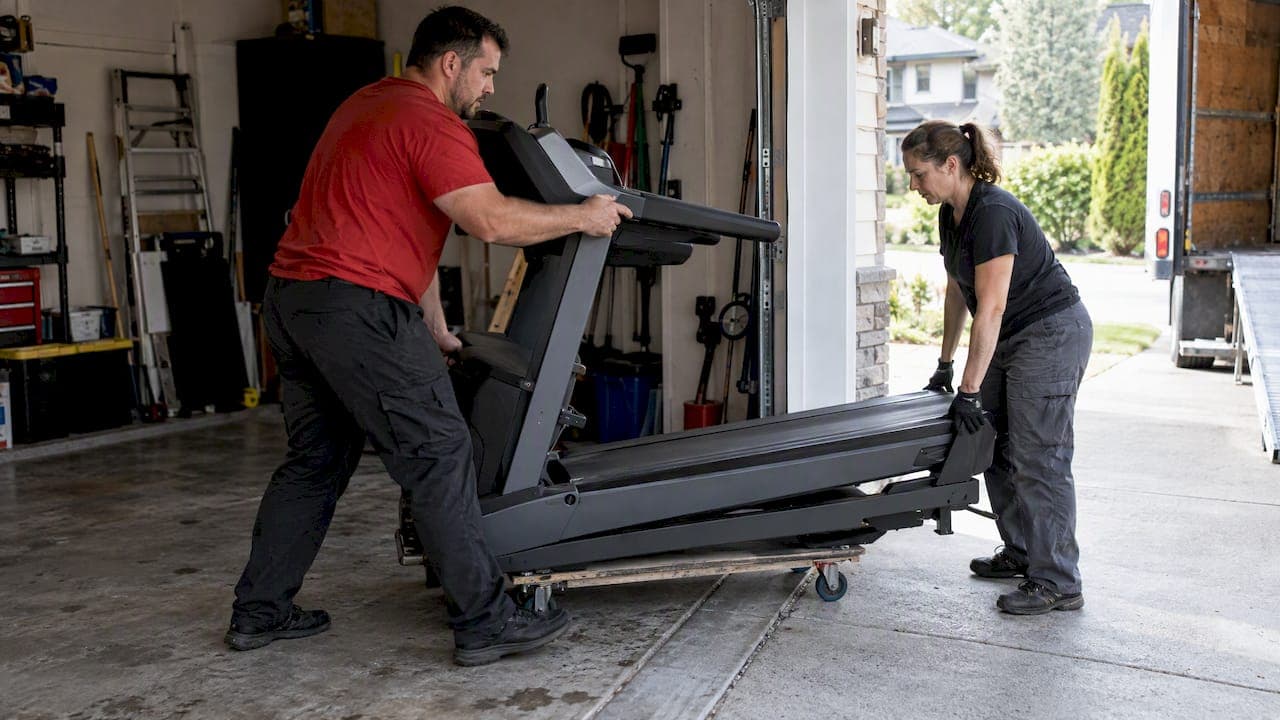
- Use two people at least. Many treadmills weigh well over what one person can safely control on a staircase.
- Do not drag it across a floor on its wheels unless the manufacturer says the wheels are made for that. Transport wheels are meant for short, level rolls.
- On stairs, use a proper appliance dolly with straps. Go slowly, keep the heavy end low, and have a spotter at the bottom.
- In the truck, secure it upright or in the position the manual allows, strapped to the wall rails so it cannot tip.
If your treadmill is not a folding model, or you are moving it down a basement staircase, that is a job for a crew that does it every week. The risk is not only a damaged machine. It is a back injury or a dented stair wall.
Racks, benches and strength machines
Power racks and squat stands
Most rack frames unbolt into uprights, crossmembers and attachments. Take the pull-up bar, safety arms, J-hooks and band pegs off first and bag them by type. Photograph the hole positions the uprights use so you can reset heights quickly. Wrap uprights in blankets, and pad the ends of crossmembers that could scratch a van wall or a doorframe.

If the rack is bolted to the floor in a garage, check how it is anchored before you start. Keep the anchor bolts and note the hole spacing if you plan to reinstall them.
Benches
Adjustable benches usually fold flat, but the pad and the frame are heavier than they look. Remove the pad if it detaches. Wrap the frame, and keep the adjustment pin attached or in the hardware bag.
Cable machines and functional trainers
These are the most complex items in most home gyms. Weight stacks are heavy, and the cables run through a precise path. Before disassembly:
- Take photos of the cable routing through every pulley.
- Remove the weight plates from the stack and move them separately. Secure the guide rods.
- Note the order of any collars, pins and spacers.
Because a recalled functional trainer in Canada was pulled for cable ends breaking off, it is worth checking cable condition and recall status before reassembling any machine of this type.
Weights, plates and dumbbells
Iron is the simplest equipment to understand and the easiest to injure yourself with. The mistake is packing too much in one box.
- Use small, strong boxes or plastic crates. A box that is easy to carry will hold up. A big box full of plates will split at the bottom.
- Keep each load to a weight one person can lift comfortably. Mix plates with soft items like towels or mats to fill space and prevent rattling.
- Stack plates flat, with a layer of cardboard or a towel between them, so edges do not chip the paint or each other.
- Dumbbells in a rack: take them out and move them separately. Rack and weights together are a hazard on stairs.
- Barbells: wrap them in blankets or a bar tube, and lay them flat in the truck so they cannot roll or bend under other loads.
- Kettlebells: pack them in crates, not loose in a box. Handles can crack floors and truck beds.
A useful rule of thumb: if you wince when you lift it, it needs a second person or a dolly.
Protect your floors, stairs and walls
Home gyms often live in basements and garages, which means narrow stairs, concrete steps and finished corners. Before moving day:
- Lay down floor protection along the route, including the front entry. Runners or hard board work well, and cardboard is a cheap backup.
- Wrap door frames and railings at tight corners with moving blankets or foam.
- Put corner protectors on uprights and frames.
- Remove interlocking foam or rubber flooring and roll it, stacking it separately. Rubber mats are heavy but easy to carry once rolled.
- Clear the path completely. Shoes, boxes and kids' toys on the stairs are how accidents happen.
At the new place, protect the floor before the first piece goes in. A single dropped plate on engineered hardwood is a bigger repair than the whole protective layer costs.
Condos, apartments and stairs
If your gym lives in a strata or rental building, access matters as much as weight. Ask the building manager about elevator booking, loading bay times and any rules about moving large equipment. Do this early. A BC Residential Tenancy Branch decision on elevator modernization shows that tenants are expected to plan around building access, so do not count on a landlord to rescue a move if the elevator is booked or out of service.
Practical points for apartment and condo moves with gym equipment:
- Book the elevator for a window long enough to take the heavy items down first.
- Measure the elevator interior. Many racks and treadmills fit only when stood on end.
- Protect the elevator walls and floor if the building asks you to.
- If the unit is on an upper floor with stairs, consider moving the heaviest pieces first, while everyone is fresh.
We handle this regularly through our apartment and condo moving service.
Garage gyms, driveways and Fraser Valley houses
In Abbotsford, Mission, Langley and Maple Ridge, a lot of gyms sit in garages or basements of single-family homes. That brings a different set of challenges:
- Driveway slope. A heavy rack on a dolly can pick up speed. Keep a person on the downhill side.
- Wet weather. In the Fraser Valley fall and winter, wet driveways and steps are slippery. Lay mats or boards, and keep gym equipment dry in transit so steel does not rust.
- Garage doors. A door that does not open fully will limit what the truck can load from. Check it ahead of time.
- Basement stairs. Count steps and note any turns. This determines how many people you need and which pieces need disassembly.
DIY, hire help, or a mix
You can move a modest gym yourself: a bench, a barbell, dumbbells and a set of plates. You need a vehicle, a dolly, straps, blankets and willing friends. The cost is time and risk to your back and your property.
Here is a quick way to decide:
| Situation | DIY is realistic | Hire a crew |
|---|---|---|
| Bench, bar, plates, mats | Yes, with a vehicle and help | If you also have a full household move |
| Folding treadmill on ground floor | Possibly, with two strong people and a dolly | If stairs or a truck ramp are involved |
| Power rack or cage | If you are comfortable disassembling it | If bolted down or in a basement |
| Cable machine or stacked trainer | Rarely | Yes, especially with stairs |
| Gym is part of a whole-home move | Not usually worth splitting | Yes, one team handles all of it |
| Long-distance move within BC | Only if you rent a truck and have time | Yes |
A mix often works best: you disassemble, photograph and label, and the crew carries, loads, drives and unloads. That keeps your cost down and puts the heavy lifting in trained hands.
Our perspective: what we see on gym moves
We move homes across Abbotsford and the Fraser Valley, and gym equipment shows up in a large share of them. A few things we have come to believe:
- Planning does more than muscle. A crew that knows the stairs, the door widths and the order of loading saves more time than a bigger crew that wings it. That is why we ask for details up front: the equipment list, where it is, and what the access is like at both ends.
- Treat the gym as its own load. We prefer to handle heavy equipment first, with the right straps and dollies, rather than at the end of a long day when everyone is tired.
- Disassemble what the manufacturer designed to come apart. It reduces damage and makes the item easier to carry. Photos and labelled bags remove the stress from reassembly.
- Say what you own. Tell us about the treadmill and the rack when you ask for a quote. A surprise on moving day is bad for you and for us.
- Be honest about what we do. We move and carry equipment. Calibrating electronics or reassembling complex machines to factory spec is a manufacturer or technician job, so keep your manuals handy.
We built our service around clear communication, careful planning and making the process easier, and a home gym is a good test of all three.
— Jack W.
How we can help with your gym move
If your move includes a treadmill, a rack or a full set of plates, tell us when you request a quote. We handle residential and commercial moves across Abbotsford, Mission, Maple Ridge and Langley, and we can take on the heavy pieces as part of a local move or a long-distance move within BC. If you want help with the smaller items, our packing services cover boxing and wrapping, and our furniture moving team carries the bulky, awkward pieces. Need just the lifting? Our loading and unloading service does that, and if the gym will sit in a unit between homes, we also do storage moves. We also work with Maple Ridge and Langley customers through our Maple Ridge and Langley pages.
Moving day checklist
Print this or keep it on your phone:
- Equipment list with brand, model and approximate weight
- Recall check done for each machine
- Manuals found or downloaded
- Photos of cabling, wiring and bolt positions
- Hardware in labelled bags, taped to the right piece
- Treadmill unplugged, safety key stored, deck locked
- Weight stacks pinned and plates removed
- Plates and dumbbells in small crates
- Floor protection down along the whole route
- Elevator or loading bay booked, if you live in a building
- Destination room measured and cleared
- Tools ready: Allen keys, wrenches, socket set, tape, zip bags, marker
Setting up again in the new place
A gym is easier to reassemble when you plan the layout before the first piece goes in. Mark out the floor with tape. Leave room around a rack for the bar to travel, and room behind a treadmill so you can step off safely. Place heavy items on a solid, level surface, and use mats under machines to protect the floor and absorb vibration.
Assemble the biggest piece first, then work out. Reconnect the treadmill only once it is in position and plugged into an outlet that suits it. If your manual calls for a dedicated circuit, follow it. After reassembly, check every bolt, pin and cable before you use the machine, and test each piece at light load.

Regular strength work is worth protecting. The Public Health Agency of Canada recommends that adults aged 18 to 64 get at least 150 minutes of moderate-to-vigorous activity a week, including muscle-strengthening activities at least twice a week. A gym that is back in working order within a day or two of the move makes that routine easy to keep through a busy transition.
FAQ
How do I move a treadmill without damaging it?
Unplug it, remove the safety key, lower the incline and fold and lock the deck if your model allows. Wrap the console, use an appliance dolly with straps, and have two people on any stairs. Check the manual for the manufacturer's own transport instructions.
Can movers take apart and reassemble gym equipment?
Crews can usually handle simple disassembly such as unbolting racks, but responsibility for electronics and complex machines is limited. Keep manuals and photos handy, and ask about it when you request a quote. Tell the company about every machine in advance.
How should I pack weight plates and dumbbells?
Use small, sturdy boxes or plastic crates, and keep each load light enough for one person to lift comfortably. Separate plates with cardboard or towels, and move dumbbells out of their rack. Never load a large box with plates.
Should I check if my gym equipment has been recalled?
Yes. Health Canada publishes recalls on treadmills, trainers and other machines, and the Canada Consumer Product Safety Act prohibits selling or giving away recalled products. Search by brand and model before you move or sell anything.
Is it worth hiring movers just for the gym equipment?
Often yes, if it includes a treadmill, rack or cable machine, or if you have stairs. A short booking for the heavy items can protect your floors and your back. If you are moving the whole home anyway, adding the gym to one job is simpler.
Sources
- General steps and tips for moving fitness equipment
- Pre-move information booklet, Government of Canada
- BC Residential Tenancy Branch decision on elevator service
- Physical activity for your health, Public Health Agency of Canada
- Progression Fitness X-Plode PFX-2200 Functional Trainer recall, Health Canada
- Horizon T101-05 folding treadmill recall, Health Canada
- Matrix T1 and T3 treadmill recall, Health Canada
- Cybex Smith Press recall, Health Canada