
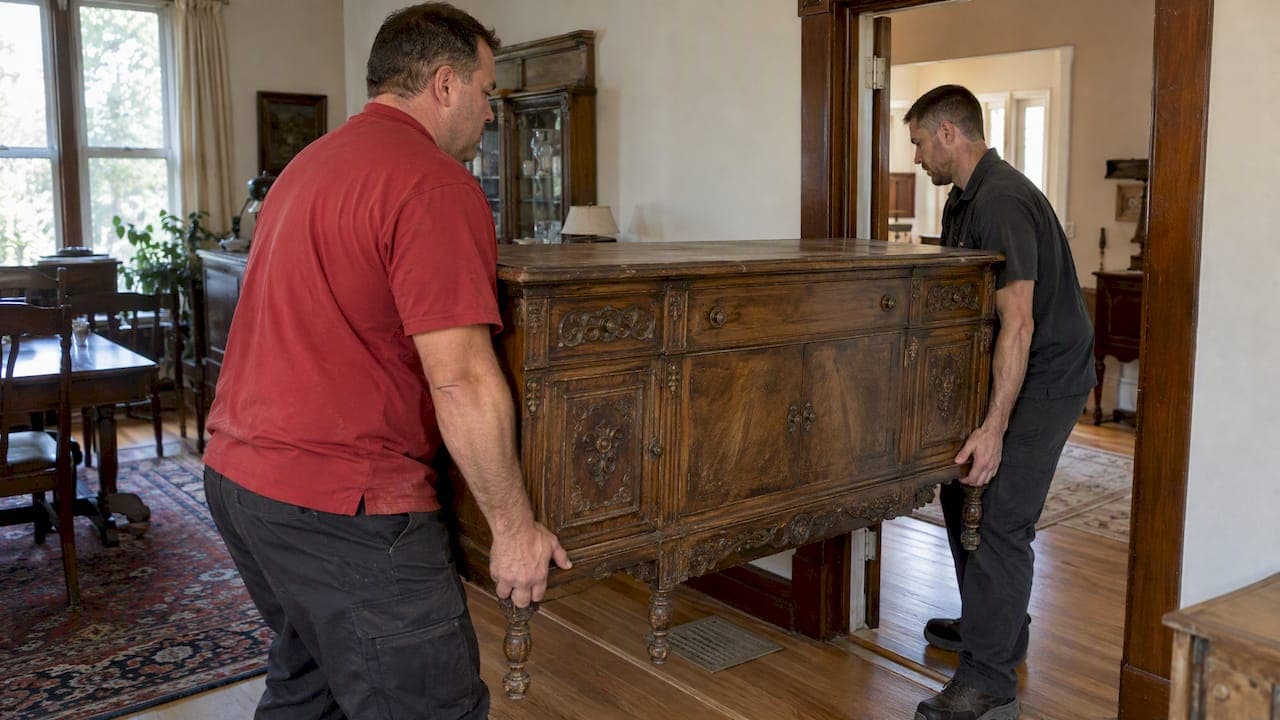
Antique furniture can be moved safely, but only if the mover knows about each piece before moving day and plans for it. That means a clear inventory, the right padding, trained lifting, and a written understanding of what happens if something is damaged. This guide covers all four, with notes for Abbotsford, Mission, Maple Ridge and Langley moves.
TL;DR
- Tell your mover about every antique when you ask for a quote, with photos and rough dimensions. Surprises on moving day are what cause damage.
- Antiques fail at their weak points: joints, legs, veneer, finishes and marble tops. Lift by the frame, never by a tabletop or a loose part.
- Movers are generally not responsible for goods of extraordinary value unless you declare that value in advance. Get coverage in writing.
- A quote far below the others often leaves out the labour, materials and coverage an antique needs.
- Pack, wrap and load in the right order, and keep the pieces' route clear at both homes.
Table of Contents
- What counts as an antique when you are moving it
- Why antiques break in moves
- Before you book: build an antique inventory
- How movers should handle antique furniture
- Packing small antiques and what goes inside
- Coverage: the part most people skip
- Questions to ask any mover about antiques
- Our perspective: plan the antiques first
- Moving antiques in the Fraser Valley: local notes
- Long-distance and cross-border moves
- Moving antiques with Two Friends Trucking & Moving
- A simple timeline for an antique move
- FAQ
- Sources
What counts as an antique when you are moving it
There is no single legal definition of "antique" that covers every purpose. Canadian heritage rules, for example, look at age and significance. For cultural property export controls, objects generally need to be at least 50 years old and made by someone no longer living. That rule is about sending important objects out of the country, not about a move across the Fraser Valley.
For a mover, a simpler definition works better. An antique is any piece where damage cannot be repaired back to its original state, or where the value is mostly in its age and original finish. A Victorian dresser, a family sideboard, a clock case, a hand-carved chair set and a bedroom suite from your grandparents all qualify. So does a piece that is only 40 years old if it matters to you.
This matters because it changes how you plan. A modern dresser is an inconvenience if it gets scratched. An antique with a cracked veneer or a loosened joint may be permanently changed.
Why antiques break in moves
Most antique damage is predictable. Old furniture was built with hide glue, hand-cut joints and thin veneers, and it has spent decades adjusting to one home's temperature and humidity.
The Canadian Conservation Institute's guidance on basic care of wooden furniture points to the main risks:
- Loose or dry joints. Chairs and tables that wobble can come apart under their own weight when lifted.
- Lifting stress on legs. Picking up a table by its top puts the strain on the legs and the joints that hold them.
- Marble and stone tops. These should be removed and carried upright, not flat.
- Finishes sensitive to climate. Shellac, old varnish and veneer react to sudden changes in temperature and humidity.
In practice, damage tends to come from four things: lifting the wrong way, pieces rubbing against each other in the truck, drawers and doors opening in transit, and tight turns in stairwells or doorways that nobody measured.
Before you book: build an antique inventory
The single most useful thing you can do is tell your mover early. Specialty moving companies say the same: the crew should know about the item before moving day so the right approach is planned. A piece that appears unannounced on a loaded truck gets handled like everything else.
Spend an hour on this list:
- Photograph each piece from the front, side and back, plus close-ups of any existing damage, cracks, chips or repairs. Date-stamped photos are your baseline.
- Measure each piece and note the heaviest and tallest items. Measure doors, hallways and stairwells at both ends.
- Note removable parts: marble tops, glass shelves, mirrors, finials, leaves, casters, hardware.
- Write down what you believe each piece is worth, and gather any appraisal, receipt or provenance paperwork.
- Flag pieces that are already fragile: loose joints, lifting veneer, split panels, wobbly legs.
If you are starting your wider move plan, our house moving checklist walks through logging and protecting items from eight weeks out. The same habit works for antiques.
How movers should handle antique furniture
Here is what careful handling looks like, so you can check whether a crew is doing it.
Preparation
- Drawers are emptied. Heavy contents shift and strain old runners. Remove loose items and wrap them separately.
- Doors and drawers are secured closed with padding or stretch wrap on the padding, not tape on the finish. Tape and stretch film can lift old finishes and veneers if they touch the surface directly.
- Removable tops, mirrors and shelves are taken off and wrapped separately.
- Legs, carvings and corners get extra padding before the main wrap.
Lifting and carrying
Conservation guidance advises lifting tables by the apron or legs rather than the top, and using straps for stability, as described in the Canadian Conservation Institute's furniture care page. Heavier pieces need two or more people, and nobody should drag a piece across a floor.
Walk the route first. Know where the turns are, which doors need removing, and where the piece will rest on the way out. A crew that has already planned the path does not improvise on the stairs.
Loading and transport
- Antiques go on last or in a protected zone of the truck, secured so they cannot shift.
- Furniture stays upright in its natural orientation where possible. Mirrors and marble tops travel on edge.
- Nothing heavy is stacked on top of an antique, and pieces do not touch each other without padding between them.
Unloading and placement
At the new home, unwrap in place, check each piece against your photos, and put it down where it will stay. Re-moving a heavy piece after it is set down adds another risk.
Packing small antiques and what goes inside
A chest of drawers is only part of the story. Mirrors, clocks, china cabinets with contents, lamps and glass need their own care. Professional packing services are worth considering for anything fragile you cannot easily replace, because the cost of one broken heirloom can outweigh the packing fee. Even if you pack most of the house yourself, hand the delicate items to the crew.
For your own boxes, use clean packing paper (not newsprint on bare finishes), and label every box with the room and "fragile." Keep keys, hardware and small parts from antique pieces in a labelled bag that travels with you.
Coverage: the part most people skip
This is where antique moves go wrong in a different way. Under Canadian transportation law as summarized by the federal Office of Consumer Affairs, a mover is not responsible for carrying goods of extraordinary value, such as works of art, unless that value has been declared. The same page explains that standard liability is limited and that you should understand your options before moving day.
So before you sign:
- Ask what the mover's standard liability is, in writing, and how it is calculated.
- Ask whether you can declare a higher value for specific pieces and what that costs.
- Call your home insurer and ask whether items in transit are covered. Many home policies limit or exclude goods in transit, so do not assume.
- Keep your photos and any appraisals with the paperwork.
The cheapest quote may not include any of this. Our guides on comparing movers for coverage, not just price and questions to ask movers cover what a complete quote should list.
Questions to ask any mover about antiques
| Question | What a good answer sounds like |
|---|---|
| Have you moved pieces like these? | Specific examples, not a vague "yes" |
| Who will lift and wrap them? | The crew assigned to your move, with a clear process |
| What materials will you use? | Padding and wraps suited to finishes, not just tape |
| What is your liability for these items? | A written answer, with options to declare value |
| Will you visit or review photos first? | Yes, before quoting |
| What happens if there is damage? | A claims process you can describe back |
A mover who dodges the liability question has told you what you need to know.
Our perspective: plan the antiques first
We move families and businesses across Abbotsford, Mission, Maple Ridge and Langley, and our approach to antiques is the same as to any job that matters: plan carefully, communicate clearly, and handle things with care.
Here is how we think about it. The antique is not the problem. The surprise is. When a customer tells us about a piece at the quote stage, we can plan crew size, padding, the route through the home and where it sits on the truck. When it appears on moving day behind a stack of boxes, we are improvising, and so is the customer.

We would rather you over-share. Send photos. Mention the grandmother's cabinet with the loose back leg. Tell us about the marble top. We can then give you a quote that reflects the real job, rather than one that grows later. That is also why we encourage you to compare quotes on scope, not just on the total.
We also suggest customers decide in advance which pieces are truly irreplaceable. For a few, the right answer may be to handle them personally or ask a specialist, such as a conservator or restorer, to look at fragile joints before the move. Honest advice beats a promise we cannot keep.
— Jack W.
Moving antiques in the Fraser Valley: local notes
Older homes in Abbotsford, Mission and Langley often have narrow staircases, tight door frames and steps at the entry. Measure these before you assume a large armoire or china cabinet will fit. If a piece cannot get out in one piece, a removable top or doors may need to come off first, and that should be planned, not discovered.
Condos and apartments add elevator bookings, loading zones and building rules. If you are leaving or entering a strata building, book the elevator early and ask about protective padding requirements. Our apartment moving checklist covers timing, and the apartment and condo movers page describes how we handle those moves.
Access also matters. A clear driveway and clear paths allow the crew to work carefully rather than rush. See our note on preparing for movers for why unreserved access can delay a move.
If the antiques will wait between homes, a climate-sensitive piece is better in a stable indoor space than in a damp garage. Our guide to storage in transit covers how to protect belongings in that gap, and we also offer storage moving.
Long-distance and cross-border moves
For a longer move within BC, the same rules apply with more hours on the road. Vibration, temperature swings and a longer time in the truck make padding, securing and coverage more important. Ask how the mover plans the load for your pieces. Our long-distance moving service covers moves within British Columbia.
If you are returning to Canada with antiques bought or used abroad, the border has its own rules. The Canada Border Services Agency explains that returning residents prepare a list of goods with values and descriptions, and that eligibility for duty- and tax-free entry depends on how long you owned and used the goods abroad. Check the current page before you ship. If you are exporting something of possible national importance, review the federal export permit guide for cultural property first. Neither applies to a move within Canada.
Moving antiques with Two Friends Trucking & Moving
We provide residential and commercial moving across Abbotsford and the Fraser Valley, including local moves, furniture moving, packing, loading and unloading, and storage moving. We also list piano moving among our services. Antiques fit naturally into a furniture move when we know about them in advance.
To get a quote that reflects your antiques, send photos, measurements and your list of fragile pieces through our main page. We serve Maple Ridge and Langley as well. If you need help only with the heavy part, our loading and unloading service can cover it.
A simple timeline for an antique move
- Six to eight weeks out: photograph and measure pieces, collect appraisals, and call your home insurer.
- Four to six weeks out: request quotes, share your antique list, and ask the liability questions above.
- Two to three weeks out: book, confirm which pieces the crew will wrap, and arrange any pre-move repair of loose joints.
- The week before: empty drawers, remove loose parts, clear the routes and book building elevators.
- Moving day: walk the crew through the antiques, point out weak spots, and check each piece against your photos on arrival.
FAQ
How do I move antique furniture safely?
Tell your mover about every piece before the quote, empty the drawers, remove tops and loose parts, and pad corners and legs before wrapping. Lift by the frame, legs or apron, not by the top. Check each piece against your photos when it arrives.
Will movers be liable if my antique is damaged?
Not automatically. Goods of extraordinary value are generally not covered unless you declare that value in advance, according to the Office of Consumer Affairs. Ask for the mover's liability terms and any declared-value options in writing, and check your home insurance for goods in transit.
Should I fix loose joints before a move?
If a chair or table wobbles, it is better to have it looked at by a furniture restorer or conservator before the move. Loose joints are one of the main weak points in old furniture, as the Canadian Conservation Institute notes. At minimum, tell your movers so they can support the piece correctly.
Is a cheaper quote a warning sign for antique moves?
It can be. A low total may leave out packing materials, extra crew time or coverage that fragile pieces need. Compare quotes line by line for scope, materials and liability, not just the bottom number.
Do I need a specialist, or can a regular moving company handle antiques?
Many antique pieces are well within the reach of an experienced moving crew that plans ahead. The key is that the company knows about the piece early, uses suitable padding and has a clear liability policy. For very rare or high-value items, consider asking a conservator or appraiser for advice too.
Sources
- Basic care: furniture and objects made of wood, Canadian Conservation Institute
- Moving advice, Office of Consumer Affairs
- Guide to Exporting Cultural Property from Canada, Canada.ca
- Moving or returning to Canada, Canada Border Services Agency