
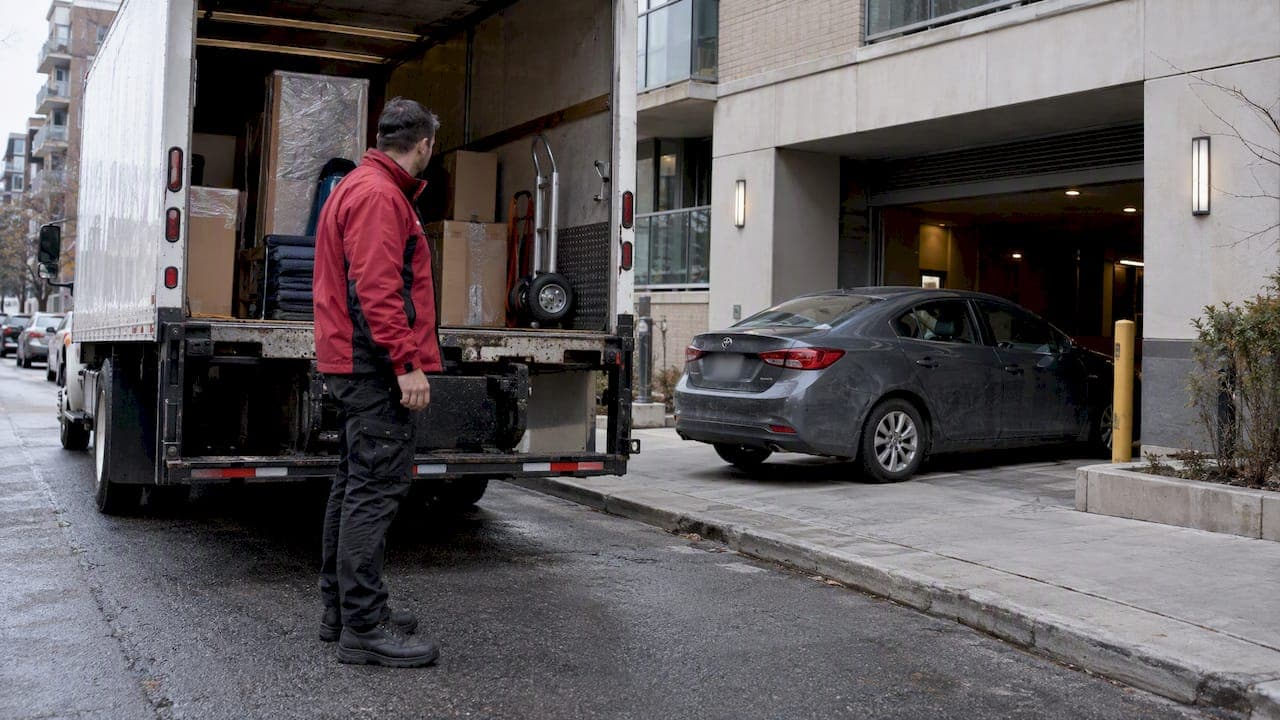
A key step to prepare for movers is confirming your logistics in writing and staging items room by room, so the crew can start working the moment they arrive. Blocked parking, unreserved elevators and undisclosed hazardous items can cause delays, and Office of Consumer Affairs guidance points to each of them.
TL;DR:
- Get at least three written estimates, and confirm which services and specialty items each includes before signing; compare coverage, not price alone.
- Reserve parking at both addresses and book elevators early, because crews may charge for waiting when loading areas or building access are not ready.
- Label boxes you packed yourself and record their contents, since local movers may not provide an itemized inventory if belongings go missing.
- Defrost and dry refrigerators and freezers 24 hours before loading, and arrange disconnection of gas or water lines because movers will not connect them.
- Move gasoline, propane, paint, cleaning chemicals, fireworks, and opened food yourself; movers cannot transport hazardous materials, and coverage usually excludes them.
Table of Contents
- What should you do room by room before movers arrive?
- When should you do each task before the move?
- How do you pack, label and inventory your belongings?
- How do you prepare appliances and large furniture?
- How do you secure parking, elevators and access?
- What documents and insurance should you check?
- Which items will movers refuse to carry?
- How do you verify delivery and start a claim if needed?
- How do you communicate special instructions to movers?
- How do you prepare children and pets for moving day?
- How do you prepare utilities for disconnection and reconnection?
- What is the checklist for updating your address and contacts?
- A mover's perspective: two tips that save the most time
- Let us handle the checklist for you
- FAQ
- Sources
What should you do room by room before movers arrive?
Start with the biggest lever you control: what you move at all. Every item you donate, sell or discard is an item nobody has to pack, carry, load, unload or insure. Do this weeks ahead, not the night before, because selling or donating takes time.
Then work through the house one room at a time:
- Sort each room into keep, donate, sell and discard piles, and remove the last three before moving day.
- Keep passports, jewelry, keys, medication and cash with you. Set them aside in one bag that never touches the truck.
- Label every box with the destination room and a short contents list, such as "Kitchen: pots and pans."
- Pack an "open first" box with toiletries, chargers, bedding and basic tools for your first night.
- Disassemble small furniture the crew asked you to handle, and put screws and bolts in labeled bags taped to the piece.
- Mark owner-packed boxes clearly and keep a digital list of what is inside each one.
Keep a toolkit by the door with a screwdriver, a hex key set and a roll of tape. Crews work faster when the basics are within reach, and you avoid paying for time spent hunting for a missing wrench.
When should you do each task before the move?
Timing matters as much as the tasks themselves. Booking late is the one mistake you cannot fix with extra effort later, so work backward from moving day. Our guide to when to book movers covers lead times and building rules in more detail.
- Before moving day: Book your movers and get a written, signed estimate. Ontario's consumer guidance recommends collecting at least three written estimates and spelling out which services, such as packing or specialty items, are included.
- Before moving day: Declutter, start packing items you will not need soon, gather boxes and tape, and notify key services that your address is changing.
- Closer to moving day: Reconfirm the move time and truck access with your mover. Finish packing everything except daily essentials, and map your route to the new home.
- Before moving day: Defrost the refrigerator and freezer, pack your essentials bag and set aside anything the movers will not carry.
- Moving day: Clear floors and pathways, put a point person at both homes, and expect to review the inventory with the crew before they leave.
If you are weighing several companies, we explain how to compare three quotes for coverage and not just price.
How do you pack, label and inventory your belongings?
Good packing protects your belongings, and good labeling decides how fast you are settled in. Think of each box as a message to the crew: where it goes, what is inside, and how carefully to handle it.
- Fragile items: Wrap each piece individually, fill the gaps so nothing shifts, and mark the box "fragile" with the contents listed. For high-value pieces or antiques, consider professional packing.
- Owner-packed boxes: Movers often limit their liability for boxes you packed yourself, so label them clearly and keep a record of what is inside each one.
- Labels: Use room, contents and priority together, for example "Bedroom, linens, open first." Number each box so it matches a line in your inventory.
- Inventory: Build a room-by-room list on paper or in a spreadsheet. Keep one copy with you and give one to the movers.
The inventory matters more than most people expect. For local moves, professional movers are often not required to provide a formal itemized inventory, so your own list is the record you will rely on if something goes missing.
Pro Tip: Photograph each room, and the inside of open cabinets, before packing. Those photos double as a quick inventory and as evidence if you ever need to file a claim.
How do you prepare appliances and large furniture?
Appliances are one area where unprepared movers can lose time. Crews expect them ready to roll, and movers will not hook up gas or water connections. The Canadian relocation guidance on unloading notes that movers will not hook up gas or water connections, so you need to have utilities disconnected and appliances prepared.
- Defrost and dry the refrigerator and freezer 24 hours before loading, and leave the doors ajar so they air out.
- Disconnect gas, water and electrical lines ahead of time, or hire a licensed technician to do it.
- Clear the area around each appliance so the crew can reach it, and remove loose shelves and debris.
- Keep manufacturer instructions handy for anything that needs special handling.
- Have disassembly instructions and hardware available if a bed frame, table or wardrobe has to come apart.
Packing standards for major appliances and furniture disassembly also expect the shipper to make large articles accessible for servicing. A washer with a hose still attached can stall the whole job.
How do you secure parking, elevators and access?
Access problems cost real money because a crew standing around is a crew still on the clock. Treat access as a booking in itself, not an assumption.
- Reserve parking at both the old and new address, and book building elevators well ahead of time. Tell building management your arrival window.
- Measure doorways, stairwells and tight turns, then tell your movers about anything narrow so they can plan or bring the right equipment.
- Confirm who will be on site to open doors and loading areas, and name a backup contact in case plans change.
- Check building rules about move hours, deposits and protective floor coverings.
Movers may charge for time spent waiting if locations are not ready when they arrive. That is guidance from the Office of Consumer Affairs, and it is the simplest reason to lock down access early.
If you need a place to hold belongings between homes, our guide to storage in transit walks through the steps.
What documents and insurance should you check?
Some things should never go in a box. The rest is paperwork you want in your hands before the truck is loaded.
- Carry passports, keys, medication, financial documents and jewelry with you.
- Ask your mover for a Certificate of Insurance and ask them to explain their liability limits and replacement value options before you sign.
- Check whether your homeowner or tenant insurance covers goods in transit, or whether to buy mover replacement value protection. Mover insurance does not automatically cover the value of your belongings.
- Keep every estimate, bill of lading and receipt in one folder for claim purposes.
Which items will movers refuse to carry?
Professional movers cannot transport hazardous materials, and their liability and insurance usually do not cover them. Official consumer guidance lists gasoline, propane tanks, paint, cleaning chemicals and fireworks, plus many perishables.
- Gather these items in one spot before the crew arrives, and either dispose of them safely or take them in your own vehicle.
- Pay attention to the less obvious ones: perfumes, aerosols, pool chemicals, fertilizers and opened food products also commonly appear on restricted lists.
- Tell your mover about borderline items in advance, so nothing surprises the crew on load day and your coverage stays intact.
How do you verify delivery and start a claim if needed?
Do your final check before the crew leaves, because that is when problems are easiest to document and resolve.
- Walk every room, plus basements, attics, closets and garages, and look along pathways for anything left behind.
- Compare your room-by-room inventory with the mover's paperwork, and note missing or damaged items before you sign anything.
- If something is damaged or missing, photograph it and send a written claim to the mover promptly. Keep copies of every document.
At the destination, a short walkthrough with the crew lead takes ten minutes and saves weeks of back-and-forth.
How do you communicate special instructions to movers?
Movers cannot plan around what they do not know. The best time to share special instructions is when you book, and the second best is during your pre-move call. Waiting until the crew is at the door leaves no room to adjust staffing, equipment or time.
Put the important points in writing, in the same email thread as your estimate, so there is a record. Cover the following:
- Fragile or high-value pieces: Name them, say where they are, and ask how the crew will protect them.
- Heavy or awkward items: Pianos, safes, gym equipment and oversized sectionals may need extra people or equipment.
- Access limits: Tight stairs, long carries from the parking spot, or a shared driveway all affect timing.
- Items staying behind: Tag them with painter's tape or a sticky note, and tell the crew lead directly.
- Special sequencing: If something must load last so it unloads first, such as a crib or your essentials box, say so.
The Pre-Move Information Booklet stresses that a pre-move consultation and your active involvement reduce surprises. That consultation is the moment to raise concerns, not a formality.
On moving day, walk the crew lead through the home first. Point out what is going, what is staying, and anything delicate. A brief tour beats interruptions later, and it shows the crew you have a plan.
If something changes, such as a delayed key handover or a closed road, call your mover as early as you can. Most crews can adapt when they hear about it before the truck rolls, and far fewer can adapt once they are already on site.
How do you prepare children and pets for moving day?
Moving day is loud, busy and unpredictable, and children and pets feel that. A little planning keeps them safe and keeps the crew's pathways clear.
Children. Explain what will happen in simple terms, and let them pack a small bag of favorite things that travels with you, not on the truck. Younger children do best with a trusted adult or sitter away from the house during loading. If they stay, give them a quiet room that is the last one cleared, and make sure nobody is playing near open doors or the truck ramp. Older children can help by labeling their own boxes, which gives them a sense of control.

Pets. Doors stay open for hours on moving day, and that is how pets slip out. Options include a boarding facility, a friend's home, or a closed room with a sign on the door telling the crew to stay out. If a pet stays in the house, set up food, water, a bed and familiar toys in that room beforehand. Cats in particular can hide in unexpected places, so check boxes and furniture before they close.
Prepare travel needs in advance:
- Carriers and leashes within reach, not buried in a box
- Medication and any vaccination or vet records in your personal bag
- Enough food and water for the first day and night
- Updated ID tags with your new address and phone number
At the new home, set up the pets' room and the children's rooms first. Familiar bedding and toys help everyone settle sooner, and the household calms down faster when the youngest and furriest members feel at ease.
How do you prepare utilities for disconnection and reconnection?
Utilities are easy to forget until the lights go out in an empty house. Schedule them as early as you schedule your movers, because providers book up around busy moving dates.
Call each provider and give them two dates: when service ends at the old address, and when it should start at the new one. List what you need to arrange:
- Electricity and natural gas
- Water, sewer and garbage services
- Internet, cable and home phone
- Home security and alarm monitoring
Keep power on at the old home through moving day and a day or two beyond, so you can finish cleaning and show the home with the lights on. At the new home, make sure power is active before you arrive, so the refrigerator can cool and you are not unpacking in the dark.
Appliances need their own attention. Movers will not disconnect gas or water lines, as the relocation unloading guidance notes, so book a licensed technician for gas ranges and dryers at both ends if you are not comfortable doing it yourself. Take a photo of your meter readings on moving day at both homes. It takes seconds and settles billing disputes quickly.
Return rented equipment, such as modems and cable boxes, and ask for confirmation in writing. Before you leave, turn off the water supply to washers and shut off breakers for anything you disconnected, then walk through one last time to confirm taps are off and lights are out.
What is the checklist for updating your address and contacts?
Address changes are not shared automatically between agencies. The Government of Canada advises that you notify each agency or service provider individually, and a mailed change of address to the CRA can take 4 to 6 weeks to process, so start early instead of waiting until after you arrive.
Work through the list in order of urgency:
- Government and health: Tax agency, provincial health coverage, driver's licence and vehicle registration. Provincial deadlines vary, and our BC address change guide explains why the applicable MSP deadline comes first.
- Money: Banks, credit cards, loans, investment accounts and insurance policies.
- Work and school: Your employer's payroll office, plus schools, childcare and any professional memberships.
- Healthcare: Doctors, dentists, pharmacies and any specialists. Transfer records and prescriptions if you are changing providers.
- Everyday accounts: Phone, internet, streaming services, subscriptions, online shopping accounts and loyalty programs.
- People: Family, friends and anyone who sends you important mail.
Set up mail forwarding with the postal service as a safety net, but do not rely on it for long. It catches stragglers, and it does not replace updating each sender.
Keep one master list, with a column for "done," and tick things off as confirmations arrive. Save confirmation emails in a single folder, because you will be glad to have them if a statement or a bill goes astray.
A mover's perspective: two tips that save the most time
Delays on a job often trace back to a few simple things, and none of them costs a cent. The first is a confirmed start time with one person on site who can answer questions and make decisions. When family members give the crew different instructions, work slows and mistakes creep in. The second is staging: clear walkways, group boxes by destination room, and leave furniture in the open where the crew can reach it. A home that is staged before arrival loads faster, gets handled less, and gets damaged less. Everything else on the checklist matters, but these two change the pace of the day more than anything else.
— Jack W.
Let us handle the checklist for you
If you would rather hand this list to professionals, our team at 2 Friends Trucking & Moving can do the heavy parts. We offer packing services, furniture moving, loading and unloading, and storage moving for residential and commercial customers across Abbotsford and the Fraser Valley.

Request your written estimate through our moving services page and tell us what you need.
FAQ
What should you do before movers arrive?
Confirm the arrival time and parking in writing, finish packing, and stage boxes room by room. Set aside valuables, documents and hazardous items so they never reach the truck.
Do you need to empty drawers for movers?
It depends on the piece and your mover's policy, so ask when you book. Lightweight clothing in sturdy dressers is often fine, while breakables, liquids and heavy items should come out. Emptying drawers also protects furniture from shifting weight and damage.
How should you prepare for packers?
Declutter first, then tell the packers which rooms to pack and which items to skip. Keep valuables and daily essentials with you, and confirm in your written estimate that packing services are included.
What do movers dislike moving the most?
Overloaded boxes, unlabeled boxes and items stored in hard-to-reach spaces slow crews down. Hazardous materials are an important concern, because movers cannot legally carry them. Keep box weights manageable and clear every pathway.