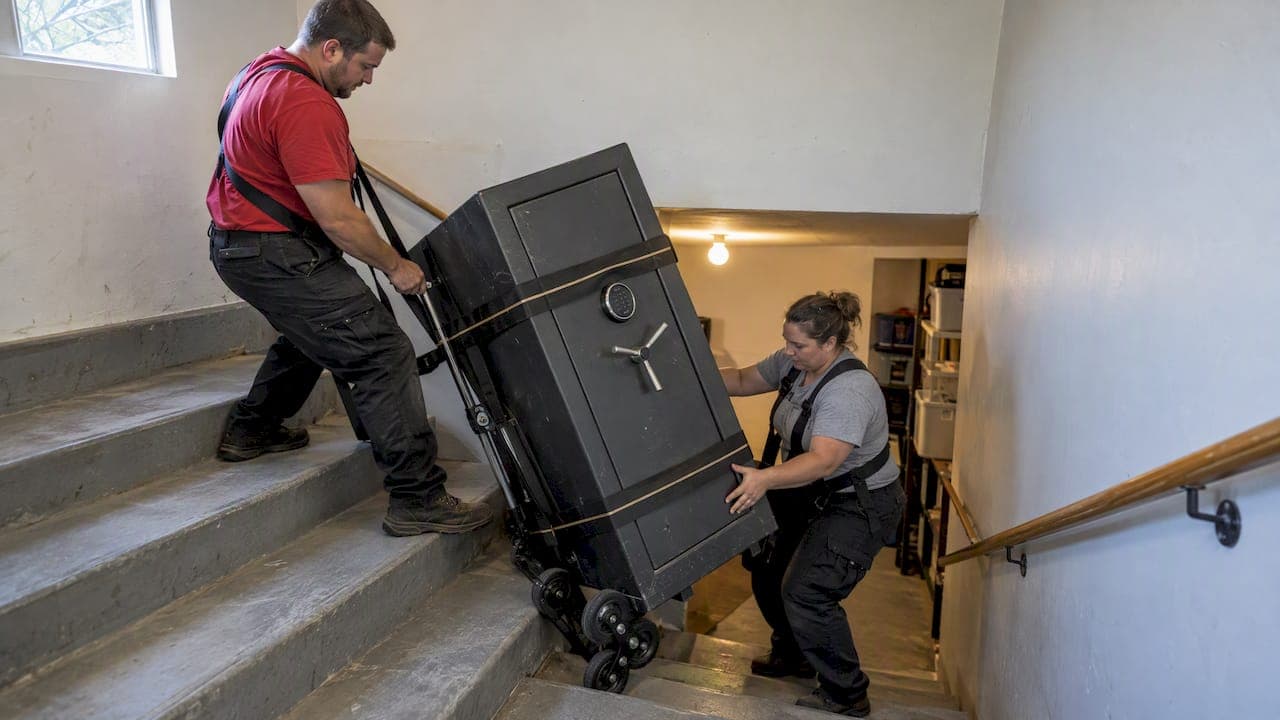
To move a safe, find out what it really weighs, measure every door, hallway and stair on the route, and use a heavy-duty dolly or stair climber with at least two or three trained people. If the safe has to go up or down stairs, or weighs more than your crew can control, hire movers. A safe that slips is a serious injury risk, and it can wreck a staircase in seconds.
This guide is for homeowners, renters and families in Abbotsford and the Fraser Valley who have a gun safe, home safe or office safe to relocate. It covers the planning that decides whether the job goes smoothly, the equipment worth using, a step-by-step method, and how to tell when a do-it-yourself move stops making sense.
TL;DR
- Weigh the safe first. Typical gun safes are often 500 to 600 pounds before you add the contents, and many are heavier.
- Empty it completely, lock the door, and measure the safe against every doorway, corner and stair on the route.
- Use equipment rated for the load: a heavy-duty dolly, a stair climber, straps, blankets and floor protection. A standard hand truck is not enough.
- Stairs are where most safe moves fail. If the route has more than a few steps, bring in professionals.
- If the safe holds firearms, read the RCMP rules on storing and transporting firearms before moving day.
Table of Contents
- Why a safe is not just another heavy box
- Step 1: Find out what the safe weighs
- Step 2: Measure the route, not just the safe
- Step 3: Use the right safe moving equipment
- Step 4: Prepare the safe and the space
- Step 5: Move it, slowly
- If your safe holds firearms
- When to hire movers instead
- Our perspective: how we approach heavy and awkward items
- What it costs to move a safe
- Moving a safe as part of a full move
- Work with us in Abbotsford and the Fraser Valley
- FAQ
- Sources
Why a safe is not just another heavy box
A fridge or a sofa is awkward. A safe is awkward and dense, with its weight concentrated in a small footprint. It does not flex, it has no good handholds, and its centre of gravity is often high because of the thick door. Once it starts to tip, people cannot stop it.
There are three things that make safes different from other heavy furniture:
- The weight is hard to judge. A small fire-rated home safe can feel manageable and still weigh well over 100 pounds. A full-size gun safe is a different category entirely.
- The footprint is small. All that weight sits on four narrow edges, which means point loads on floors, stair treads and thresholds.
- Damage is expensive. Dented drywall and cracked tile are the small problems. A dropped safe can also damage its own bolt work and door alignment, which is the part you bought it for.
Canada's occupational safety body CCOHS stresses that selecting the right equipment for a heavy task minimizes handling, improves safety and increases efficiency. That principle is the whole job when you move a safe: reduce how much anyone has to lift, and let equipment carry the load.
Step 1: Find out what the safe weighs
Do not guess. Look for the weight in the owner's manual, on the manufacturer's spec sheet, or on a label inside the door frame. Write down the empty weight, then add what you plan to leave inside (ideally nothing).
If you cannot find the number, search the make and model online. If that fails, treat the safe as heavier than you think and plan for professional equipment.
A rough sorting of safes by how they are normally moved:
| Type of safe | Typical situation | Usual approach |
|---|---|---|
| Small fire box or under-bed safe | Light enough for one or two people | Carry or use a regular dolly, protect the corners |
| Mid-size home or office safe | Heavy, but fits through standard doors | Two or three people, a rated dolly, straps |
| Full-size gun safe | Often hundreds of pounds | Heavy-duty dolly or stair climber, three or more people, floor protection |
| Large vault or bolted-down safe | Anchored, very heavy, tight access | Specialist crew and equipment |
The categories are guidance, not a standard. The only number that matters is the one on your safe's spec sheet.
Step 2: Measure the route, not just the safe
Most failed safe moves are failed measurements. Before anyone touches the safe, walk the whole route from where it sits now to where it will end up, including the truck.
- Measure the safe's height, width and depth. Note any protruding handle, hinge or dial, since the door may need to come off for a tight fit (a task for a trained person, not a guess).
- Measure every doorway at its narrowest point, from the door stop, not the frame.
- Check hallways for corners where a long safe has to pivot. Safes turn on a corner slowly and need clearance both sides.
- Count the stairs, note whether they are straight or have a landing, and check the width between railings.
- Check the destination floor. A basement slab handles a safe differently than a second-storey floor, and weight that sits on a single point may need a plywood sheet under it to spread the load.
- Look at thresholds, door sills, and any step between the garage and house.
The Finlandic guide to moving a chair step by step is written in Dutch and is about a chair, but its approach to tight spaces and stairs (plan the path, clear it, and move slowly) applies to anything heavy.
Step 3: Use the right safe moving equipment
This is where most do-it-yourself attempts fall short. A borrowed appliance dolly and a ratchet strap will move a light safe on flat ground. They will not safely handle a heavy gun safe on stairs.
CCOHS lists the standard tools for moving heavy objects: carts, dollies, hand trucks and trolleys, along with hoists and lifting aids for loads that exceed what people should handle by hand. For safes, the useful kit is:
- A heavy-duty dolly or safe cart, rated above the safe's weight with a good margin. Check the rating on the dolly itself.
- A stair climber, a powered or tracked dolly designed for steps. Ontario's workplace health and safety resources note that stair climbers reduce the pushing, pulling and lifting forces workers face when stairs get in the way.
- Ratchet straps, in good condition, to hold the safe to the dolly. Do not use frayed or worn straps.
- Moving blankets and corner guards, for the safe and for walls, door frames and banisters.
- Floor protection, such as plywood sheets or hard floor runners, to keep wheels from gouging hardwood or tile and to spread the weight.
- Gloves and closed, sturdy footwear, for everyone on the crew.
- Pipe rollers or a pallet jack, on flat surfaces like a garage floor, to move a safe sideways in a straight line.
Online forums are full of tips about rolling a safe on lengths of pipe. That can work on a flat hard surface in a garage. It is not a method for stairs, slopes or finished floors, and it takes more care than people expect.
Step 4: Prepare the safe and the space
- Empty it. Remove all contents, including loose shelving, racks and dehumidifier rods. Contents shift, add weight, and can damage the interior.
- Lock the door. An open door swings and shifts the weight. If your safe has a door that can be removed by the manufacturer's instructions, ask yourself whether you need to do this at all, since it complicates the reinstall.
- Protect the safe. Wrap it in moving blankets and secure them with tape or straps. Pad the corners.
- Clear the route. Remove rugs, door stops, pictures, and any furniture that narrows the path. Pets and kids stay out of the area.
- Plan the landing. Know exactly where the safe is going before it moves, and place floor protection there first.
- Assign roles. One person leads and calls out every move. Everyone else follows only that voice.
If the safe was bolted to a floor or wall, you will need the right tools to unbolt it. Make sure you will be able to re-anchor it at the new location, and use appropriate anchors for the new floor type.
Step 5: Move it, slowly
Here is the standard method for a safe that fits your equipment and your crew.
- Tilt, don't lift. Two people tilt the safe back just enough for a third person to slide the dolly under it. The tilting people hold it while the dolly goes in. Never rely on one person to keep a safe from tipping.
- Strap it. Secure the safe to the dolly with straps across the body, not just the top. Check the straps again after the first tilt.
- Lower it to a stable rolling angle. Keep the angle shallow. The dolly carries the load, not your back.
- Roll with one person in front, one behind, and a spotter. The spotter watches clearances and calls out hazards.
- On stairs, go one step at a time. Stop at each step. Keep the safe on the downhill side of the crew when going down, so that people are never below the load. A stair climber does the heavy part, but a crew still guides it.
- Use ramps for the truck. A rated loading ramp is safer than lifting. Check that the ramp rating exceeds the combined weight of the safe, the dolly and the person walking beside it.
- Secure it in the vehicle. Stand the safe upright against the front bulkhead of the truck or a wall of the cargo area, strap it to the tie-down points, and pad all sides. A safe that slides in transit can damage the truck and everything else in it.
Provincial regulators describe the typical injury patterns in moving work. Quebec's workplace safety body notes that movers face risks such as dropping loads, pinched fingers, and slips or falls while carrying. Lack of time is also flagged as a risk factor in the busy season, so do not rush a safe move to fit a tight schedule.
If your safe holds firearms
A gun safe is the most common reason people search this topic in BC, and it adds a legal layer. Empty the safe of firearms and ammunition before moving the safe itself, and handle the firearms as a separate task.
The RCMP sets out how non-restricted, restricted and prohibited firearms must be stored and transported in Canada. The rules differ by class. If you have restricted or prohibited firearms, or you are moving to a new address, check the current RCMP guidance and your licence conditions before you move anything, and contact the Canadian Firearms Program if you are unsure. That is a legal question, not a moving question, and we cannot answer it for you.
In practice, owners usually transport their own firearms themselves, in a compliant manner, and have the empty safe moved separately. A professional crew should not be asked to carry your firearms.
When to hire movers instead
There is no shame in handing this one off. These are the situations where we would advise a professional crew:
- The safe weighs more than you and your helpers can control with a rated dolly.
- There are stairs, especially from a basement or to a second floor.
- The route has tight turns, narrow doorways or low ceilings.
- The safe is bolted down or built into a wall or floor.
- The floors are finished hardwood, tile or stone you cannot afford to damage.
- You have no way to get at least three capable, sober, healthy people to the job.
- The safe is going into a condo or apartment, where building rules, elevator padding and booking windows apply.
For the last point, our guide to when to book movers in Canada explains lead times and building rules that also apply to heavy items.
Our perspective: how we approach heavy and awkward items
We are a local Abbotsford moving company, and heavy items are part of normal moving work for us. We handle furniture moves, apartment and condo moves, and specialty items such as pianos, and the same discipline applies to any dense, awkward piece: know the weight, know the route, and plan the crew and equipment before the truck arrives.
Here is what we think matters most.
Information beats effort. The best safe moves we can imagine start with a five-minute conversation: make and model, approximate weight, where it sits now, where it is going, and how many stairs are in between. Photos of the stairs and doorways help more than anything. With that, we can tell you honestly whether it is a job for us or whether it needs a specialist rigging crew.

Stairs decide the price and the risk. A safe on a ground-floor garage is a different job from the same safe in a basement. When you ask for a quote, tell us about the stairs first.
Honest scoping protects you. If a safe is beyond what we can handle safely, we will say so rather than take a job that puts people and your home at risk. That is the kind of clear communication we try to build every move around.
Protect the house, not just the safe. We treat floors, banisters, door frames and walls as part of the job. Padding, runners and slow, deliberate handling are standard for heavy pieces.
— Jack W.
What it costs to move a safe
People search "how much does it cost to move a safe" because there is no single price. We do not publish a flat price for safe moves, and any honest mover will tell you the same thing: the cost depends on several factors.
- Weight and size of the safe. Heavier items take more people and more equipment.
- Stairs and access. Each flight adds time, crew and risk.
- Distance. A move across a house is not the same as a move across the Fraser Valley.
- Equipment needed. Stair climbers and ramps are part of the scope, not an afterthought.
- Whether it is a standalone item or part of a full move. Adding a safe to a house move is often more practical than booking a separate trip.
To compare quotes properly, ask each company what is included, how they handle overweight items, and what happens if the access turns out to be different than described. Our guide on how to choose movers shows how to compare quotes on coverage and scope rather than just the headline number.
There is also a cost to doing it yourself that people forget: renting a rated dolly or stair climber, buying blankets and straps, missing work for injuries, and the risk of floor or wall repairs. For a heavy safe, the saving on paper often disappears.
Moving a safe as part of a full move
If you are moving house anyway, plan the safe early. Our house moving checklist walks through an eight-week plan, and the safe belongs on that list from the start: measurements in week eight, the call to your mover soon after, and the contents sorted well before the day.
Tell your mover about the safe when you book, not on moving day. It changes crew size, truck loading order, and time estimates. The safe usually loads first and unloads first, so it sits against the front of the truck and does not have to be dug out from under boxes.
If there is a gap between homes, our guide to storage in transit covers how to protect belongings between addresses. For a safe, that usually means keeping it empty, upright and padded.
Work with us in Abbotsford and the Fraser Valley
We move households and businesses in Abbotsford, Mission, Maple Ridge, Langley and Langley Township, as well as long-distance within BC. If you have a safe that is part of your move, or a heavy piece that needs careful handling, tell us about it when you request a quote. Send the make and model, the weight if you know it, and photos of the stairs and doorways, and we will tell you plainly how we would approach it.
If you are moving furniture alongside the safe, see our furniture moving service, or start from our Abbotsford moving services page to see everything we handle, from local moves to office relocations.
FAQ
What is the easiest way to move a safe?
The easiest and safest way is to empty it, lock it, wrap it, and use a rated heavy-duty dolly with a stair climber if there are steps. Use enough people to keep control, and have a spotter guide the route. For heavy safes or any stairs, hiring movers is the easiest option.
How many people does it take to move a 400 lb safe?
At least three people for a straight, ground-level route with a rated dolly, and often more if there are corners or steps. The crew needs people to tilt, people to slide the dolly, and a spotter. If you cannot field that many capable people, or there are stairs, book professionals.
What is the best tool for moving a safe?
For flat routes, a heavy-duty safe dolly rated well above the safe's weight, with straps and blankets. For stairs, a stair climber designed for heavy loads is the better choice. A standard hand truck or a few helpers is not a safe substitute.
Can I leave things inside the safe when moving it?
No. Empty it completely before moving. Contents add weight, can shift, and can damage the interior or injure someone if the safe tips. Firearms in particular must be handled under the RCMP's storage and transport rules, separately from the safe.
Should I tell the movers about the safe in advance?
Yes, always. Give the make, model, estimated weight, and a description of stairs and doorways when you book. It affects crew size, equipment and scheduling, and it lets the mover tell you honestly whether the job is within their scope.
Sources
- How to Get a Gun Safe Upstairs, Weapon Genetics
- Hoisting and Moving Heavy Objects, CCOHS
- Stair Climbers in Materials Handling, MSD Prevention Guideline for Ontario
- Moving safety, CNESST
- Storing, transporting and displaying firearms, RCMP
- Stoel verplaatsen stap voor stap, Finlandic