A move goes well for an older adult when it starts early, moves at their pace and keeps them in charge of the decisions that matter. Start with the home and the person, not the truck. Decide where they are going and why. Then sort belongings in small steps over weeks. Book movers who will be patient and can handle the heavy work. This guide covers each step, with local detail for Abbotsford, Mission, Langley, Maple Ridge and the wider Fraser Valley.
TL;DR
- Start 8 to 12 weeks ahead if you can. Sort one room or one category at a time, so nobody burns out.
- Moves are often about money, family and health. Name the real reason for the move first, because it decides what to keep.
- Check the new home for falls risks before moving day: thresholds, handrails, lighting, grab bars.
- Low-income renters in BC may qualify for SAFER rent help, and homeowners making accessibility changes may qualify for a federal tax credit.
- Hire movers for the heavy lifting and the packing, and keep the older adult involved in what goes where.
Table of Contents
- Why seniors move, and why it matters for planning
- Start the conversation before you need to
- Downsizing without the overwhelm
- Check the new home for safety before moving day
- Choosing what kind of move you are making
- Perspective: what we see when helping older customers move
- What to ask a moving company before you book
- Moving day, step by step
- Help for senior moves in Abbotsford and the Fraser Valley
- A short checklist for the family
- FAQ
- Sources
Why seniors move, and why it matters for planning
Most people think of a senior move as a response to a crisis. Sometimes it is. More often it is a mix of money, family and health. Statistics Canada's look at why Canadians move found that among older movers, 27.3% cited reducing housing costs as their main reason, 19.1% wanted to be closer to family and 12.7% moved for health reasons.
That split is useful, because the reason shapes the plan:
- Cost-driven moves usually mean a smaller home, so downsizing is the main job. Expect to part with furniture that will not fit.
- Family-driven moves often cross town or cross the province. Logistics and timing matter more than sorting.
- Health-driven moves tend to be urgent. The new place needs to be safe on day one, and the move needs to be gentle on the person.
Federal reporting on housing needs of seniors notes that most seniors prefer to age in their own community, and that many put off moving until a health or mobility problem forces it. Moves made under that pressure tend to involve rushed choices. The fix is simple to say and hard to do: talk about the move before you must.
Start the conversation before you need to
The hardest part of moving with seniors is rarely the boxes. It is the feeling of losing a home, a neighbourhood and a routine. Government reporting on seniors' housing describes how strongly many older adults are attached to their homes and social networks, and how the loss of community can weigh more than the physical work of moving.
A few ways to open the subject well:
- Ask about what they want, not what you worry about. "What would make daily life easier?" lands better than "You can't manage the stairs anymore."
- Agree on triggers together. For example: a second fall, a driving licence concern, or a yard that has become too much. Agreeing on them calmly, ahead of time, makes a later decision feel less like a verdict.
- Visit the options together. Seeing a condo, a townhouse or a care residence in person is far less scary than imagining one.
- Protect social ties. Public health guidance on life changes in older adulthood stresses keeping social connections through transitions. If possible, choose a home close to friends, a place of worship, a doctor and familiar shops.
The National Seniors Council's expert panel on aging at home makes a related point: support is not only about the building. Older adults also need help finding community services and handling complicated applications, and they need to stay connected so that a move does not lead to isolation.
Downsizing without the overwhelm
Downsizing is where most senior moves stall. A home that took forty years to fill cannot be sorted in a weekend, and pushing it is how arguments start.
Give it months, not days
Experienced movers who work with older adults generally suggest starting months ahead and working one room or one category at a time, rather than facing the whole house at once. Start with spaces that carry the least emotion: the garage, the spare room, the linen closet. Leave photos, the kitchen and the bedroom for later, when the person has built some momentum.
Use four piles
For each room, sort into:
- Keep and take. It fits the new home and it gets used or loved.
- Give to family. Let relatives choose in person where possible. Handing over a piece with its story is easier than seeing it go to a stranger.
- Donate or sell. Be realistic: large dark wood furniture rarely sells for much, and the time spent selling it is itself a cost.
- Recycle or dispose of. Old paint, electronics and expired medications need proper disposal. Ask your municipality about local drop-off.
Measure before you decide
The most useful tool in a senior downsize is a tape measure. Get the floor plan of the new place, measure the sofa, the bed, the dining table and the doorways, and mark furniture on paper. Deciding "it won't fit" with numbers is easier than deciding "you don't need it."

Keep a short list of non-negotiables
Let the older adult name five to ten items that must come, whatever the space. A reading chair, a clock, a quilt. Having that list protects what matters, and it makes it easier to let go of the rest.
Our own house moving checklist lays out an eight-week plan that works well as the backbone for a senior move too. Stretch the timeline if you can.
Check the new home for safety before moving day
Falls are the biggest injury risk in the home for older adults. The Government of Canada's Safe Living Guide points out that most injuries at home among seniors are due to falls, and it gives practical fixes that apply just as much to a new place as to the old one. Walk through the new home with this list before the first box arrives:
- Door thresholds no higher than about 1/2 inch (13 mm), so nobody trips.
- Handrails on both sides of every interior and exterior staircase, firmly anchored.
- Grab bars fixed into wall studs, not just into drywall, in the shower and beside the toilet.
- Lever-style handles on faucets and doors, which are easier for stiff or arthritic hands.
- Non-slip flooring, and no loose area rugs.
- Nightlights on the path from bed to bathroom, and cords cleared from walkways.
The guide recommends starting with the simple, non-permanent fixes: clear cords, remove loose rugs, add nightlights. They cost little and can be done before the move.
If the person plans to stay mobile on their own, it is also worth thinking about how they will get around the new neighbourhood. A reader comfortable with German may find this guide to choosing an e-bike for seniors and families useful for thinking through stability and ease of use. In Abbotsford and the Fraser Valley, where many errands still need a vehicle, check the new address for bus access, sidewalks and the distance to a pharmacy and doctor.
Money that can help
Two programs are worth checking before you commit to a new home:
- SAFER in British Columbia. The Shelter Aid for Elderly Renters program helps low-income seniors with rent. According to the province's April 2025 announcement, the household income limit rose to $40,000 and the program supports roughly 25,000 seniors. Confirm the current rules with BC Housing before relying on it, since limits can change.
- Home Accessibility Tax Credit. Homeowners who pay for renovations that make a home safer or more accessible may be able to claim a non-refundable credit. The Canada Revenue Agency explains who qualifies and what counts on its home accessibility expenses page. Keep receipts, and ask a tax professional how it applies to your situation.
The federal overview of income and benefits from government programs is also a good place to check that nothing is being missed, since most benefits require an application.
Choosing what kind of move you are making
The move type changes the work. Here is how the common ones compare.
| Move type | Typical challenge | What helps |
|---|---|---|
| House to condo or apartment | Big cut in space, stairs or elevator booking | Measure early, book the building elevator, plan which furniture goes first |
| House to retirement or assisted living residence | Strict move-in rules and a small suite | Ask the residence about move-in hours, insurance and parking; bring only essentials |
| Move in with family | Blending two households | Agree on one room for the older adult's own furniture and keepsakes |
| Long-distance move within BC | Distance, travel fatigue | Pack and unload in stages so the person arrives to a ready bedroom |
| Short-notice move after a hospital stay | Time pressure | Fewer decisions, more professional help |
Residences often have rules on elevator use, move-in times and certificates of insurance from the moving company. Ask for them in writing early, and pass them to your movers.
Perspective: what we see when helping older customers move
We are a local moving company, so our view is about the practical side of the day, and about what we think makes it calmer.
First, the plan matters more than the truck. When a move is clear, scheduled and explained in advance, people relax. We aim for clear communication so that the older adult, and the family helping them, know who is arriving, when, and what will happen to each room.
Second, the order of work protects energy. Where we can, we think it helps to have the bedroom and the bathroom ready first, so the person has a place to sit down, a bed made and their medications within reach before the rest of the house is unpacked. A full day of boxes is tiring at any age.
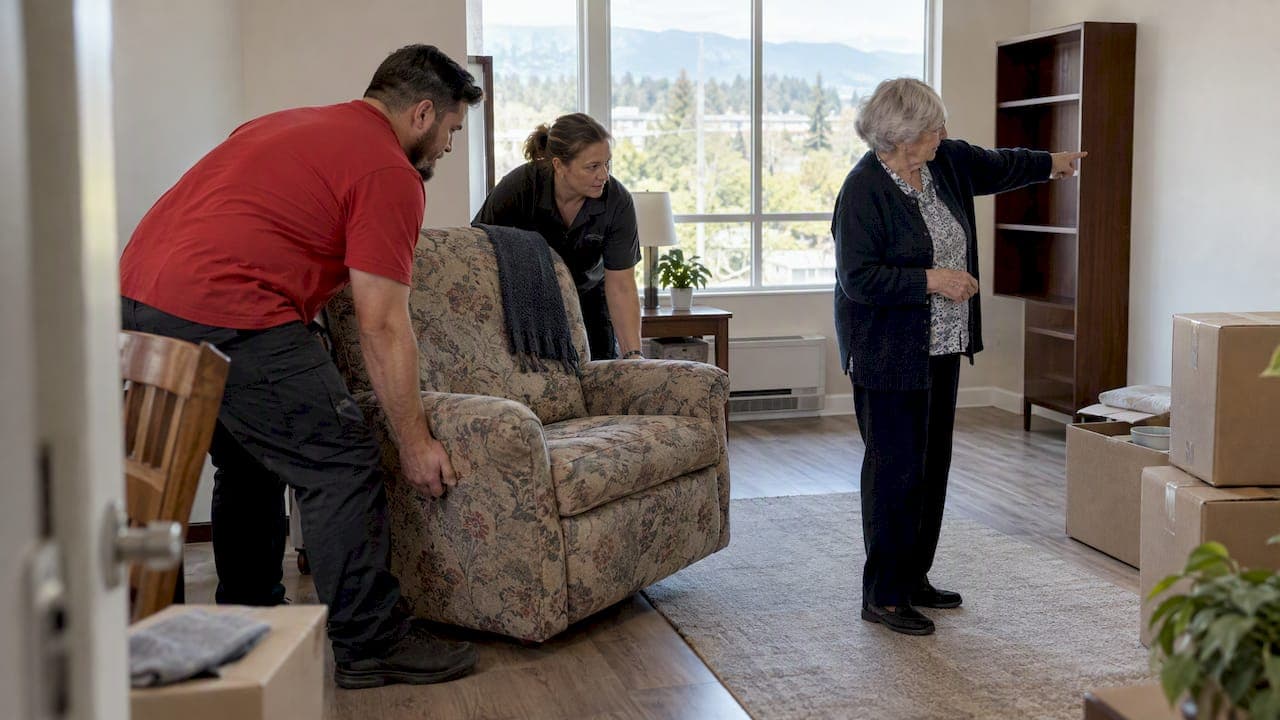
Third, let the person direct. It is their home. Movers can carry, wrap and load, but the older adult should be the one pointing at where the armchair goes. We try to treat every item with care, because to the owner it is rarely just furniture.
Fourth, take the heavy and awkward jobs off the family. Wardrobes, dressers, a dining table and a piano are the items that cause back injuries and family stress. That is what a moving crew is for. If a family member wants to help, give them the paperwork, the keys and the cup of tea.
Finally, be honest about what you do not need. Some families call a mover looking for a full downsizing and estate service. We handle the move itself: packing, loading, transport, unloading and moving to storage. If you also need help sorting, selling or clearing a home, plan that in the weeks before and tell us what you have done so we quote the real job.
— Jack W.
What to ask a moving company before you book
Senior moves reward a little extra checking. Ask:
- Do you offer packing, and will you pack the kitchen and fragile items? Packing is often where older adults are most tired and most worried about breakage.
- How is the price set? Moves are priced by distance, size and services such as packing or specialty items, so get the quote in writing and ask exactly what it includes.
- Can you move the large or delicate pieces? Ask specifically about pianos, glass cabinets and heirlooms.
- Can you work to the residence's rules? Elevator booking, loading zones and insurance requests should be handled in advance.
- What if the date changes? Hospital discharges and closing dates shift. Ask about flexibility and about last-minute availability.
- Where can things stay in the meantime? If the new place is not ready, short-term storage and later delivery can save a stressful gap.
Be wary of any company that pressures an older customer to sign on the spot, or that cannot explain what is in the estimate. Ask a trusted relative or friend to read the contract with you.
Moving day, step by step
- The week before. Confirm the arrival time, parking and elevator booking. Pack a "first night" bag: medications, glasses, chargers, a change of clothes, bedding, toiletries and important papers. Keep it with the person, not on the truck.
- Photograph the new layout and label each box by room with large, clear writing. Colour-coded labels help.
- Morning of the move. Have the older adult leave for a quieter place, such as a relative's home, if the noise and traffic would be hard. Or give them a chair and a role, such as checking each room is empty at the end.
- Loading. Walk the crew through the home first and point out fragile items and anything staying.
- Unloading. Set up the bed, the bathroom and the kitchen basics first. Place furniture where the person wants it, and check that pathways are clear and rugs are not loose.
- The following days. Unpack slowly. Update the address with banks, pharmacy, doctor and government services, and keep familiar routines going, such as the usual walk, the weekly call or the coffee with a neighbour.
Help for senior moves in Abbotsford and the Fraser Valley
We are based in Abbotsford, and we move customers across the Fraser Valley. Here is where our services fit a senior move:
- Packing services for the rooms that are hardest to sort and wrap, such as the kitchen and china cabinet.
- Loading and unloading services when the family has a rental truck or container but nobody should be lifting heavy furniture.
- Apartment and condo moves, which suit the common house-to-condo downsize and involve elevators and building rules.
- Storage moving when the new home is smaller and some pieces need a temporary home.
- Long-distance moves within BC for families relocating a parent closer to them.
- Furniture moving for individual pieces, such as a bedroom set going to a relative.
We also serve nearby communities, including Mission, Maple Ridge, Langley and Chilliwack.
If you are planning a move for yourself or a parent, tell us about the home, the new address and any special items and we will explain what the job involves and what it will cost. Our site promises a guaranteed quote in 15 minutes. We price each move by distance, size and the services you need, so the quote reflects your actual job.
A short checklist for the family
Use this as a starting point and adapt it to the person.
Eight to twelve weeks ahead
- Agree on the destination and the reason for moving.
- Get the floor plan and measure the main furniture.
- Check eligibility for SAFER or other supports, and ask about move-in rules at any residence.
- Start sorting in the least emotional rooms.
Four to six weeks ahead
- Book movers and confirm any packing help.
- Arrange donation or disposal pickups.
- Decide which family members get which items.
- Begin forwarding mail and updating addresses.
The last two weeks
- Pack the "first night" bag.
- Confirm elevator booking, parking and arrival time.
- Arrange for disconnecting and reconnecting phone, internet and cable.
- Plan meals for the moving day and the following day.
After the move
- Set up the bed and bathroom first, then the kitchen.
- Do a falls check: rugs, lighting, cords, handrails.
- Visit regularly in the first weeks, since the first month is when loneliness and confusion show up most.
FAQ
Is moving stressful for seniors?
Often, yes, and the stress is as much emotional as physical. Many older adults are deeply attached to their home and neighbourhood, and a move can feel like losing a piece of their identity. Starting early, involving them in decisions and keeping familiar routines and social contacts in place helps.
What is the most common reason older adults move?
According to Statistics Canada, reducing housing costs was the most-cited reason among older movers, at 27.3%. Wanting to be closer to family (19.1%) and health reasons (12.7%) followed. Your own reason may differ, so ask the person directly.
How far ahead should we start planning a senior move?
Two to three months is a comfortable minimum for a full home, and longer is better if the person is attached to the house. If the move is urgent, shorten the sorting and rely more on professional packing and loading so the older adult is not overwhelmed.
Can low-income seniors in BC get help with rent?
Yes, the SAFER program helps eligible low-income seniors who rent. The province raised the household income limit to $40,000 in April 2025. Check BC Housing for the current rules and how to apply before signing a lease.
What should we do with belongings that will not fit the new home?
Offer them first to family, then donate or sell, and keep a short list of the most meaningful items. If you are not ready to decide, short-term storage can buy time without forcing a rushed choice.
Sources
- Canadians on the move, Statistics Canada
- Report on housing needs of seniors, Canada.ca
- Supporting Canadians Aging at Home, National Seniors Council
- The Safe Living Guide, Canada.ca
- SAFER and RAP enhancements, BC Gov News
- Home accessibility expenses, Canada Revenue Agency
- Income and benefits from government programs, Canada.ca