
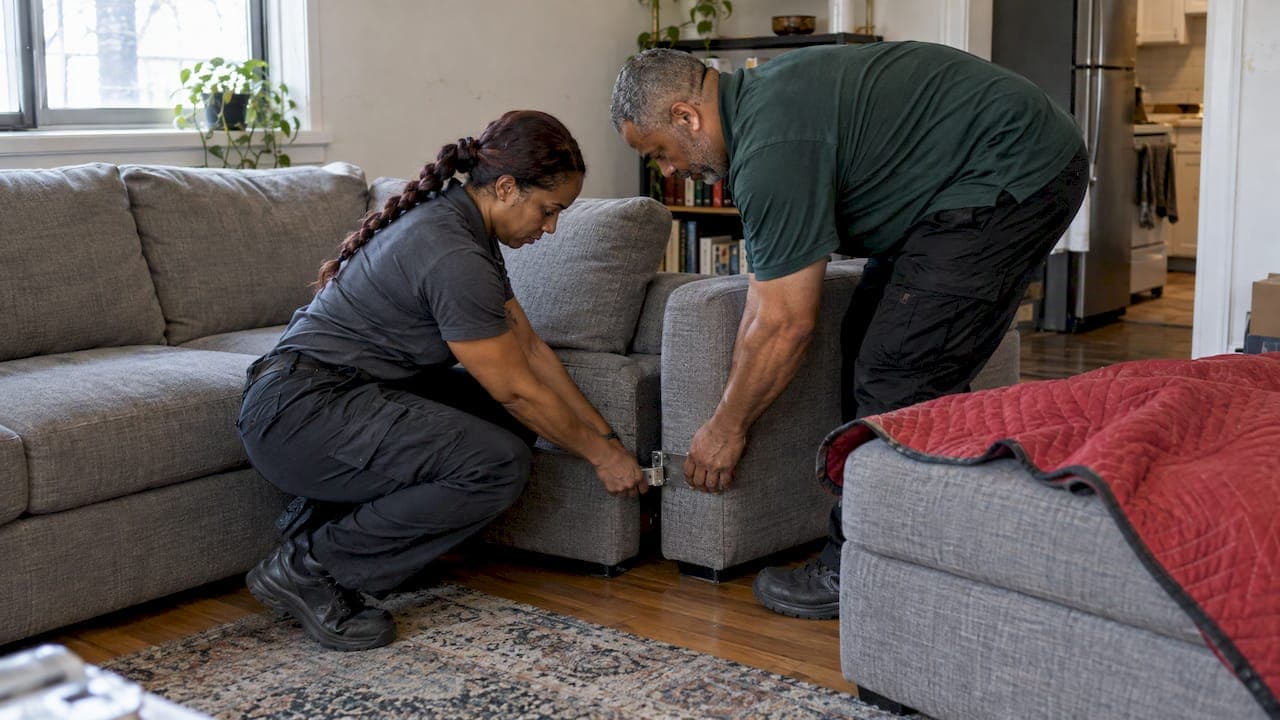
Many movers will take furniture apart and put it back together, but it is not automatic. It depends on the company, the piece and the plan agreed before moving day. The safest approach is to list every item that needs to come apart when you ask for a quote, and to have the crew confirm who handles each one. Below you will find what to ask, how to prepare beds, IKEA pieces and sectionals, and how to keep screws and parts from going missing.
TL;DR
- Tell your mover at the quote stage which pieces need disassembly and reassembly, so the time and crew are planned in, not improvised on the day.
- Most IKEA furniture is not designed to be taken apart once built, so go slowly, follow the manual in reverse and expect looser joints on reassembly.
- Photograph each piece before you start, label parts, and bag hardware by item. This is the single biggest time-saver on the other end.
- Sectionals usually separate at connectors between sections. Find them before you pull anything, and watch for wiring on power models.
- Wrap panels, legs and glass separately. Flat, padded parts travel better than assembled pieces that flex in the truck.
Table of Contents
- Do movers disassemble furniture?
- Which furniture usually needs to come apart
- Moving IKEA furniture without damaging it
- How to take apart a sectional sofa
- Keep hardware organized so reassembly is easy
- Protect furniture while it is apart
- Disassembly for local and long-distance moves
- Prepare a week ahead
- Our perspective
- Moving furniture with 2 Friends Trucking & Moving
- FAQ
- Sources
Do movers disassemble furniture?
Some do, and some leave it to you. Full-service movers commonly handle simple jobs such as bed frames, tables and shelving. Others limit themselves to loading and driving, and expect everything to be ready to carry. The only way to know is to ask, and to get the answer in writing in your quote or booking confirmation.
Here is what to confirm before you book:
- Which pieces are covered. Beds, dining tables, desks, wall units, bunk beds, sectionals, trampolines and wardrobes are different jobs. Name each one.
- Whether reassembly is included. Taking a bed apart at the old place and rebuilding it at the new place are two separate tasks. Make sure both are on the plan.
- What is out of scope. Wall-mounted items, built-in cabinetry, wired electronics and anything that needs a licensed trade (gas, electrical, plumbing) usually sits outside a mover's job.
- How hardware is handled. Ask how screws, brackets and fasteners will be kept with each piece.
- Damage and handling. Ask how the crew protects floors, doorframes and the furniture itself.
- Timing. Disassembly adds time. A crew that knows about it in advance can plan the day properly.
If a piece is fragile, old, or has missing hardware, say so up front. A crew can only plan for what it knows about.
Which furniture usually needs to come apart
Not everything needs disassembly. A good rule is to take apart anything that will not fit through a doorway, stairwell or elevator door, or that would be at risk of flexing and cracking if carried assembled.
| Piece | Usually taken apart? | What typically comes off |
|---|---|---|
| Bed frame (queen, king) | Yes | Side rails, slats, headboard, footboard |
| Bunk or loft bed | Yes | Ladders, rails, guardrails, upper frame |
| Dining table | Often | Legs, leaves, sometimes the base |
| Large wardrobe or armoire | Often | Doors, shelves, sometimes the top section |
| Desk | Sometimes | Legs, hutch, drawers removed |
| Bookcases and wall units | Sometimes | Shelves, backs, modular sections |
| Sectional sofa | Often | Separate sections, legs, ottoman |
| Flat-pack (IKEA-style) pieces | Case by case | See the section below |
Drawers should come out of dressers and desks so they do not slide open in transit, and loose shelves and glass inserts should be removed and wrapped on their own.
Moving IKEA furniture without damaging it
IKEA pieces are the ones people ask about most, and they need the most care. IKEA's own assembly guide states that most of its furniture is not designed to be disassembled after it has been put together. It also notes that when a piece is reassembled, screw holes and parts may have more gaps than designed, so the product may not perform as it did originally. It advises checking the assembly structure in the manual first and releasing cam locks rather than removing screws directly.
In practice, that means:
- Keep the original manual if you have it. Most manuals can be looked up online by product name or article number if you have thrown yours out.
- Work in reverse order. Take the piece apart in the opposite sequence from assembly, so each step undoes the one before it.
- Release cam locks, do not strip them. Turn them back to the open position instead of forcing screws out.
- Avoid taking apart what does not need to be. A solid bookcase that fits through the door can travel upright, wrapped, with shelves removed.
- Expect some looseness afterward. Particleboard holes do not always grip as well the second time. Reassemble carefully and do not over-tighten.
A practical moving guide suggests labelling every component, placing screws in sealable bags marked with the piece name, and wrapping each panel in thick blankets or towels. Those habits work for any flat-pack furniture, not just one brand.
How to take apart a sectional sofa
Sectionals look intimidating, but many are built to separate. Most detachable sectionals use metal hooks, clips, pins, brackets or bolts between sections, and not every sectional is designed to come apart, so find the connection points before you pull on the frame.
A calm, careful approach:
- Clear the space. Move coffee tables and rugs away so you can work around all sides.
- Remove cushions and loose pillows. Bag them separately; they are light but bulky.
- Look underneath and behind. Connectors are usually on the back, the sides of the frame or underneath.
- Check for wiring. Power recliner sections may have cables between modules. Unplug and disconnect them before separating, and note where each one goes.
- Separate one section at a time. Lift slightly to release hooks or clips, rather than dragging sections apart.
- Remove legs if they unscrew. Tape or bag the legs and hardware to the section they belong to.
- Photograph the layout. A quick picture of how the sections fit together saves guesswork later.
If a sectional is a fixed, one-piece frame, do not try to take it apart. Plan instead for door width, stairwell turns and elevator size, and tell your mover the dimensions at the quote stage.
Keep hardware organized so reassembly is easy
Lost screws are the most common reason a bed is not built on the first night. A simple system prevents it.
- Photograph before, during and after. Take a picture of the assembled piece, then of key joints as you open them.
- Use one bag per piece. Seal screws, bolts, cam locks and dowels in a labelled bag, such as "Queen bed, master bedroom".
- Tape the bag to the furniture. Attach it to the underside of a rail or inside a drawer, where it will not catch on anything. Taping the bag to the piece itself keeps it from being separated.
- Or keep a single hardware box. If you prefer, use one clearly labelled box per room, but only if it travels with you and not on the truck.
- Label parts in order. Use masking tape and numbers, or left/right and top/bottom marks, so panels go back where they came from.
- Keep the tools. Put the Allen key, screwdriver and small wrench in your own bag with your essentials, not in a box that may be unloaded last.
The small-parts habit is also useful if you hire packers: tell them hardware should stay with the furniture, not be packed into general kitchen or bedroom boxes.
Protect furniture while it is apart
Once a piece is in parts, the parts are often more vulnerable than the whole.
- Pad every flat panel. Wrap with blankets, moving pads or thick towels, and tape the wrapping to itself, not to the finish.
- Keep panels flat or on edge. Do not stack heavy items on top of thin panels. Lean them on their long edge with padding between.
- Protect corners. Corners chip first. Fold extra padding or cardboard around them.
- Wrap glass and mirrors separately. Mark them clearly so the crew knows they are fragile.
- Group parts by piece. Bundle rails together, legs together and slats together, and label each bundle.
- Protect your home too. Floor runners and doorframe guards matter more when long panels are being carried through tight spaces.
If you want extra help here, our packing services can handle wrapping and boxing so fragile pieces are ready before the truck arrives.
Disassembly for local and long-distance moves
The plan changes with the distance.
On a local move around Abbotsford, Mission, Langley or Maple Ridge, the truck is usually in and out the same day, and many pieces can travel assembled if they fit. Disassembly is mostly about access: narrow townhouse stairs, tight condo hallways and elevator limits. If you live in a unit, apartment and condo moving often comes down to measuring the elevator and the corridor in advance.
On a long-distance move within BC, furniture spends more hours on the road, with more braking, vibration and shifting. Taking apart tall or heavy pieces, and securing legs and panels flat, lowers the risk of damage over mountain routes. It also saves space in the truck. Read more about our long-distance moving service if you are planning a move across the province.

If your furniture is going into a unit before it goes to a new home, the same approach applies for storage moves: flat, padded and labelled parts stack better and are easier to pull out later.
Prepare a week ahead
A short checklist makes the move day smoother.
- Make an inventory. List every piece that needs disassembly and note anything unusual.
- Measure. Measure the pieces and the doors, stairs and elevators they must pass through.
- Gather tools. Allen keys, screwdrivers, a rubber mallet, masking tape, marker and sealable bags.
- Find manuals. Look up instructions for flat-pack pieces if you do not have them.
- Do the simple ones early. Remove drawers, shelves and legs the day before, and leave larger frames for the crew if they are handling them.
- Keep bedding and essentials separate. You want to sleep in a made bed the first night.
- Reconfirm with your mover. Check that the plan for disassembly and reassembly matches your booking.
Our perspective
Furniture disassembly is where careful planning shows. A bed frame that comes apart cleanly, with its hardware tied to it, goes back together in minutes. One that is rushed can cost you an evening of searching for bolts.
At 2 Friends Trucking & Moving, we focus on dependable service, clear communication and careful handling. That starts before moving day: we want to know what is in your home, what has to come apart and what the access looks like at both ends, so the plan fits the job.
Our advice is to be specific. Tell us about the sectional, the loft bed, the antique table. Send photos if you can. The more we know, the more accurately the crew can plan time, wrapping and sequence, and the less stress you carry on the day.
Jack W.
Moving furniture with 2 Friends Trucking & Moving
If you are planning a move in Abbotsford or the Fraser Valley and want furniture handled with care, we can help. We offer residential and commercial moving, local and long-distance moves within BC, apartment and condo moves, packing, loading and unloading, and storage moving. Our furniture movers page explains how we approach heavy and awkward pieces.

When you ask for a quote, list the pieces that need to come apart and tell us about stairs, elevators and parking. Contact us through our main page to start planning your move. If you are in Mission, Maple Ridge or Langley, we serve those communities too.
FAQ
Do movers disassemble and reassemble furniture?
Many do, but it varies by company and by piece. Ask at the quote stage which items need disassembly, whether reassembly is included and what falls outside the job. Get the answer in your booking confirmation so there are no surprises on the day.
Should I take furniture apart myself before the movers arrive?
Simple items such as drawers, shelves, removable legs and cushions are easy to prepare ahead. For larger frames, agree with your mover beforehand who will do them. Whatever you take apart, bag and label the hardware and keep it with the piece.
Is it "dismantle" or "disassemble"?
Both work for taking furniture apart, and in everyday use they mean the same thing. Movers and furniture makers usually say "disassemble" and "reassemble" for pieces meant to go back together. "Dismantle" tends to suggest taking something apart for good.
Can I move IKEA furniture without taking it apart?
Often, yes, if it fits through your doors and stairs. Sturdy pieces such as bookcases can travel upright with shelves removed and everything padded. Pieces that must come apart should be taken apart carefully, following the manual in reverse and releasing cam locks rather than removing screws directly.
How do I move a sectional sofa?
Find the connectors between sections, disconnect any wiring on power models and separate one section at a time. Remove legs and cushions, wrap each part and photograph the layout before you start. If your sectional has a fixed frame, measure doorways and stairs instead and share those measurements with your mover.
Sources
- Assembly guide, IKEA
- How to pack IKEA furniture for moving, Moving Tips
- How to take apart a sectional sofa, Povison