
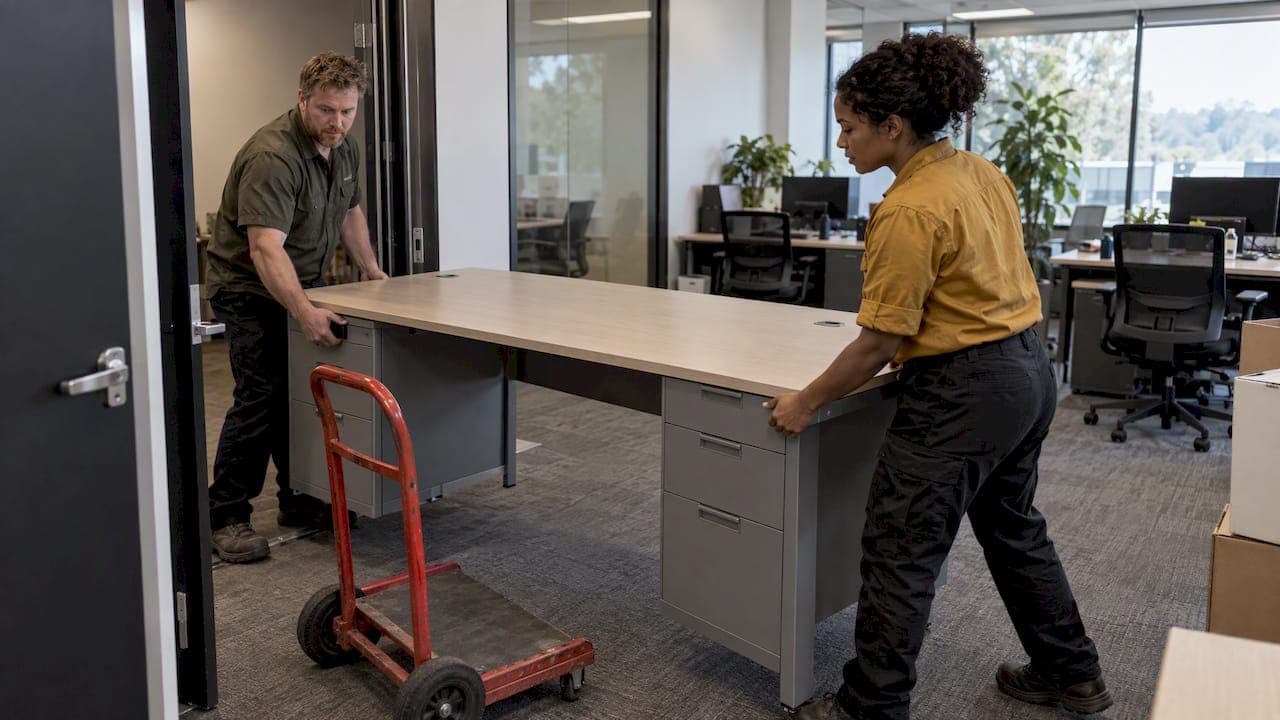
Office furniture moving goes well when three things are settled before the truck arrives: a final floor plan, a tagged inventory that matches it, and a building that is ready to receive the crew. Do those and the desks, chairs, filing cabinets and workstations arrive where they belong, and your team is back at work the next morning instead of hunting for their monitors. This guide walks through the whole job, from the first inventory to the last cleaned floor, with a focus on what matters for businesses in Abbotsford and the Fraser Valley.
TL;DR
- Start with an up-to-date inventory and a final floor plan. Every desk, chair and cabinet gets a number that matches a spot on the plan.
- Check both buildings first: elevator rules, loading access, parking, keys and security can delay a move more than the furniture does.
- Systems furniture, large desks and anything with electronics needs planned disassembly and dedicated reinstallation time. Don't leave it to the last evening.
- Ask the mover about extra charges, liability and payment terms before the job, and keep your inventory lists for any claim.
- Moving outside working hours is the usual way to limit disruption.
Table of Contents
- Why moving office furniture is different from a house move
- Build the plan before you book anything
- Inventory, tag and label everything
- Disassembling desks, cubicles and modular furniture
- Moving a large or heavy desk safely
- Packing, boxes and equipment on the day
- Insurance, estimates and paperwork
- Setting up after delivery
- Our perspective: what we see on office furniture jobs
- Getting help with your office furniture move
- FAQ
- Sources
Why moving office furniture is different from a house move
A home move is mostly about packing belongings and getting them into rooms. An office move is about getting people productive again. The same desk that sits in a bedroom-sized den in a house has to be reconnected to power, data and a phone line, and positioned where a particular employee will sit on Monday morning.
That changes the priorities. Furniture is only part of the job: you are also coordinating cabling, phones, photocopiers, electricians and sometimes carpenters. The Canadian Association of Movers advises coordinating the final floor plan, elevator use, installation, and telephone, photocopier, electrical and carpentry work as part of one plan. It also prefers moves outside working hours so that the business is not disrupted.
For a small business in Abbotsford, Mission, Langley or Maple Ridge, that usually means an evening or weekend move, with the furniture set up before staff return. Our commercial moving service is built around that pattern.

Build the plan before you book anything
The Canadian Association of Movers recommends a general plan that covers staff communication, procedures and a schedule for each stage of the move. In practice, that means someone owns it.
Name a move coordinator
The Oregon state office relocation guide is written for a US government audience, but its core advice applies anywhere: appoint a move coordinator, create a timeline with assigned responsibilities, prepare dated floor plans and keep a representative at both sites. One person at the old office and one at the new one means the crew always has someone to ask where a credenza goes.
Look at the new space first
The Government of Canada's Canadian Centre for Occupational Health and Safety (CCOHS) recommends assessing the new office before the move. The list includes accessibility, privacy, electrical outlets, computer cabling, telephone lines, storage, emergency and security policies, ventilation and air quality. A desk is no use where there is no outlet within reach, so match the floor plan to the actual outlets and data drops.
Check the building, not just the furniture
The Oregon guide points to elevator restrictions, loading-dock access, parking, security, keys, signage and building readiness. Ask both buildings these questions in writing:
- Can the freight elevator be booked, and for what hours?
- Is there a loading zone or dock, and how close can a truck park?
- Who holds keys and fob access after hours?
- Are there rules about floor protection or door propping?
A landlord who requires a certificate of insurance or an elevator booking a week ahead can derail an evening move if you only learn that on the day.
Ask for a realistic duration
The same guide says the mover should give you a realistic duration, and that computers, printers and copiers need dedicated installation time. Treat the estimate as a schedule input. If the crew says the furniture takes five hours, plan the IT work around it rather than assuming everything happens at once.
Inventory, tag and label everything
Most office furniture mix-ups are inventory problems, not handling problems. The Canadian Association of Movers recommends listing each item with its area, department, floor and employee, and integrating any new furniture into the same list. Start from the CCOHS advice to begin with an up-to-date inventory and remove items that are not useful or valuable. Every chair you do not move is a chair you do not pay to carry.
A simple tagging system
- Walk the old office with the floor plan of the new one. Decide for each item whether it moves, goes to storage or is disposed of.
- Number every piece. Each number matches a position on the new floor plan.
- Tag the item and the spot. Put the matching number on the furniture and on the floor or wall at the destination, so the crew can place it without asking.
- Isolate the exceptions. The Association advises separating do-not-move items and items for storage, so they do not end up on the truck by mistake.
- Give staff packing instructions. Employees pack their own drawers and desk contents, and need to know what labelling and deadlines apply.
If some furniture is going into storage because of a downsizing or a renovation, see our guide to moving into storage and our storage moving service.
Disassembling desks, cubicles and modular furniture
Systems furniture is where office moves get slow. Workstation panels, shared worktops, overhead bins and cable channels are designed to be reconfigured, but each manufacturer's system is put together differently. We are not going to give a universal how-to, because there is none. The method below is what holds up across systems.
- Photograph before you take anything apart. Shoot each workstation from several angles, including cable routing and the underside of worktops.
- Decide the new layout first. Cubicles rarely fit the new space exactly as they did the old one, so measure both and plan the new configuration before you disassemble.
- Bag and label hardware. Keep screws, brackets and connectors in a labelled bag taped to the part they belong to, and match the label to the item tag.
- Keep panels and components in sets. Tag every panel with its workstation number so that a corner station does not turn into a puzzle.
- Protect finished surfaces. Wrap glass, laminate edges and fabric panels. Edge damage on a worktop is the most common cosmetic claim.
- Check the manufacturer's instructions where they exist. If your system has a model name, the maker may have an assembly guide that is the safest source for torque, connectors and panel order.
This is also the point to decide whether your staff do it or the movers do. For a handful of simple desks, a crew can unbolt and reassemble them as part of the job. For a large floor of workstations, ask whether the mover has done your type of system before, or whether your furniture dealer should handle the technical reconfiguration while the mover handles transport. Either way, settle that in writing.
Moving a large or heavy desk safely
A big executive desk or a solid wood boardroom table is a two- or three-person job at the least, and it is where backs and door frames get hurt. CCOHS lists manual material handling among the relocation hazards, and recommends avoiding twisting, reaching and overhead lifting. It also advises keeping hallways clear, and notes the trip-and-fall risk from boxes and trolleys.
Here is the approach we recommend for a large desk:
- Measure the desk and every doorway, stairwell and elevator on the route. Do it before moving day, not during it.
- Take it apart where possible. Remove drawers, pedestals, legs and modesty panels. Lighter pieces are easier to carry and less likely to chip.
- Empty the drawers. Loose contents shift and add weight. Lock or tape pedestal drawers if they stay attached.
- Clear the route. Remove carts, boxes and floor mats from corridors.
- Use the right equipment. Hand carts, trolleys and furniture pads exist for this. Plan which ones the job needs.
- Carry with a plan. One person leads, others follow signals. Keep the load close to the body, and set it down rather than dropping the last few centimetres.
- Wrap before it goes on the truck. Protect corners and surfaces, and load heavy, flat pieces upright and secured.
If a desk simply will not clear a stairwell or door, stop and call for help. Forcing it is how people are injured and walls get gouged. Experienced movers will often have a way around, such as removing a door from its hinges, but that needs to be agreed with the building.
For valuable or older pieces such as a solid wood partner's desk, our guide to moving antique furniture safely covers padding and handling in more detail.
Packing, boxes and equipment on the day
The remaining office contents travel better when they are packed to the same standard as the furniture. CCOHS recommends containers with good handles, packing materials, markers, labels, tape and hand carts or trolleys. Boxes should be taped, clearly labelled, upright if needed, and light enough for one person to lift. Heavy items such as files and books go in smaller boxes.
A few practical points:
- Label by destination, not by contents alone. "Workstation 14, Finance" is more useful to a crew than "Misc."
- Keep computers and monitors with their owner's tag. Reconnecting a workstation is much quicker when the keyboard, dock and monitor all arrive together.
- Bring in packers if staff time is tight. Our packing services take care of supplies and boxing for offices that cannot spare people for a day of packing.
- Make it easy for the crew to reach everything. Our prepare for movers guide explains how blocked access delays a move. The same applies to an office with locked rooms and closed storerooms.
Insurance, estimates and paperwork
The Canadian Association of Movers suggests discussing the plan and any extra work or charges with the mover, and confirming the payment plan in advance. It also says to keep your inventory and tagging lists, clarify what the mover is liable for, and substantiate any claim with notations on the receipt. That gives you a checklist to take into the quote conversation.
Before signing, ask:
| Question | Why it matters |
|---|---|
| What is included in the estimate (disassembly, reassembly, packing, stairs, elevator waits)? | Extra work is where quotes grow. |
| What are the possible extra charges, and when do they apply? | You want to know before the day, not after. |
| What is the mover liable for if furniture is damaged? | Liability terms differ, so get them in writing. |
| What is the payment plan and when is payment due? | Confirm it in advance. |
| Who signs for condition at the destination? | Notes on the receipt support any later claim. |
We cannot quote a price in an article, because office moves depend on the volume of furniture, the distance, the building access and the services required. A short walkthrough, or photos and an inventory, is how a mover can give a realistic figure.
Setting up after delivery
The final floor plan and your tags do the work here. The Canadian Association of Movers advises positioning furniture according to that plan and installing new furniture before existing furniture. Then schedule the final telephone, photocopier, electrician and carpenter work. Clean the furniture and floors once installation is complete.
After the crew leaves, do a short check:
- Walk the floor with the inventory list and tick off every numbered item.
- Note any damage on the receipt before the crew leaves, since the Association says notations support a claim.
- Confirm that equipment works and fits the space, as CCOHS advises.
- Reassess workstations. CCOHS says an ergonomic assessment is needed after furniture is rearranged, because a chair or monitor at the wrong height can cause problems that were not there in the old office.
- Keep corridors clear while cartons are unpacked, and remove empty boxes quickly.
Our perspective: what we see on office furniture jobs
Most problems we meet are planning problems, not lifting problems. A business that has numbered its furniture and agreed the floor plan with us can have a crew move quickly and quietly. A business that hasn't often finds that we are the ones asking where things go, and that is the slowest way to move.
So our advice is simple. Start with the floor plan. Tell us about the stairs, the elevator and the parking. Tell us about any large or unusual items, such as a heavy desk, a safe or a piano in a reception area, and we can plan the crew and the equipment for it. Communication before the move is how we keep it calm during it.
We work with offices of different sizes across Abbotsford and the Fraser Valley, and our approach is the same each time: careful planning, careful handling and clear updates. If your plan changes, call us and we will adjust rather than leave you guessing.
— Jack W.
Getting help with your office furniture move
If you want a crew that already works this way, we handle office relocations and furniture moves for businesses in Abbotsford, Mission, Langley and Maple Ridge. We can move desks, chairs, filing cabinets and boardroom tables, with loading, unloading and packing where you need them. If you only need furniture moved, see our furniture movers page. For larger jobs, or to book a time, start from our main moving page.
If you are also coordinating staff apartments or a home move for the owner, the apartment moving checklist can help you plan from the same timeline.
FAQ
How far ahead should I plan an office furniture move?
Start as soon as you know the new address, because the building checks, the floor plan and the inventory all take time. The sources we rely on do not set a single number of weeks. They describe stages, each with an owner and a schedule. For a small office a few weeks is usually workable, and a larger office needs longer.
When is the best time to move office furniture?
Outside working hours is the usual advice, because the Canadian Association of Movers prefers it to prevent disruption. Evenings and weekends let the crew work without staff in the way. Check your lease for building hours and elevator bookings first.
Do movers disassemble and reassemble office desks?
Many do, but it depends on the furniture and the mover, so ask. Simple desks are quick for a crew. Large systems furniture may need a specialist or your furniture supplier, so get the scope written into the quote.
How do I keep track of which furniture goes where?
Number each item, tag it, and put the matching number on your floor plan and at the destination. The Canadian Association of Movers recommends tagging furniture against destination locations. Keep the list, because it also supports a claim if something is damaged.
What is the safest way to move a large desk?
Measure the route, remove drawers and detachable parts, clear the corridor and use trolleys or carts. Avoid twisting and reaching while carrying. If it will not fit, stop and bring in more help rather than forcing it.
Sources
- Office Moving, Canadian Association of Movers
- Office Relocation, Canadian Centre for Occupational Health and Safety
- Office Relocation Planning Guide, State of Oregon