Moving into storage goes smoothly when you do four things in order: decide what actually goes, pack it for months of sitting, check what is banned and what is insured, then book the truck and crew so everything is loaded in a sensible order. Skip any of those and you pay for it later, in damaged furniture, a unit that is too small or a second trip.
This guide walks through each step for people moving in and out of Abbotsford, Mission, Maple Ridge and Langley, where wet winters make packing choices matter more than they do in a dry climate.
TL;DR
- Sort first: store only what you will not need for months, and keep daily items, documents and valuables with you.
- Pack for damp and cold: sturdy uniform boxes, sealed tightly, with furniture wrapped and raised off the floor.
- Some things never go in: hazardous goods, perishables, plants, firearms and ammunition. Valuables and papers usually need separate arrangements.
- Do not assume your home or tenant insurance covers a storage unit. Call your insurer before move day.
- Load in reverse order of need, with an aisle and a written inventory, and have the crew and truck booked before the unit is.
Table of Contents
- Why people move into storage, and when it makes sense
- Decide what goes in before you pick a unit size
- What not to put in storage
- Preparing appliances and furniture
- Packing for a storage unit
- Warehouse storage or a self-storage unit?
- Insurance: do not assume you are covered
- Loading the unit: how to use the space
- A realistic timeline
- Moving in or out of storage in rental housing
- Our perspective: plan the move around the storage, not the other way round
- Moving into storage with 2 Friends Trucking & Moving
- FAQ
- Sources
Why people move into storage, and when it makes sense
Most storage moves in the Fraser Valley fall into a few situations:
- A gap between homes. Your sale closes before your new place is ready, or a rental ends before the next one starts.
- Downsizing. You are moving from a house to an apartment or condo and the furniture does not all fit.
- Students and renters. You are leaving a suite for the summer or going away for a term.
- Renovations. You need rooms cleared for a few weeks.
- Staging. You want a home to show well before listing.
- Businesses. An office is being renovated or consolidated and furniture and files need a temporary home.
Storage earns its cost when the alternative is worse: living around boxes, carrying double rent, or selling things you will want again. It is a poor choice for things you could sell, donate or recycle for less than a few months of rent would cost. A simple test: if you would not pay to move it a second time, do not pay to store it.
Decide what goes in before you pick a unit size
Sizing a unit before you sort is the most common mistake. Do the sort first, room by room, in four piles:
- Keep with you. Daily clothing, medications, laptops and chargers, kitchen basics, children's essentials.
- Store. Off-season items, spare furniture, books, décor, sports gear, seldom-used appliances.
- Sell or donate. Anything you have not used in a year and would not miss.
- Handle separately. Documents, jewellery, cash, irreplaceable photos and anything hazardous.
Then count what is left in terms of furniture pieces and boxes. A mover who sees that list can tell you far more reliably how much space and how many hours you need than a guess from the number of bedrooms.
The oversized items deserve a second look. A sofa, a mattress, a dining table and a dresser fill more space than 40 boxes. If the room is tight, ask whether furniture can be disassembled. Our furniture moving team handles bulky pieces every week, and taking a bed frame or table apart usually saves real space in the unit.
What not to put in storage
Every facility has its own rules, but the banned categories are consistent. Industry guidance, including the Government of Canada's moving booklet for relocating personnel, lists these as prohibited from shipment or storage:
- Hazardous materials regulated under the Transportation of Dangerous Goods Act, such as propane tanks, gasoline and aerosol cans
- Ammunition and firearms
- Perishable food
- Live plants and pets
The same guidance notes that fine art, jewellery, currency and important documents typically need special handling or fall outside standard liability coverage. Those are rules for a specific government program, so treat them as a sound baseline rather than the rule for every provider. Always read your own storage agreement.
A practical extra list from experience with Fraser Valley weather:
- Paint, cleaners, fertilizer, lighter fluid. Beyond the safety issue, they leak and ruin what sits next to them. Use them up or take them to a proper disposal site.
- Anything that has been damp. Wet gear, tents and cushions that are not fully dry will grow mildew in a sealed space.
- Food, including pet food and open pantry goods. It attracts pests.
- Documents you will need. Passports, tax records, mortgage papers and the lease for your next place travel with you.
- Medications and irreplaceable photos. Heat and cold swings are a bad fit.
- Batteries. Remove them from electronics and toys before storing.
If you are unsure about a specific item, ask before move day, not at the unit door.
Preparing appliances and furniture
Appliances are the item people most often get wrong. Movers do not normally do plumbing or electrical disconnection. Government relocation guidance states that refrigerators and freezers must be defrosted and dry and water lines disconnected before the crew arrives. Otherwise they may refuse to handle the appliance, or not be liable for leak damage in transit or storage.

For a fridge, that means emptying it at least a day ahead, defrosting, drying it and propping the door slightly open so it does not smell when you reopen it. The same applies to a chest freezer. For a washer, drain the hoses and secure the drum as the manual directs.
For furniture:
- Wood pieces. Wrap in moving blankets or furniture pads, not plastic directly on the wood, which traps moisture.
- Upholstery and mattresses. Use breathable covers or purpose-made mattress bags, and keep them off the floor.
- Drawers. Empty heavy contents so dressers are safe to carry. Light soft items such as linens can sometimes stay, but confirm with your movers first.
- Glass and mirrors. Pack on edge, never flat, in corner protectors or mirror boxes.
- Hardware. Tape screws and bolts in a labelled bag to the piece they belong to.
Packing for a storage unit
Packing for storage is not the same as packing for next weekend's move. Boxes will be stacked, left for months and dug through later. A few rules cover most of it:
- Use one or two box sizes. Uniform boxes stack stably. Small boxes for books and dense items, larger ones for light items such as linens.
- Fill every box, but keep weight sensible. Half-empty boxes collapse under stacking, and overloaded ones tear.
- Seal with proper packing tape, and use plastic bins for anything you cannot afford to have damp.
- Label on the side, not the top. Stacked boxes hide their lids. Write the room and the main contents, and number the boxes against a list.
- Clean everything first. Wipe down tools, outdoor gear and kitchenware. Dirt and food residue attract pests.
- Wrap, do not just stuff. Use clean packing paper for dishes. Newsprint can transfer ink onto good china.
For a longer checklist on getting belongings ready for a mover's storage service, practical steps for preparing belongings cover labelling and handling in more detail.
If you would rather not spend your last week taping boxes, professional packing is available and is especially worth it for kitchens, artwork frames and fragile items that will sit untouched for months.
Warehouse storage or a self-storage unit?
The two main options differ in how they are handled and where your things sit.
| Warehouse storage (movers hold your goods) | Self-storage unit (you rent a space) | |
|---|---|---|
| Access | Usually by appointment | Often available during posted hours |
| Handling | Crew loads and unloads | You or your movers load it |
| Climate | Typically indoor and more stable | Varies: indoor, climate-controlled or outdoor |
| Best for | Longer gaps, whole-household storage | Frequent access, smaller loads |
For household goods, relocation guidance published by the Province of British Columbia notes that warehouse storage is often preferred over containers because it generally offers better security, temperature consistency and dryness, while outdoor containers are more exposed to moisture and temperature swings. In a region as damp as the Lower Mainland, that matters for mattresses, books, wood furniture and electronics.
If you are choosing a self-storage unit, visit it in person. Look for dry floors, no musty smell, good lighting, working locks and cameras, and an access point your truck can actually reach. Ask what the lease says about liability, because most facilities limit what they will pay for.
Insurance: do not assume you are covered
Many people assume their home insurance follows their belongings into a unit. Storage guidance from Square One says this is often a misconception: standard home policies typically give limited or no coverage for property kept permanently at a separate facility. It recommends asking your provider directly whether off-site storage is covered during a move, and being ready to buy a separate policy if needed.
Call your insurer or broker before move day and ask three things:
- Does my policy cover belongings in a storage facility, and up to what amount?
- Does coverage change if the items are there for more than a set number of months?
- Are high-value items such as jewellery, art or electronics limited or excluded?
Then photograph your belongings before they go in. Take a dated inventory with photos of serial numbers on electronics. If a claim ever happens, that record is what you will lean on.
Loading the unit: how to use the space
How things go in decides how easily you can get them out and how well they survive.
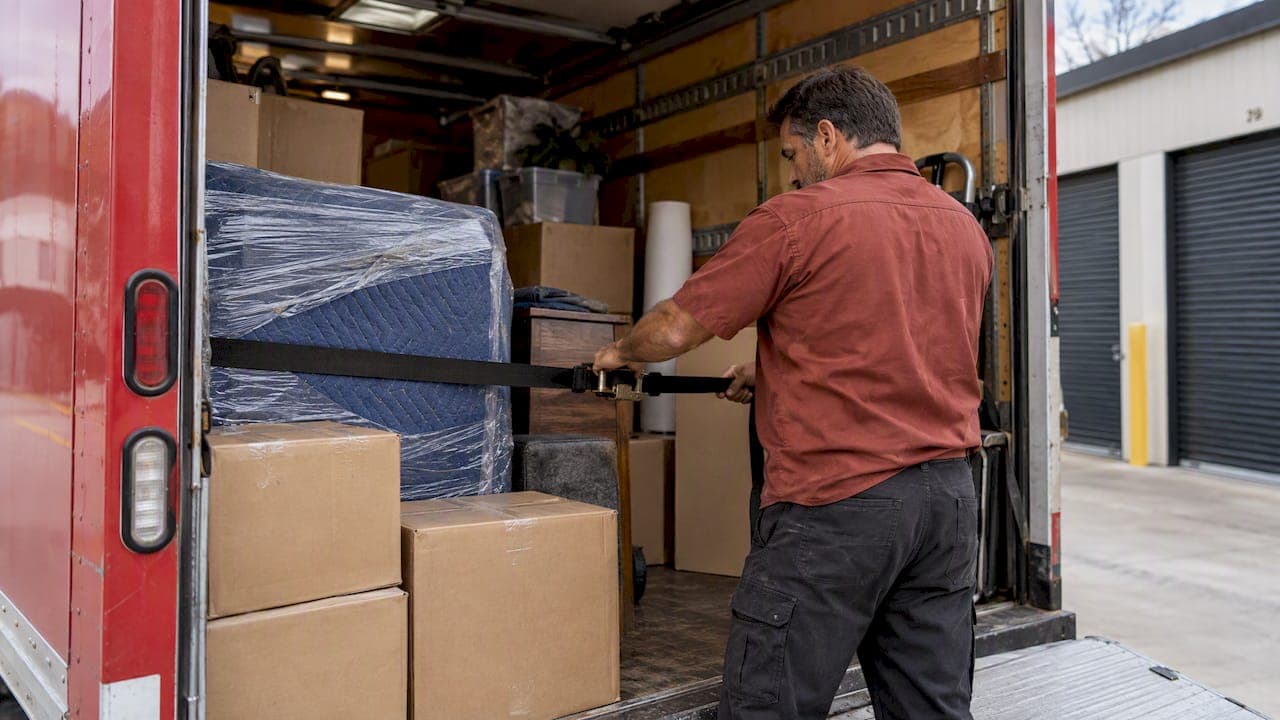
- Load in reverse order of need. Things you will want first go in last, near the door.
- Heavy at the bottom and back, lighter and fragile on top.
- Leave an aisle down the middle or side so you can reach the back without unstacking everything.
- Raise items off the floor with pallets or sheets of plastic-wrapped boards if the floor is concrete.
- Stand mattresses and sofas on end only where the manufacturer allows it, and wrap well.
- Keep a box list at the door with numbers and locations.
- Do not seal tight against walls. A small gap allows air to move.
A loading crew that does this daily plans the order before the first box goes on the truck. Our loading and unloading service is built for exactly this: you rent the space, and a crew puts things in safely and efficiently.
A realistic timeline
| When | What to do |
|---|---|
| 4 to 6 weeks before | Sort, sell and donate. Check insurance. Choose warehouse or unit. |
| 3 to 4 weeks before | Request moving quotes. Order or pick up boxes and supplies. |
| 2 weeks before | Start packing items you will not need. Disassemble what can be taken apart. |
| 1 week before | Defrost appliances. Drain hoses. Finish inventory and photos. |
| Day before | Pack your essentials bag. Confirm times and parking access. |
| Move day | Be present, walk through with the crew, keep your documents and valuables with you. |
Last-minute situations happen, particularly when a sale closes early or a lease ends. If you are short on time, tell your movers up front so they can plan staffing and the truck.
Moving in or out of storage in rental housing
If your tenancy is ending, do not leave things behind and hope. The Province of BC explains that when a tenant leaves belongings, landlords must follow specific rules for storing, selling or disposing of abandoned property. Plan your move-out date and your storage date together so nothing is left in a suite after your tenancy ends.
If your employer, or a government ministry, is covering part of your relocation, ask whether storage fees count. The Province of BC's policy says storage can be treated as a moving cost for its own staff when possessions must be placed in temporary storage during a move. That applies to those employees only, but it is worth asking any employer.
Our perspective: plan the move around the storage, not the other way round
We move people in and out of storage across Abbotsford, Mission, Maple Ridge and Langley, and the pattern is consistent. Problems rarely come from the truck. They come from the plan: a unit chosen before the sort, appliances still wet on the morning of the move, boxes with no labels, or a storage date that does not match the moving date.
Our advice is to decide three things early. First, how long things will really be stored, because that determines whether warehouse storage or a unit makes more sense. Second, how often you will need access. Third, what the crew must know on arrival: stairs, elevator booking in an apartment or condo, parking, and the fragile or heavy items.
Clear communication is the thing we care most about. Tell us what is going where and when, and we will plan the loading order, the crew size and the timing around it. A move into storage is easier to run well when everybody has the same list.
— Jack W.
Moving into storage with 2 Friends Trucking & Moving
If you want a crew to handle the lifting, we offer storage moving in Abbotsford for moves into and out of a storage unit, alongside local moves, packing, furniture moving, apartment and condo moves, and long-distance moves within BC. Pricing is set per move based on distance, size and services such as packing or specialty items, so the best way to get a number is to request a free quote with your inventory and dates.
FAQ
What should I not put in a storage unit?
Leave out hazardous goods such as propane, gasoline and aerosols, plus perishable food, live plants, firearms and ammunition. Keep documents, jewellery, cash and irreplaceable items with you, since they are often excluded from standard coverage. Check your own storage agreement for its full list.
How far ahead should I start packing for storage?
Four to six weeks is comfortable for a household. Begin with items you will not touch before the move, such as off-season clothing, books and décor, and leave the kitchen and bedrooms for the last week.
Does my home or tenant insurance cover a storage unit?
Not always. Standard policies often give limited or no coverage for belongings kept in a separate facility, so ask your insurer directly and be ready to buy extra cover. Do it before move day, not after a loss.
Should I use a warehouse or a self-storage unit?
Warehouse storage generally offers better security, dryness and temperature stability, which suits longer stays and whole-household moves. A self-storage unit works well when you need regular access or have a smaller load. In either case, check for dry floors and no musty smell.
Sources
- OUTCAN Pre-move Booklet: Household Goods & Effects, Canada.ca
- Pre-Move Information Booklet, Canada.ca
- Non-ministry relocation guide, Province of British Columbia
- Storage Unit Guide, Square One
- Items left behind, Province of British Columbia
- Moving, Transportation, and Living Costs, Province of British Columbia