For most people the answer is one of three sizes. A 5x10 suits a studio or one-bedroom apartment, a 10x10 suits a one- to two-bedroom home, and a 10x20 suits a three- to four-bedroom house. Those are starting points, not promises. The right size also depends on how tightly you pack, whether you will visit the unit, and whether big appliances are going in. This guide shows how to work out your number before you sign a rental agreement, with Abbotsford and Fraser Valley details along the way.
TL;DR
- A 5x10 (50 sq. ft.) generally covers a studio or one-bedroom apartment, a 10x10 (100 sq. ft.) a one- to two-bedroom home, and a 10x20 (200 sq. ft.) a larger family house, according to a BC self-storage provider.
- Plan for height, not only floor area. Most purpose-built facilities have ceilings of about eight feet.
- If you will retrieve items later, leave an aisle and size up. Never pack wall-to-wall if you need the back of the unit.
- If you are between homes or unsure how long you will store, go one size larger rather than one smaller.
- Check insurance and climate control before you pay. Both matter more than a few square feet.
Table of Contents
- How storage unit sizes work
- Storage unit sizes at a glance
- Size by what you are storing
- Measure instead of guessing
- The mistake most people make: no room for access
- When to size up
- What it costs in Abbotsford
- Climate control, location and insurance
- Our perspective: what we see on storage moves
- Let us handle the move into storage
- Frequently asked questions
- Sources
How storage unit sizes work
Unit sizes are quoted as width by depth in feet. A 10x10 is ten feet wide and ten feet deep, so 100 square feet of floor. The third number, height, is often left out. In Canada there is no legal standard size for a storage room, though most purpose-built facilities design units with ceilings about eight feet high.
That height is what turns floor area into usable volume. A 5x10 with an eight-foot ceiling holds roughly 400 cubic feet. If you can stack boxes and furniture safely to the ceiling, a small unit goes a long way. If you cannot, because of fragile items or a stack that would block the door, the floor area becomes your real limit.
Units range widely. One Abbotsford-area provider lists options from 25 sq. ft. up to 300 sq. ft., enough for an entire household.
Storage unit sizes at a glance
Use this table as a first pass. Capacity figures are typical, and your own packing will move them up or down.
| Unit size | Floor area | What it typically holds |
|---|---|---|
| 5x5 | 25 sq. ft. | Seasonal items, bikes, boxes, a twin mattress set, small furniture |
| 5x10 | 50 sq. ft. | A studio or the contents of one room: queen mattress set, sofa, several boxes |
| 10x10 | 100 sq. ft. | A one- to two-bedroom apartment, including major appliances |
| 10x12 | 120 sq. ft. | One to two bedrooms, or small vehicles such as an ATV or snowmobile |
| 10x20 | 200 sq. ft. | A three- to four-bedroom house, or a car |
Sources for the figures: the 5x10 description comes from a national storage operator, the 10x10 description from an Ontario guide, and the 10x12 figures from an online size estimator.
Size by what you are storing
Student or single-room storage: 5x5 to 5x10
If you are clearing a dorm or a small room for the summer, a 5x5 holds boxes, a bike and a twin mattress set. A 5x10 adds a sofa or a desk. A recent Abbotsford price listing says a 5x5 or 5x10 is almost always enough for students and single-room moves.
Studio or one-bedroom apartment: 5x10 to 10x10
A 5x10 is the usual recommendation for a studio or one-bedroom apartment. Those homes tend to have a queen bed, a sofa, a small table and 20 to 30 boxes. That fits, but with little to spare. If you own a dresser, a bookcase, a bike and a TV stand on top of that, go to a 10x10 rather than fighting for centimetres.
Two-bedroom apartment or small home: 10x10 to 10x15
A 10x10 can hold the contents of two full rooms. According to the Ontario guide above, that can include queen or king bed sets, a dining table with chairs, a sectional sofa, a fridge, washer and dryer, and dozens of medium and large boxes. Many facilities describe it as about half of a single-car garage. If you also have patio furniture, a home office and a lot of kitchenware, a 10x15 is more comfortable.
Three- to four-bedroom house: 10x20 or larger
Larger family homes generally need a 10x20 (200 sq. ft.) or more. If you are storing the whole house, not just the overflow, pick a 10x20 and expect to fill it. Anything with a workshop, a garage full of tools or a home gym will push you towards the top of the range. Our guide on moving a home gym shows how much space heavy equipment really takes once it is broken down.
Vehicles and recreational gear
A 10x12 can suit small vehicles like ATVs and snowmobiles. One storage guide says most cars need a 10x20 and trucks usually a 10x30, so check the listing for the exact dimensions of what you own before you reserve.
Measure instead of guessing
Square-foot rules of thumb fail because homes vary. Two one-bedroom apartments can hold very different amounts of stuff. A better method takes about an hour.
- Walk the home room by room and write an inventory. The federal Office of Consumer Affairs advises making a room-by-room list to judge total volume, rather than relying on floor area alone. Its moving advice page is worth a read before you book anything.
- List the large items first. Beds, sofas, wardrobes, dining tables, appliances. These decide your minimum footprint.
- Measure the awkward pieces. Note length, depth and height of sofas, dressers and mattresses. A sofa stood on end uses less floor but needs height.
- Count the boxes. A small apartment often lands at 20 to 40 boxes, a family home at 100 or more. Uniform boxes stack well. Odd bags and loose items do not.
- Sketch the floor plan. Draw the unit to scale on paper and place your large items. Leave a path down the middle.
- Add a buffer of 10 to 20 per cent. You will find things you forgot, and you will buy things before you retrieve anything.
If you want us to take the weight off this step, our crew can pack your belongings in uniform boxes. They stack far more efficiently than a mix of bags, bins and grocery totes.
The mistake most people make: no room for access
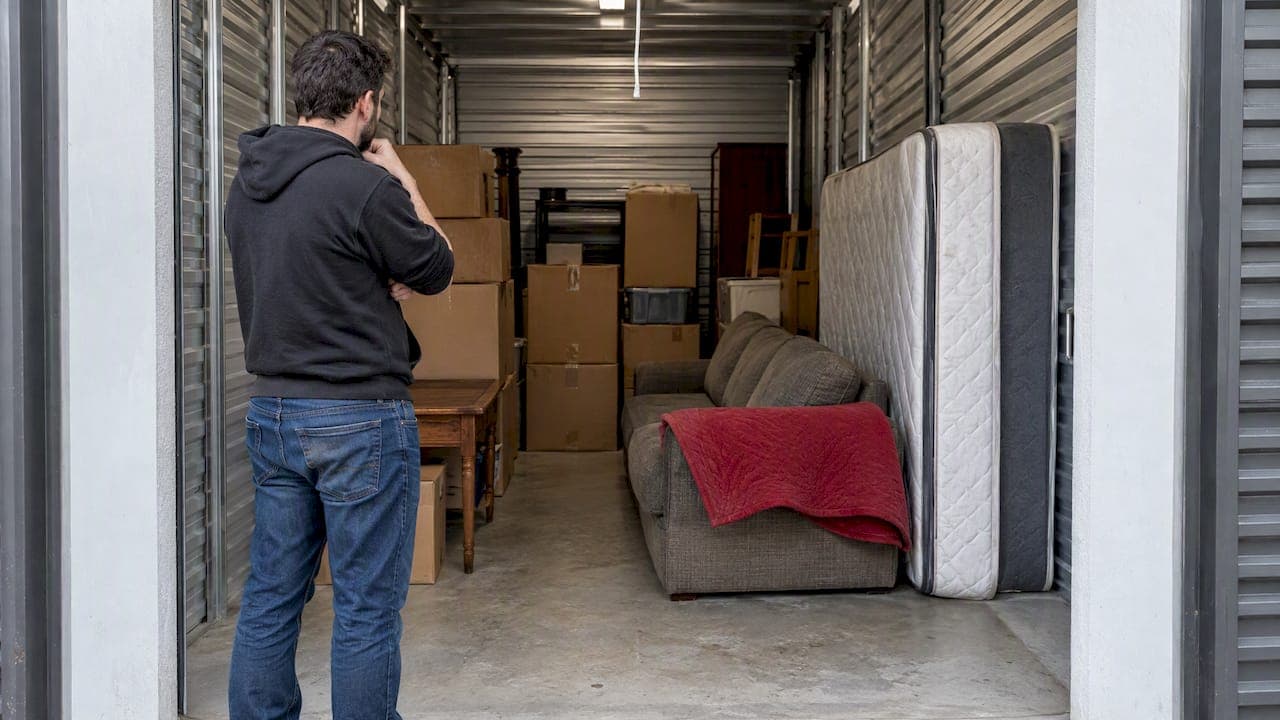
The most common sizing error is ignoring how you will use the unit. A storage specialist at an Abbotsford facility points out that if you need to visit, you have to plan for aisle space. Pack a unit wall-to-wall and you will have to unload half of it to reach a box at the back.
So ask yourself one question: will you open this unit after the first day?
- Never, or once at the end (a long-term hold during an overseas posting, for example): pack tight, stack high, size to the inventory.
- Occasionally (seasonal swaps, a renovation): leave a 2-3 foot aisle and keep the items you will need near the door. Expect to go up one size.
- Often (a business stockpile, a hobby, tools): size up and add shelving if allowed. Label every box on two sides.
Vertical space helps, but never at the cost of the door. Stack only what is stable, put heavy items at the bottom, and keep clear of the entry so nothing falls on you when you open it.
Access planning also applies to how things get in the door. Tight elevators, narrow stairwells and long carries decide how much a crew can move per hour, and that affects your timing. This write-up on preparing narrow access for a move (in French) covers measuring doorways and protecting surfaces before furniture goes through them, and the same checks help when you load a storage unit.
When to size up
A slightly bigger unit often costs less than the trouble of a too-small one. Go one size up if any of these apply:
- You are in transition. Moving between homes, renovating or downsizing is when people underestimate. If you do not know how long the items will be stored, the federal consumer guidance and facility managers lean towards oversizing a little for airflow, organization and fewer damaged items during repeated loading.
- You plan to visit. See the access section above.
- Large appliances are included. A fridge, freezer, washer and dryer each take a footprint that no box can fill around. Appliances like fridges and freezers should also be defrosted and drained to avoid mould and odours.
- You have many odd shapes. Bikes, exercise gear, lamps, framed art and mirrors waste volume.
- You expect to add items. Students often come back with more in September than they left with in April.
Go smaller only when you are packing a single room's worth of uniform boxes and you will not return until pickup day.
What it costs in Abbotsford
Size drives the monthly rate more than any other factor. A live price comparison for Abbotsford, dated 15 October 2026, reports that units range from $88 a month for a 5x5 to $636 a month for the cheapest 10x20. The most popular 10x10 averages $207 a month, with the lowest at $180. Prices vary by facility and features, and promotions change often. The same source says late fall and winter tend to bring the best deals, so a flexible start date can save money.

Two ways to use that. First, if a 10x10 and a 10x15 differ by a modest amount, buy the larger one rather than risk paying for a second unit. Second, if your items fit a 5x10 with room to breathe, do not pay for a 10x10 "just in case".
Climate control, location and insurance
The right size in the wrong environment still loses you money.
Climate control
The Canadian Conservation Institute says attics, basements and garages are poor places to store furniture because of fluctuating environmental conditions. For wooden furniture, electronics, instruments and anything that holds moisture, a climate-controlled unit is worth the premium, particularly through the damp Fraser Valley winters. If you own antiques, read how we approach antique furniture moving before deciding what goes where.
Insurance
Do not assume your home insurance covers belongings in an external unit. The Office of Consumer Affairs tells movers and storers to check the coverage you have for the whole storage period. Many moving company policies do not cover goods in storage unless you buy replacement value protection from the mover or from your own insurer. Ask for both the facility's and the mover's liability terms in writing before you sign. If you are unsure, call your home or tenant insurance broker with your inventory in hand.
Preparing items
Clean and dry everything. Drain and defrost fridges and freezers and leave the doors slightly open. Take high-value or irreplaceable items such as documents, jewellery and small electronics with you rather than leaving them in a unit.
Our perspective: what we see on storage moves
We move people into and out of storage units across Abbotsford, Mission, Maple Ridge and Langley, so we see sizing mistakes from the loading dock side. The pattern is steady. People pick the size from a chart, then discover on moving day that the chart counted floor space and not the way their furniture actually sits.

Our advice comes from careful planning. Decide the order things go in before anything leaves the house: the items you will want last go in first, and the items you may need early go near the door. Pack boxes that stack and furniture that disassembles. Tell your crew whether you will return to the unit, so they leave an aisle instead of building a solid wall.
If you are torn between two sizes, we tell customers what we would tell a friend: take the bigger one if your storage period is open-ended, and the smaller one only when you have a firm end date and a uniform load. Paying a little extra per month is cheaper than a second trip, a second unit or damaged furniture. For the broader picture, our guide to storage in transit between homes walks through the four steps we follow.
— Jack W.
Let us handle the move into storage
We offer storage moving for customers in Abbotsford and the Fraser Valley, including loading your belongings, transporting them and unloading into the unit you have chosen. If you want to see how it works, read about our storage movers service. We can also help with loading and unloading alone if you already have a truck, or with a last-minute move when your keys-over date lands sooner than planned. Tell us what you are moving and where it is going, and we will quote the job. Start from our Abbotsford movers page.
Planning the rest of the move? Our apartment moving checklist and house moving checklist lay out what to do and when, and our note on how to prepare for movers covers access on the day.
Frequently asked questions
How big is a 5x10x8 storage unit?
It is 50 square feet of floor with an eight-foot ceiling, about 400 cubic feet of volume. That is about the size of a walk-in closet. It typically fits the contents of one room or a studio, such as a queen mattress set, a sofa and several boxes.
How many rooms can a 10x10 storage unit hold?
About two rooms, or the contents of a standard one- to two-bedroom apartment. That can include bed sets, a dining table, a sectional and large appliances. Pack carefully and leave an aisle if you will need to reach items later.
What is the size of a 10x12 storage unit?
It offers 120 square feet. People use it for the contents of one or two bedrooms, or for small vehicles like ATVs and snowmobiles. How much it holds depends on whether you are storing furniture or motorized equipment.
Is there a standard size for a storage room in Canada?
No. There is no legal standard, although most purpose-built facilities use ceilings of about eight feet. Common widths and depths run from 5x5 up to 10x20 or larger, so always confirm the exact dimensions with the facility.
Should I choose a bigger unit if I am unsure?
Usually yes, if you are between homes or do not know how long items will be stored. The extra room lets you leave aisles, protect fragile pieces and avoid unloading everything to reach one box. If you have a firm end date and a uniform load of boxes, the smaller size is fine.
Sources
- Self storage, Abbotsford provider
- Storage unit size guide, Public Storage Canada
- Comprehensive storage unit size guide, My Storage
- Size estimator, Storage Bros
- Moving advice, Office of Consumer Affairs
- Basic care: furniture and objects made of wood, Canadian Conservation Institute
- Storage units in Abbotsford, price comparison