
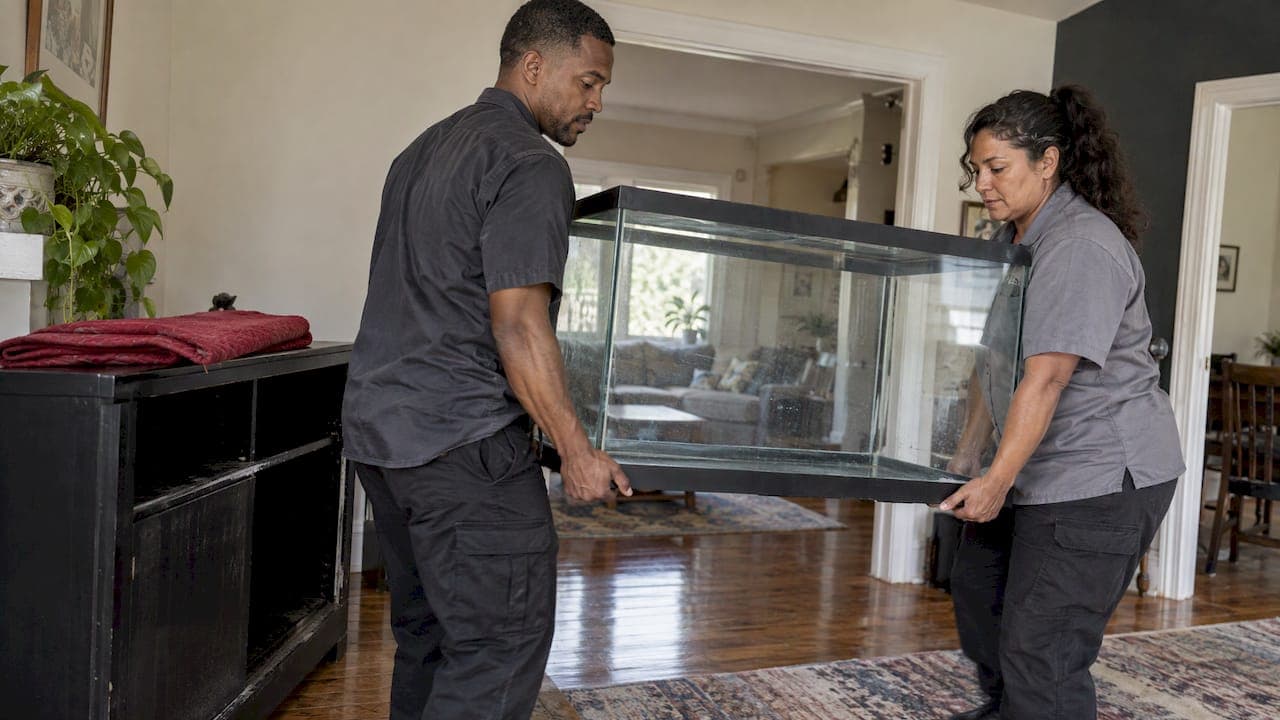
To move a fish tank, treat it as two separate jobs. The fish, water and filter media travel with you, kept wet and warm. The empty, dry tank travels wrapped, upright and supported underneath. Never lift or carry a tank with water or gravel inside. Plan the biology two weeks ahead and the lifting for moving day.
This guide walks through both jobs in order, from the water change before the move to the first week in the new home. It also covers how heavy a tank really is and when to call a moving crew for the stand and the rest of the furniture.
TL;DR
- Do a normal partial water change about two weeks before moving. Don't deep-clean or replace filter media, because that is where your beneficial bacteria live.
- Save most of your tank water in clean, lidded buckets, and keep filter media and plants wet.
- Fish travel with you in sealed, insulated containers, never in the moving truck. Keep time out of water to a minimum.
- Drain the tank completely, wrap it, and keep it upright and supported underneath. Never lift it by the rim.
- At the new home, set up the stand and tank first, add saved water, then fish. Test ammonia and nitrite for the first week.
Table of Contents
- Know what you are lifting
- Two weeks before: prepare the tank
- The day before and the morning of
- Moving day: step by step
- Moving a tank over a long distance
- Setting up at the new home
- What the move looks like with a crew
- Help with the rest of the move
- A checklist you can print
- FAQ
- Sources
Know what you are lifting
A fish tank is heavier than it looks, and the water is most of the weight. One US gallon of fresh water weighs about 8.34 pounds (3.78 kg). A guide to the common 55-gallon size puts the empty glass tank at roughly 75 to 100 pounds, the water alone at about 458.7 pounds, and a finished setup at around 600 to 650 pounds. In kilograms, that is a full tank of about 270 to 295 kg.

That is why the first rule is simple. Aqueon says never to lift or transport an aquarium with water or gravel inside. Water sloshing in a partly filled tank also puts uneven stress on the seams, so "just a little water" is not a shortcut.
For a 55-gallon tank, the empty glass is a two-person lift. Bigger tanks, tanks with a heavy built-in stand or cabinet, and moves involving stairs or an elevator are where people get hurt or crack glass. Measure the tank, the doorways, the hallway turns and the stairwell before moving day so nothing surprises you with the tank in your arms.
Two weeks before: prepare the tank
The best thing you can do for your fish is protect the bacteria colony that keeps the water safe. Most of it lives in the filter media and on the gravel and decor, not in the water.
- Change some water. About two weeks out, do a normal 25 to 30 percent water change and lightly vacuum the substrate. Don't deep-clean, rearrange or replace filter media at this point.
- Test and write down your baseline. Test pH, ammonia, nitrite and nitrate now. You will compare against these numbers after the move.
- Line up supplies. Aqueon suggests gathering your moving equipment at least a week ahead. You need clean buckets with lids that have never held soap or chemicals, a siphon, a net, towels, sealable containers or bags for fish, and insulated boxes or coolers.
- Check the destination. Confirm the floor can carry the weight, the stand location is level, and there is an outlet nearby. Have conditioned water ready for topping up.
- Plan the temperature. Avoid exposing fish to extreme heat or cold where you can. A winter move in the Fraser Valley means pre-warming the car and using insulated containers. A summer move means keeping containers out of a hot trunk.
If you also have houseplants coming along, our guide to moving plants safely covers those, including live aquarium plants' dry-land cousins.
The day before and the morning of
Withhold food for 24 hours before the move. Fish that haven't just eaten produce less waste in their transport containers, which keeps the water cleaner while they travel.
Pack everything else first, so the tank is the last thing you take down and the first thing you set up. Pack décor, spare equipment and test kits in a clearly marked box. Pack glass lids, hoods and light fixtures separately and cushion them. If you're packing a lot of fragile items, our tips on packing glasses without breaking them apply to glass lids and small decor too.
Moving day: step by step
1. Save the water
Siphon tank water into clean buckets before you touch anything else. The amount people recommend varies by source. Aqueon recommends saving about 75 to 80 percent, and Scale & Stem suggests 50 to 75 percent of the total volume. The reason is the same either way: it's established water your fish are used to, so they don't face a sudden change in pH, hardness or trace minerals on top of the stress of moving.
A practical rule: for a short local move, save at least half. For a longer trip, save as much as your buckets and vehicle allow. Lid the buckets, label them "fish water" and keep them upright in the car, wedged so they can't tip.
2. Catch and contain the fish
Transport is stressful for fish, so keep handling short. The Association of Zoos and Aquariums' fish transport manual says to plan capture to minimise handling time, and to keep fish underwater during transfers wherever possible. It cites veterinary advice that time out of water should be one minute or less to avoid serious damage to gills and other organs. In practice:
- Lower water level first so fish are easy to net, then net them one at a time.
- Move each fish straight from net to container, with the net under the surface.
- Put them in sealed bags or lidded containers with tank water, and place those in insulated boxes or coolers so the temperature stays steady.
- Give aggressive or territorial species their own container.
The manual also says plans should allow for postponement if capture goes badly. If a fish is badly stressed or the tank is too heavily decorated to net quickly, stop, let things settle and try again.
Fish travel with you in the car, not in the moving truck. Truck cargo areas aren't climate-controlled, and you can't check on the fish. Our guide on moving with pets has a plan for cats, dogs and small animals, and the same principle applies: live animals stay with you.
3. Pack plants, filter media and gravel
Keep the biology wet. Aqueon advises keeping filter media and gravel wet and moving plants in water or wrapped in wet paper inside sealed containers. Put filter sponges and cartridges in a bucket with tank water, never tap water, since chlorinated water can kill the bacteria you're trying to protect. Don't let media dry out or sit in a sealed bag without water for long.

Gravel or sand can go into buckets with a little tank water, but it is heavy. Fill buckets only part way so you can lift them.
4. Drain, dismantle and clean up
Once the fish are secure, siphon out the rest of the water, remove substrate and decor, and unplug and pack the heater, pumps, lights and tubing. Wrap cords and label each piece so setup goes quickly. Make sure no water remains in the tank, because even a small amount adds uneven weight and can slosh.
5. Wrap and carry the empty tank
Aqueon says to wrap the empty tank in blankets or other protective material and secure it so it cannot shift in the vehicle. A few handling rules help:
- Carry the tank upright, with the bottom supported. Lifting by the top rim stresses the seams.
- Don't carry or lay a tank on its side or end. Aquarium seams are built for water pressure pushing outward on vertical panels, not for diagonal forces.
- Use two people for anything beyond a small tank, and use a trolley or dolly with the tank sitting flat when you have a long route to the vehicle.
- Place the wrapped tank upright in the vehicle, packed in with soft items so it can't slide. Nothing heavy should sit on or lean against it.
The stand or cabinet is its own moving job. It is often heavy, built from particleboard or laminate, and prone to damage at corners. Remove drawers or doors, wrap it with padding and move it as you would any furniture piece.
Moving a tank over a long distance
Longer trips need more of everything, because fish are in containers longer. Aqueon recommends insulated containers and battery-powered aeration for long-distance moves, along with keeping biological media wet and securing the empty tank. The AZA manual notes that fish losses in shipping cluster toward the end of the trip, so shorten the final stretch where you can, and plan your route and stops to avoid delays near the end.
Some practical rules for a long-haul move, such as a trip from Abbotsford to the Okanagan or beyond:
- Drive the fish yourself, in a climate-controlled car, and keep them out of direct sun or a blast of the heater.
- Make the new tank the first thing you set up on arrival, before unpacking boxes.
- If the route is very long, consider splitting the trip with an overnight stop where you can check temperatures and set containers somewhere stable.
- Keep a thermometer in each transport container.
Setting up at the new home
Do it in the right order, and avoid changing too many things at once. As Fishy Friends puts it, when several variables change together it's hard to tell what helped and what caused a problem.
- Place the stand. Set it on a level spot with solid support. Check it with a level before adding anything.
- Set the empty tank on it. Check it sits evenly, with no gaps under the base.
- Position equipment without powering it. Fit the filter, heater and lights, but leave them unplugged until water is in.
- Add substrate, saved water, plants and décor. Then top up with conditioned water to the right level.
- Start filtration, pumps and heating. Let the water come back to the temperature your species needs.
- Wait before adding fish. Petland Canada suggests waiting one to two days so temperature and equipment are running properly. If your fish have been in containers for many hours, you may need to move faster, so use the thermometer reading and your judgement.
Acclimating the fish
Temperature first. Float the sealed bag in the tank for 10 to 15 minutes, as Petland Canada recommends. Scale & Stem suggests 15 to 20 minutes, then opening the bag and adding small amounts of tank water over another 15 to 20 minutes so fish adjust to minor chemistry differences. Then net the fish into the tank and discard the transport water, not pouring it into the aquarium. Keep lights off for several hours afterward.
If you've moved fish in a bucket of their own tank water, the tank water is nearly identical, so the float-and-adjust step is mostly about temperature.
The first week
Aqueon suggests not feeding for 24 hours, checking temperature daily for the first few days and testing ammonia and nitrite after three to five days. Because ammonia and nitrite should normally read zero in an established tank, test them any time fish look distressed and compare the other readings with your species' normal range and your pre-move baseline.
Watch for rapid breathing, colour fading, hiding and refusing food. Scale & Stem advises monitoring closely for the first 48 hours. When you start feeding, offer small portions to keep waste low while the bacteria settle. A small ammonia bump in the first days is common, so water changes and testing matter more than any additive.
If a test shows ammonia or nitrite above zero, or fish seem seriously unwell, contact a local aquarium store or an aquatic veterinarian with your test results and species list. They can advise on your specific fish.
What the move looks like with a crew
Most people move the fish and water themselves, and that's the right call. What a crew helps with is everything around the tank: the heavy stand, the cabinets, the sofa that has to go through the same doorway, and the dozens of boxes you'd rather not carry while you're also watching buckets.
A realistic plan for a local move looks like this:
- You handle the fish, water and filter media, and drive them to the new home.
- The crew loads the truck, with the empty tank wrapped and kept upright and last in line to be unloaded first.
- You set up the tank first, before the rest of the unpacking.
We suggest telling your mover about the tank, its approximate size and the stand when you ask for a quote. That lets the crew plan the truck load, the number of people and the order of loading and unloading.
Our view on moving aquariums
People often ask whether the movers should "handle the aquarium." Our honest answer is that the fish are a job for the owner, and the rest of the move is a job for a well-planned crew. The best aquarium moves we see are the ones where the owner has done the water prep, has the fish in the car, and has left the heavy, awkward work to people who do it every week.
What we focus on is careful planning, clear communication and careful handling of items. For a household with a tank, that means knowing the tank and stand are coming before moving day, deciding who carries what, and getting the heavy furniture into the new home so you have a clear, level place to set up. It also means keeping the schedule predictable, so you aren't holding buckets of fish water while waiting for a truck.
If you tell us early, we can plan around it. A calm, well-sequenced move is the best thing for you and your fish.
Jack W.
Help with the rest of the move
A fish tank is one of several awkward items in a typical household. We're an Abbotsford moving company serving Abbotsford, Mission, Maple Ridge, Langley and the surrounding Fraser Valley, handling residential and commercial moves, local and long-distance moves within BC, apartment and condo moves, furniture moving, packing, and loading and unloading.
If you want the heavy furniture, the stand and the boxes handled while you look after the fish, start with our local moving service. For a move to another part of the province, see our long-distance moving service, or our packing services if you'd like someone else to pack the rest of the house.

Tell us about the tank, its size and the stand when you get in touch, and we'll plan the day around it. You can reach us through the 2 Friends Trucking & Moving website. If you have other tricky items, such as a pool table, artwork or a home gym, our blog has guides on those too.
A checklist you can print
Two weeks before
- Partial water change (25 to 30 percent) and light substrate vacuum
- Test and record pH, ammonia, nitrite, nitrate
- Buy or borrow buckets, lids, siphon, net, insulated containers
The day before
- No food for the last 24 hours before moving
- Pack decor, spare equipment and test kits
- Check the destination: level floor, outlet, conditioned water
Moving day
- Siphon and save water into clean, lidded buckets
- Net fish quickly, keep them underwater, seal them in insulated containers
- Keep filter media, gravel and plants wet
- Drain the tank completely, wrap it, move it upright
- Fish and water travel in your car
At the new home
- Stand, empty tank, equipment (unpowered), substrate, water, plants
- Start filtration and heating, check temperature
- Float, adjust, net fish in, lights off
- Test ammonia and nitrite over the first week, feed lightly
FAQ
How do you move a fish tank with fish still in it?
You don't. Move the fish separately in sealed containers with tank water, and move the tank empty. Lifting a tank that holds water, gravel or fish puts heavy, uneven stress on the glass and seams, and Aqueon says never to lift or transport an aquarium with water or gravel inside.
How long can fish stay in a bag during a move?
No single number fits every species, water temperature and bag size, so keep the trip as short as you can. The AZA's transport manual notes that losses cluster toward the end of the trip, so avoid delays near the arrival. For long trips, use insulated containers and battery-powered aeration, and check temperatures along the way.
Can I leave water in the tank when I move it?
No. A partially filled tank sloshes, adds heavy weight and stresses the seams. Siphon the water into clean lidded buckets and keep it for the new setup. Saved tank water carries the chemistry your fish are used to.
How heavy is a 55-gallon fish tank?
An empty glass 55-gallon tank commonly weighs about 75 to 100 pounds (roughly 34 to 45 kg). The water alone is about 458.7 pounds, and a full setup is around 600 to 650 pounds. Always empty it before moving, and check that the floor and stand at the new home can carry the load.
Do I need to cycle the tank again after moving?
Not usually, if you kept filter media wet and saved most of your tank water. Test ammonia and nitrite over the first week and feed lightly. If readings rise above zero or fish show stress, see a local aquarium store or aquatic vet with your test results.
Sources
- How to Move an Aquarium, Aqueon
- Moving an aquarium without disaster, Scale & Stem
- Fish Transport manual, Association of Zoos and Aquariums
- How Much Does a 55-Gallon Fish Tank Weigh, Hepper
- Fish Tank Weight Calculator, AquariumMath
- Setting Up Your New Aquarium, Petland Canada
- How to Move an Aquarium to a New Home, Fishy Friends