
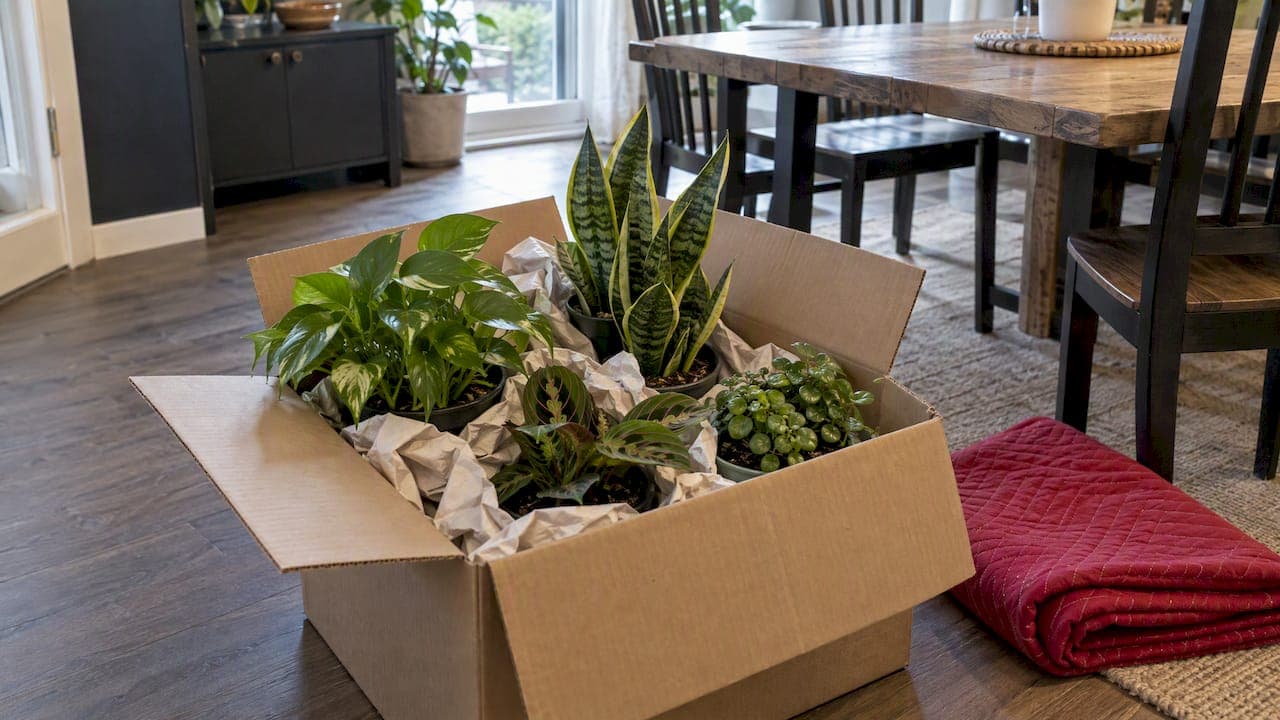
To move plants safely, treat them as the one thing in your home that is alive. Water them a few days ahead, check them for pests, swap breakable pots for light plastic ones, and pack them so soil and stems stay put. Then drive them yourself in the heated part of your car, because a cold trunk or an unheated truck is where most plants are lost. Before you load anything, ask your mover whether they take live plants at all, since many household movers do not.
We move households across Abbotsford, Mission, Maple Ridge, Langley and the rest of the Fraser Valley, and plants are one of the questions we hear most often from people planning a move. This guide covers the prep, the packing, the winter rules, the paperwork when soil leaves a regulated area in BC, and what to settle with your movers.
TL;DR
- Water plants 3 to 5 days before moving, check for pests, and prune dead or damaged leaves.
- Repot into lightweight plastic pots if yours are ceramic or terracotta, and keep soil in place with a bag or wrap.
- Ask your mover in writing whether they transport live plants. Do not assume they do, and plan to carry plants in your own car.
- In cold weather, wrap plants before they leave the house and keep them in the heated cabin, above about 10°C (50°F).
- Plants with soil leaving a Japanese beetle regulated area in BC need a CFIA Movement Certificate, so check the current map before you move.
Table of Contents
- Start with a plant triage, not a packing list
- Four weeks out: prepare the plants
- Packing plants so nothing spills or snaps
- Can movers move plants?
- Moving plants in winter
- Plant rules in BC: when you need paperwork
- Moving day: how to get plants there in one piece
- After the move: help plants settle in
- Our perspective: plants are the part of a move people underestimate
- Let us handle everything except the plants
- FAQ
- Sources
Start with a plant triage, not a packing list
Before you buy a single box, decide which plants are worth moving. A move is stressful for a plant: less light, changes in temperature and humidity, and a few days of rough handling. Cheap, fast-growing plants (a pothos cutting, a spider plant that has produced a dozen babies) are easy to replace. A 20-year-old fiddle-leaf fig or a plant from a relative is not.
Sort your plants into three groups:
- Must keep. Sentimental plants, large specimens and anything rare. These travel with you, in your car, with the most careful packing.
- Happy to move. Healthy, mid-sized plants in plastic pots. Pack them well, but do not lose sleep over them.
- Give away or take cuttings. Heavy pots, pest-prone plants and anything you only half like. A cutting rooted in a jar of water travels far more easily than a plant in a 40 cm pot.
The weight matters too. A large plant in a glazed ceramic pot can weigh as much as a small piece of furniture once the soil is wet. If it is going into a van, it is worth deciding now whether the pot or the plant is the thing you are keeping.
Four weeks out: prepare the plants
Plants cope with a move far better when they go in healthy. Use the weeks before moving day to get them there. Our house moving checklist lays out an eight-week plan for the whole home, and plants fit neatly into the first few weeks of it.
Check for pests and treat them early
Inspect leaves, undersides and the soil surface for insects. A pest you carry into a new home becomes a pest on every plant there, and treating them in a box is much harder than treating them on the windowsill. The Home Depot's moving guide recommends inspecting plants for pests and treating them before the move, and pruning weak or damaged leaves so the plant is not spending energy on foliage that will not survive anyway.
Water 3 to 5 days before
The aim is soil that is damp, not soaking and not dry. Soaking soil adds weight, leaks out of drainage holes and invites rot in a closed box. Bone-dry soil stresses roots and pulls away from the pot edge, so it spills and shifts. The same Home Depot guidance suggests watering three to five days before the move so plants arrive neither too wet nor too dry.
Swap breakable pots for lightweight ones
Ceramic and terracotta pots crack, and a cracked pot in a box is a cloud of soil and root. If a plant lives in one, repot it into a clean plastic nursery pot of the same size, then slide it back into the decorative pot at the other end. Do this a week or two ahead if you can, so the plant has time to settle rather than being repotted and driven on the same day.
Be careful with big repotting jobs
Moving is not the time to move a plant up two pot sizes or divide a root-bound specimen. Keep the pot size the same. Save major repotting for a few weeks after you arrive, when the plant has adjusted to its new light.
Packing plants so nothing spills or snaps
The goal is simple: soil stays in the pot, the pot stays upright, and leaves and stems are not crushed or bent. How you get there depends on the size of the plant.
Small plants
Pack them in sturdy boxes with crumpled packing paper between the pots so they cannot slide or knock together. Punch a few air holes in the box if it will be closed for more than a couple of hours, and mark it clearly as live plants, this way up. Home Depot's advice is to pack small plants in boxes with paper between containers and to label each box.
Keeping the soil in the pot
The University of Massachusetts suggests moistening the growing media, placing each pot in a plastic bag tied around the base of the plant, keeping the plastic away from the foliage, and packing plants tightly with crumpled newspaper so they cannot tip. The tight packing is as important as the bag: a plant that cannot move cannot spill.
If you do not have bags to hand, a layer of bubble wrap or a cut-to-fit piece of cling film over the soil surface does the same job for a short drive.
Large plants and trees
Big plants are best wrapped loosely, not tightly. Gather branches gently upward and loosely wrap them in paper or a soft sheet so they are protected, without crushing the leaves or snapping stems. Keep the pot upright on the floor of the vehicle, wedge it in with towels or boxes, and do not stack anything on top. A plant dolly or a sturdy hand truck makes it much safer to get a large pot out of the house.

Label everything
Write the plant name and the room it is going to on each box or pot. Home Depot also recommends asking movers to load plants last so they come off first, which matters most if any plants are travelling in the truck rather than your car.
Can movers move plants?
Often not, and you should find out early. Many household movers do not carry live plants because they can die in transit and cannot be insured easily. The federal Office of Consumer Affairs advises that you ask your mover what they cannot transport or store, and to check insurance and replacement-value protection before the move.
That is the right question for plants. Ask any company you are considering:
- Do you transport live plants at all, and are there limits on size or number?
- Are plants covered if they are damaged or die in transit?
- Will plants ride in a heated cab or in the unheated cargo area?
- Can plants be loaded last and unloaded first?
Get the answers in writing in your quote or booking confirmation, not in a phone call you may later misremember. If you are weighing up coverage more generally, our guide to verifying a moving certificate of insurance in Canada shows what to ask for.
Our practical advice: even when a mover will take plants, your most valued ones should travel in your own vehicle, where you control the temperature.
Moving plants in winter
In the Fraser Valley, a typical winter move is not far below freezing, but plants that grew up indoors at 20°C are still very sensitive to a short exposure to cold air. Tropical houseplants can be hurt by the walk from front door to car or the minutes it takes to carry them from a vehicle into your new home.
The Washington State University extension's gardeners' handbook advises wrapping plants before leaving, since even a short transfer in very low temperatures can severely damage them. It recommends putting them in the front seat with the heater on, and avoiding temperature drops below 50°F (10°C). Virginia Cooperative Extension likewise suggests wrapping tropical plants, using the heated front of the vehicle rather than the trunk or truck bed, avoiding wind from an open window and keeping temperatures above 10°C where possible.
In practice that means:
- Pre-warm the car and load plants last, just before you leave.
- Wrap in paper or a blanket, then a bag, and keep the wrap closed until you are inside the new home.
- Never leave plants in a parked car overnight or during a long stop. If you stop for the night, bring them inside.
- Keep them out of the moving truck on cold days, even for a short local move.
- Unwrap indoors, in a warmed room, not on the porch.
The same logic applies in the other direction. In a hot spell, a car parked in the sun becomes an oven, so park in shade, crack a window for air and do not leave plants inside while you unload.
Plant rules in BC: when you need paperwork
Most people moving a few houseplants across town will never touch this, but if you are moving between regions, it is worth ten minutes. The rules are about soil and roots, because soil can carry pests that spread.
Japanese beetle regulated areas
The Canadian Food Inspection Agency (CFIA) says that all underground plant parts, including whole plants with roots and soil, are regulated articles year-round for Japanese beetle purposes. CFIA's current notice says that as of 1 June 2026, a Movement Certificate is required year-round for plants with soil, soil-related matter or growing media leaving a regulated area in British Columbia. The current regulated areas include parts of Vancouver, Burnaby, Coquitlam, Port Coquitlam and Kamloops.
If you live in or near one of those areas, check CFIA's map before you pack, because the regulated area can change. If you do not, you are unlikely to need anything, but confirm it.
There is also a useful exemption. CFIA's directive D-96-15 exempts non-commercial houseplants grown indoors and never kept outdoors as patio plants from its Japanese beetle movement restrictions, but notes that other requirements may apply. Plant material substantially free of soil and growing media is also exempt. So a true indoor-only houseplant is generally outside the restriction, while a plant that spent the summer on the patio and is sitting in soil is not.
Moving to BC from another province
CFIA says regulated articles moving to British Columbia or Newfoundland and Labrador from elsewhere in Canada require a CFIA Movement Certificate, and that there are no Japanese beetle restrictions on movement to other provinces and territories. If you are moving to us from, say, Ontario with a car full of patio pots, check before you go. Newfoundland and Labrador goes further: soil, containers with soil and plants with roots or soil cannot leave the province without written authorization.
Crossing the US border
For moves into Canada, CFIA says houseplants from the continental United States may qualify for a personal-use exemption when they accompany you and the total does not exceed 50 plants. Eligible plants generally do not need an import permit or phytosanitary certificate, subject to species-specific rules and exceptions. From anywhere else, plants with soil generally cannot be imported. Because these rules are species-specific, call CFIA or check the directive for your particular plants before crossing.

Moving day: how to get plants there in one piece
Plants are one of the last things you pack and the first you should unpack. A simple plan keeps them out of the chaos.
- Keep plants out of the way. Gather them in one room, a bathroom or a spare bedroom, with the door closed and a sign on it, so movers do not carry them out with the furniture. Our guide to preparing for movers in Canada explains how to keep access clear on the day.
- Load them last into your own vehicle. Place heavy pots on the floor, wedged with towels, and smaller plants in boxes on the seat or footwell. Avoid putting them where sun hits for hours.
- Drive smoothly. Take corners gently. A tipped pot is the most common cause of plant damage in a car.
- Unload first at the new home. Bring plants in before the heavy furniture starts moving, so they are not sitting in a hallway in the way.
If you are moving long distance within BC, plants need more planning because of the time in the vehicle. The CFIA rules above matter more, and so does temperature across mountain passes in winter. Our long distance moving service can carry your furniture and boxes while you drive the plants yourself, which is usually the best split.
After the move: help plants settle in
The University of Massachusetts guidance suggests unpacking plants promptly, and that is the first rule of arrival.
- Unwrap and unbox soon. Take plants out of bags and boxes as soon as you arrive, and keep them grouped while you move furniture around.
- Check the light. Look at where the sun falls in each room at different times of day before choosing spots. A plant that loved an east window may burn in a west-facing one.
- Water lightly. Check soil moisture by finger and water if dry. Do not flood a stressed plant.
- Hold off on fertilizer for a few weeks, and on repotting too.
- Expect some leaf drop. Losing a few leaves in the first weeks is normal as the plant adjusts. Keep conditions steady, and do not keep moving it around.
Our perspective: plants are the part of a move people underestimate
In our experience, plants are the item customers worry about least in the planning stage and most on the day. People put months into the furniture, the boxes and the schedule, and then discover at 8 a.m. that 30 pots are sitting in the living room with nowhere to go.
Our advice is to treat plants like a separate small project. Decide early which ones come, take cuttings of the rest, and plan for them to travel with you rather than in the truck. We would much rather you tell us before the move that there is a room of plants to keep out of the way than have it come up on the day. When we plan a move, we ask about fragile and special items, because careful planning and clear communication make a move smoother for everyone. A plant that has been on your windowsill for 15 years is exactly the kind of thing we want to know about.
— Jack W.
Let us handle everything except the plants
The plants should ride with you, but the rest of the move does not have to. We provide local moves in Abbotsford, Mission, Langley, Maple Ridge and surrounding Fraser Valley communities, plus long-distance moves within BC. We can also help with packing services for the household items that are not alive, and loading and unloading so you can focus on getting your plants safely to the new place. Request a quote and tell us in advance about any plants or fragile items you have.
FAQ
What is the best way to move houseplants?
Water them 3 to 5 days before, check for pests and use lightweight plastic pots. Secure the soil with a bag or wrap, pack plants tightly so they cannot tip and keep them in your own vehicle's heated cabin. Unpack them as soon as you arrive.
Can movers move plants?
Not always. Many household movers do not carry live plants, so ask each company what they cannot transport and what insurance covers, and get the answer in writing. Even when a mover agrees, your most valued plants will usually fare better in your own car.
How do I transport plants in winter?
Wrap each plant before it leaves the house, load it last into a pre-warmed car and keep it in the heated cabin, not the trunk. Extension guidance from Washington State University advises avoiding temperatures below 10°C (50°F). Unwrap plants indoors, and never leave them in a parked car.
Do I need a permit to move plants within BC?
Possibly. CFIA requires a Movement Certificate for plants with soil or growing media leaving a Japanese beetle regulated area in BC, though indoor-only houseplants are generally exempt from that rule. Check CFIA's current regulated-area page before you move.
Sources
- How to Move Plants, The Home Depot
- Chapter 14: Houseplants, The Pacific Northwest Gardener's Handbook (Washington State University)
- Chapter 12: Indoor Plants, Virginia Cooperative Extension
- Moving advice, Office of Consumer Affairs
- Questions and Answers: Japanese beetle, CFIA
- Regulated areas for Japanese beetle in British Columbia, CFIA
- D-96-15: Phytosanitary requirements to prevent the spread of Japanese beetle, CFIA
- D-08-04: Plant Protection Import Requirements for Plants, CFIA
- Newfoundland and Labrador soil restrictions, CFIA
- Questions and answers: Import requirements for soil on plants, CFIA
- Transport of Privately-owned Houseplants Into and Out of Massachusetts, University of Massachusetts