
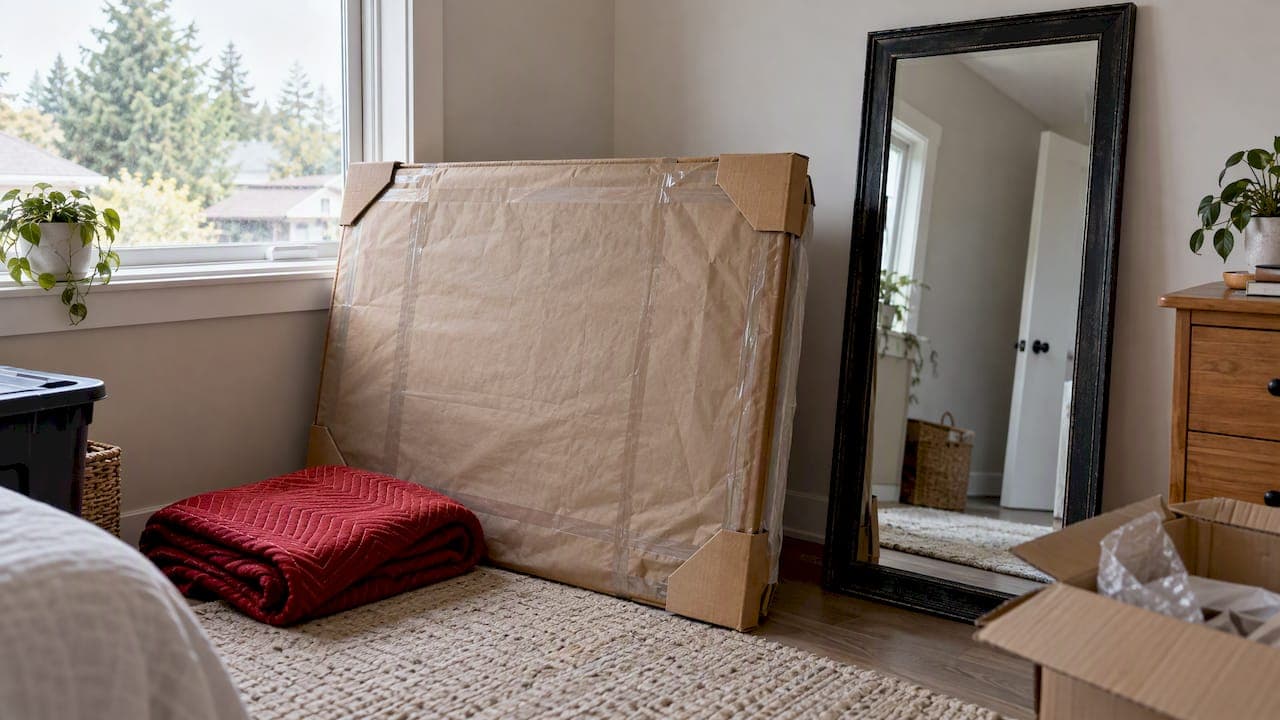
To pack artwork safely, protect the surface first, cushion the frame and corners second, box each piece upright on its own, and mark the box so the crew knows which way is up. Most damage on moving day comes from pressure, rubbing and tipping, not from one dramatic drop. This guide covers framed pictures, canvas, large mirrors and the point where a piece is better handled by professionals.
TL;DR
- Wear clean gloves, protect the face of every piece with acid-free or release paper, then add bubble wrap and corner protection.
- Pack art and mirrors upright, never flat, one piece per box where you can, and write "Fragile" on the glass side.
- Stretched canvas needs a non-stick layer against the paint and nothing pressing on the middle of the canvas.
- Very large or valuable pieces may need a custom crate or a crew that handles art regularly.
- In Abbotsford and the Fraser Valley, we can pack and move artwork for you, so you only handle what you want to.
Table of Contents
- Start with the right supplies
- Check the piece before you wrap it
- How to pack framed paintings and pictures
- Moving canvas art
- How to pack mirrors, including large ones
- Boxing, labelling and loading
- What the Canadian Conservation Institute means by layers
- When artwork needs a crate or a professional
- Our perspective: art goes last in the plan and first in the conversation
- Let us pack and move it for you
- FAQ
- Sources
Start with the right supplies
Buy materials before you start wrapping. Stopping halfway to find tape is how a painting ends up leaning against a wall with nothing on it.
A conservation-minded kit looks like this, based on the supply list in a national gallery's packing guide:
- Cotton or nitrile gloves
- Scissors, a utility knife and a measuring tape
- Clear tape and glass tape (a low-tack tape made for glass)
- Bubble wrap
- Silicone release paper or glassine
- Acid-free tissue paper
Add cardboard corner protectors, picture or mirror boxes in the sizes you need, and a marker. Skip newspaper against the artwork itself: the ink can transfer onto frames and unglazed surfaces, and acid-free tissue costs very little by comparison.
Gloves matter more than people expect. The Canadian Conservation Institute recommends clean, well-fitting, lightweight cotton or latex gloves so oils, moisture and dirt from your hands do not end up on paintings or frames.
Check the piece before you wrap it
Wrapping hides problems. Look at each piece in good light first.
The CCI says a painting should be in good condition before wrapping, have a backing board installed and, if glazed, have the glass held away from the paint by a spacer. In practice, that means:
- Look for flaking paint, loose canvas, cracked glass, or a frame joint that has opened. If you find any, photograph it and talk to a framer or conservator before the move.
- Check that the backing is intact and the hanging wire is secure.
- Photograph the front, back and any existing damage. These photos are useful for your records and for any insurance conversation later.
If you are working through a larger inventory, our house moving checklist shows how to log valuable items before they go into boxes.
How to pack framed paintings and pictures
For a framed piece under glass, the sequence from the CCI's guidance on wrapping a painting is a good model:
- Lay the piece face up on a clean, padded surface.
- Apply glass tape across the glass. If the glass breaks, the tape helps hold the pieces in place instead of letting them scrape the artwork.
- Cover the front with acid-free tissue.
- Wrap the frame in bubble wrap.
- Add cardboard corner protectors, since corners take most of the knocks.
For unglazed work, such as an oil painting in a floating frame, use glassine or silicone release paper on the exposed paint instead of tissue. Never put bubble wrap directly on a painted surface.
This is the same idea behind layering backing boards, cushioning and wrap around paintings: each layer has a job, and none of them should press hard on the surface.
Glass and acrylic panes
For very large frames, glass is the heaviest and most dangerous part. One marketplace for original art advises removing the glass or acrylic pane, sandwiching it between foam-board sheets and packing it alongside the artwork. Only do this if the frame is designed to be opened and you are comfortable with it. If the piece is valuable, ask a framer to do it.

Small prints and photographs
Smaller pieces can go together. Home Depot suggests that when you pack small framed items and mirrors in one box, they stand vertically rather than lying flat, and the box stays under 40 to 50 pounds. Put a layer of cardboard between frames so glass never touches glass, and fill gaps with crumpled paper so nothing slides.
Moving canvas art
A stretched canvas has no glass, which makes it feel tougher than it is. The danger is different: pressure on the face, dents in the middle, and anything sticky or rough against the paint.
A sound approach:
- Wear gloves and lay the canvas face up on a clean blanket or bubble wrap, never on a bare floor.
- Cover the painted face with silicone release paper or glassine. These do not stick to paint, which is why the CCI recommends them for exposed paint. Do not use plastic cling film or regular wrapping paper against the surface.
- Hold the paper in place with tape on the paper only, never on the canvas or the paint.
- Add a rigid layer on the front, such as a sheet of corrugated cardboard or foam board cut slightly larger than the canvas, so a box edge can not press into the middle.
- Wrap the whole piece in bubble wrap and tape the wrap to itself.
- Put it in a box that fits snugly, with padding on all four edges, and stand it on its long edge.
For canvases in a floating or gallery frame, treat the frame like any other framed piece and protect the corners. Do not stack canvases face to face, even with paper between them. Each one gets its own cardboard or its own box.
How you carry matters too. The CCI says to never carry a painting by the hanging wire, the top of the frame or one side alone, because holding one side can pull the corner joints apart. It also says it is preferable to carry a painting with its front facing you, so the backing board can protect the canvas if something goes wrong. Use two hands, support the bottom, and take a second person for anything big.
How to pack mirrors, including large ones
A mirror is a sheet of glass in a frame, and the same principles apply: protect the glass, protect the corners, keep it upright.
Standard mirrors
- Tape the glass face with an X, or use glass tape, so any crack stays contained.
- Cover the whole mirror with a layer of paper or thin foam, then bubble wrap.
- Add corner protectors.
- Place it in a mirror or picture box that is close to the right size. Fill any gaps with crumpled paper or bubble cushioning so there is no room to shift.
- Seal the box and mark it clearly.
U-Haul's moving guide covers the same ground and recommends keeping mirror and picture boxes upright and wedging them between two heavy objects so they do not move. Never lay a mirror box flat and stack things on it.
Large and heavy mirrors
A wall mirror or a full-length mirror is awkward more than it is delicate. The glass flexes if it is carried flat, and the weight makes people grip the frame in the wrong place.
- Remove it from the wall with a helper so one person can support the weight while the other lifts it off the hooks or brackets.
- Carry it vertically, with the glass side facing your body, one person at each end.
- Use a large mirror box or telescoping mirror carton. If you can not buy one, ask us before you improvise.
- Plan the route in advance: measure doorways, stairwells and elevators. For condos, book the elevator if the building requires it. Our apartment moving checklist covers that kind of building logistics.
If a mirror is large enough that you can not wrap your arms around it comfortably, treat it as a two-person job at minimum.
Boxing, labelling and loading
How a box sits in the truck matters as much as how it is wrapped.
| Step | What to do | Why |
|---|---|---|
| Box size | Choose a box with a snug fit, plus padding at the edges | Space inside a box lets a piece slide and hit the sides |
| Orientation | Pack and carry upright, on the long edge | Flat pieces get things set on top of them |
| Weight | Keep multi-item boxes within 40 to 50 pounds | Heavy boxes get dropped and force the bottom to flex |
| Labelling | Write "Fragile" and mark the glass side | The crew knows how to hold it and which side faces which way |
| Loading | Stand boxes upright against a wall of the truck, secured so they can not tip | Flat or loose boxes shift and get crushed |
On the labelling point, Home Depot's advice is to mark the glass side and write "Fragile" on the box, and to stand picture and mirror boxes upright during loading. We would add one thing: write the room it goes to on the box as well, so your art does not end up in a garage stack.
When you load yourself, keep art away from the tailgate and from tools or appliances. On our own trucks, art and mirrors go in last-in, first-out positions along a wall with padding on both sides, so they can not slide or tip when the truck brakes. Clear access matters here as well. Our guide on preparing for movers explains how blocked hallways and parking can slow a move and increase handling.
What the Canadian Conservation Institute means by layers
The CCI describes primary packaging as light, superficial treatment directly next to the object that supports delicate surfaces and prevents impact between objects. The tissue, release paper and glass tape in this article are that layer. Bubble wrap, corner protectors and the box itself are the outer protection. Thinking in layers helps you decide what to buy: if the first layer is wrong, no amount of bubble wrap fixes it.

When artwork needs a crate or a professional
Most household pictures, prints and mirrors can be packed at home. Some can not.
Call for professional help when:
- The piece is large. One art marketplace, for example, requires a custom wooden crate for framed artwork larger than 18 by 24 inches when shipping. That is a shipping rule rather than a law, but it shows how quickly standard boxes stop being enough.
- The artwork is valuable, fragile or irreplaceable, such as an old oil painting, a signed print or a family heirloom.
- The piece is part of a larger fragile collection, such as antiques or sculptures. Our guide to antique furniture moving covers how we approach similar items.
- You are moving a long distance, where the piece will spend hours on the road and be handled more than once.
- The move includes storage. If art is going into a unit between homes, read how to protect belongings in transit storage first. Art and mirrors should stay upright and away from damp or cold walls.
Check your coverage before moving day. Compare what the mover's liability covers and ask whether valuable art needs a separate declaration or your own home insurance. Our article on comparing movers for coverage lists the questions to ask.
Our perspective: art goes last in the plan and first in the conversation
We move households across Abbotsford, Mission, Maple Ridge and Langley, and artwork is one of the items where a short conversation before the move saves the most stress. A few things we tell customers:
- Tell us about art when you book, not on the day. A large mirror or a framed piece that did not appear on the inventory changes the crew, the truck layout and the time.
- Talk about the route. A heavy mirror in a third-floor walk-up is a different job from one in a ground-floor house, and we would rather plan the carry than improvise it.
- Keep the pieces you love most the simplest. Packing them yourself is fine if you take the time, and if you would rather not, our crew can wrap and box them as part of packing services.
- Do not let art be the last thing packed in a rush. It is the one category where fifteen extra minutes of care at the start matters more than anything done at the end.
— Jack W.
Let us pack and move it for you
If you would rather not wrap a dozen frames and a hall mirror yourself, we can help. We handle residential and commercial moves in Abbotsford and nearby Fraser Valley communities, with packing, loading and unloading, furniture moving and storage moves available. See our packing services for what we can pack, or get a quote through our main page and tell us about any large or valuable pieces when you do.
FAQ
Can I use bubble wrap directly on a painting?
No. Put acid-free tissue, glassine or silicone release paper against the surface first, then bubble wrap over it. Bubble wrap can leave an imprint and can stick to some paint, especially in warm weather or on a fresh or textured surface.
Should artwork be packed flat or upright?
Upright. Standing framed pieces and mirrors on their long edge keeps weight off the glass and stops other items being stacked on top. The same applies in the truck, where boxes should be secured so they can not tip.
How do I move a large mirror without breaking it?
Tape or glass-tape the face, add corner protectors, and use a mirror box that fits closely. Carry it upright with a second person, plan the route through doors and stairs beforehand, and secure it against a wall on the truck. If it is too big to handle comfortably, ask movers to take it.
Do I need a crate for my artwork?
Only for large, valuable or fragile pieces, or long-distance and shipped moves. Some art sellers require a wooden crate above roughly 18 by 24 inches for shipping. For a local move with a careful crew, good wrapping and an upright box are often enough, but a framer or conservator can advise on important pieces.
Can movers pack my artwork for me?
Yes. We can pack, load and move framed art, canvas and mirrors in Abbotsford and the surrounding area. Tell us what you have, with approximate sizes, when you request your quote so we can bring the right materials.
Sources
- How to Pack a Framed Painting, National Gallery Singapore
- Basic Handling of Paintings, Canadian Conservation Institute
- Wrapping a Painting, CCI Notes 10/16
- Features of Effective Packaging and Transport for Artwork, Canadian Conservation Institute
- Packaging Your Artwork, Saatchi Art Help Center
- How to Pack Pictures and Mirrors, The Home Depot
- How to Pack Pictures, Mirrors, Framed Art and Paintings for Moving, U-Haul