
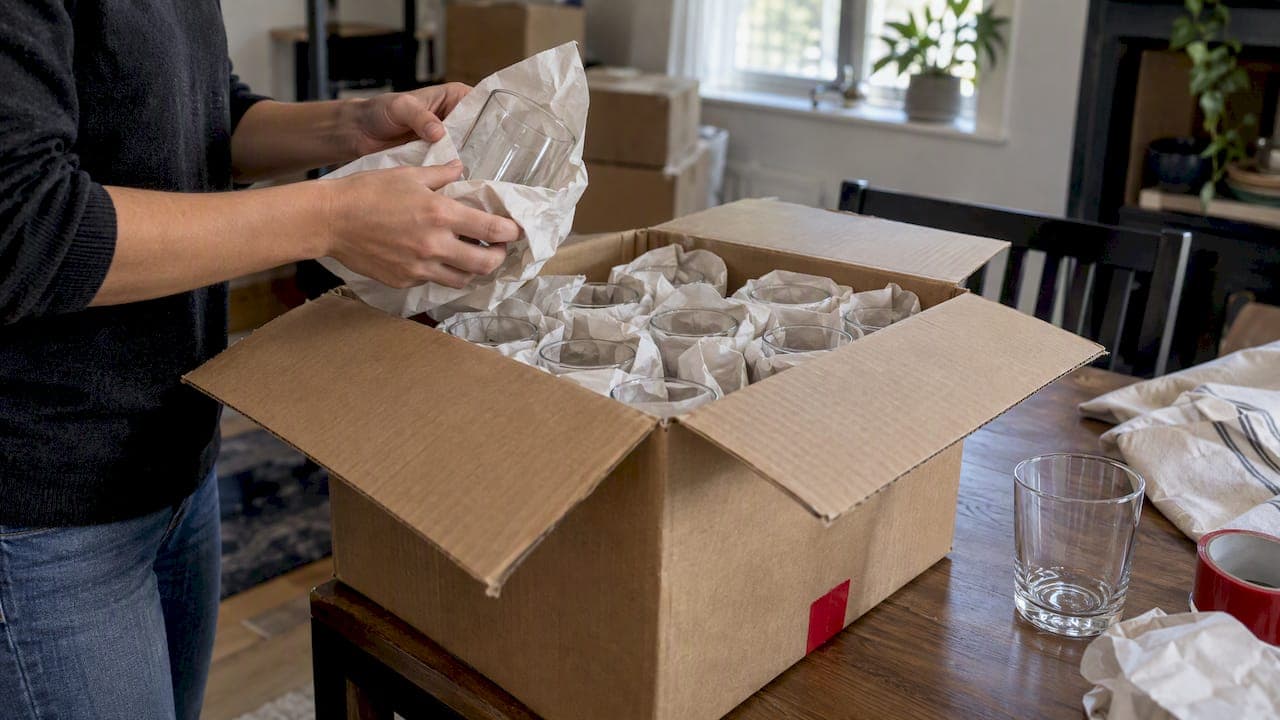
Glasses break in a move for three reasons: the box is too weak, the glass has room to move, or the box gets laid on its side. Fix those three and most of the risk goes away. Use a sturdy box, wrap every glass on its own, stand it upright, and leave no empty space. The steps below cover everyday tumblers, wine glasses, mugs and plates, and what to do when you would rather not pack them yourself.
TL;DR
- Use a strong box built for glassware (a dish pack or a small, sturdy carton), with a padded bottom and a properly taped base.
- Wrap each glass individually, stuff the inside with crumpled paper, and stand it upright. Never lay glasses on their sides.
- Pack plates on their edge, not flat, and put stemware in last, near the top, with extra cushioning above it.
- Fill every gap so nothing shifts, tape the box shut, and label two sides as fragile with the room and contents.
- If you have a lot of glassware, or little time, packing help costs less than replacing a broken set.
Table of Contents
- What you need before you start
- Prepare the box properly
- Pack everyday drinking glasses step by step
- Wine glasses and other stemware
- Mugs, cups and anything with a handle
- Plates and bowls: a different method
- Fill, seal and label the box
- Extra protection for glass you cannot replace
- Getting boxes loaded and carried safely
- Our perspective: where glassware actually breaks
- Let our packers handle the kitchen
- Unpacking glassware
- A glass-packing timeline that works
- Common mistakes to avoid
- FAQ
- Sources
What you need before you start
Gather everything first. Stopping halfway through a kitchen to hunt for tape is how glasses end up stacked on the counter with nothing between them.
- Boxes. The Canadian Association of Movers recommends stronger-walled barrels or dish packs for glassware. A dish pack is a heavy-duty double-wall carton made for exactly this job. If you use regular small boxes, choose new or very firm ones, never a soft, reused box that has already carried books.
- Packing paper. Plain, unprinted paper is the best option. Newsprint works but the ink rubs off on glass and hands, so wash the glasses after unpacking, or use clean newsprint ends.
- Bubble wrap or foam pouches. Useful for your best pieces. The Spruce points out that bubble wrap can be pricey and hard to recycle, and that towels or newsprint do the job for free on everyday items.
- Towels, tea towels or blankets. These pad the bottom and fill gaps, and they are things you are moving anyway.
- Cell dividers. Cardboard dividers are optional for stemware and good for a large set of identical glasses.
- Packing tape and a marker. Buy more tape than you think you need.
A practical rule: pick one room, clear one counter and pack in one session. A kitchen packed in scattered 10-minute bursts is the one with the missing lids and the half-wrapped glass nobody remembers.
Prepare the box properly
A box can fail from the bottom long before a glass does. The Canadian Association of Movers advises taping the base with three strips along the seam, plus two strips running perpendicular to it. That holds the flaps together under the weight of a full box of glassware.
Then build a cushion:
- Tape the bottom as described.
- Crumple several sheets of paper and lay a 5 to 8 cm (2 to 3 inch) layer across the floor of the box. A folded towel or blanket also works.
- Keep a stack of paper within reach so you can pad as you go, not after.
Do not pick a box that is too big. Glassware is dense, and a large box of it becomes heavy fast. Smaller boxes are easier to carry and less likely to be dropped, tipped or stacked under something heavy.
Pack everyday drinking glasses step by step
This is the core method for tumblers, juice glasses, highball glasses and water glasses.
- Stuff the inside. Crumple a sheet or two of paper and push it into the glass so it is supported from within. The Home Depot's packing guide suggests this for every glass.
- Wrap the glass. Place the glass at one corner of a sheet of paper, roll it diagonally, tucking in the sides as you go. Finish with a second sheet for another layer, especially around the rim, which is the thinnest and most fragile part.
- Seal the bundle. A small piece of tape stops the wrap from unrolling in the box.
- Stand it upright. The Canadian Association of Movers is clear that glasses and stemware should be wrapped individually and placed upright, not laid down. A glass is strongest when force travels down its walls, and weakest when pressure hits the side.
- Pack in rows. Line the glasses up in rows with paper between them. The heaviest glasses go on the bottom layer.
- Fill every gap. Push crumpled paper into every space so the glasses fit snugly and cannot knock against each other.
- Add a layer and repeat. Put a sheet of paper or a flattened piece of cardboard across the top of one layer before starting the next. Keep lighter pieces higher.
A quick test before you close the box: lift it slightly and tilt it a little. If you hear or feel anything shift, open it and add more paper.
Wine glasses and other stemware
Stems snap before bowls do, so stemware needs its own routine.
- Wrap the stem first. The Spruce suggests wrapping the stem with half a sheet of paper, then rolling the rest of the glass in more paper. That gives the thinnest part the most protection.
- Stuff the bowl with crumpled paper, as with tumblers.
- Add a layer of bubble wrap or a foam pouch for crystal and glasses you cannot replace.
- Use dividers or well-padded rows. For a set of eight wine glasses, cell dividers keep each one in its own space.
- Pack them last. The Spruce also advises putting stemmed glasses in last, leaving room for extra cushioning at the top. Stemware belongs on the top layer, never underneath plates or heavier dishes.
- Keep them upright. Even in a box with dividers, bowl up, stem down.
Champagne flutes are the most delicate of the lot because they are tall and narrow. Wrap each one twice and put them in the middle of a row, not against the box wall.
Mugs, cups and anything with a handle
Handles are the weak point on mugs, teacups and pitchers. Wrap the handle separately with a small piece of paper before wrapping the whole piece, as the Home Depot guide describes. Then wrap the body, stuff the inside and stand it upright. If you have lots of mugs, you can nest a few only when each is individually wrapped and there is paper between layers.

Plates and bowls: a different method
People searching how to pack dishes often assume the glass method applies. It does not. Plates are strongest on their edge, and glasses are strongest upright.
The Canadian Association of Movers says to pack plates on their edges with at least three pieces of paper between each dish, then wrap three or four together as a pack. In practice:
- Lay a stack of paper on the counter.
- Place a plate on it, add paper, then the next plate, until you have a bundle of three or four.
- Wrap the bundle and tape it.
- Stand the bundle on its edge in the box, like records in a crate, not stacked flat.
- Fill the gaps at the sides and top with paper or towels.
Bowls follow the same logic: wrap each individually, or nest two or three with paper between them, and stand them on their rims where possible. Put plates and bowls on the bottom layers of the box and keep the glasses above them, or use separate boxes altogether if you have a lot.
| Item | How it sits in the box | Wrapping | Where in the box |
|---|---|---|---|
| Tumblers and water glasses | Upright | Stuff inside, wrap individually | Middle layers |
| Wine glasses and stemware | Upright | Wrap stem first, then bowl, add padding | Top layer, with space above |
| Mugs and cups | Upright | Wrap handle, then body | Middle layers |
| Plates | On edge | 3 or 4 wrapped as a bundle, paper between each | Bottom layers |
| Bowls | On rim or nested with paper | Wrap individually or in small nests | Bottom or middle |
Fill, seal and label the box
A half-empty box collapses and a box with a bulging lid crushes what is inside. The goal is a firm, flat top.
- Fill to the top. The Canadian Association of Movers recommends filling boxes fully and checking the lid: if the top sinks more than an inch when you press it, add a blanket or towel.
- Tape it shut with the same strong seal you used on the bottom.
- Label two sides, not the top. The same guidance says to mark two sides with the room and basic contents and to mark fragile boxes as fragile. Stacked boxes hide their lids, so side labels are the ones that get read.
- Add an arrow. The Home Depot suggests a large arrow on fragile boxes showing which way is up. This matters more for glassware than for almost anything else you own.
- Write the destination room (for example, "Kitchen: glasses") so your helpers can put it down where it will be unpacked.
For fragile cartons of any kind, from glassware to a humidor that needs careful transport, the principle is the same: mark which way is up and make sure whoever carries it knows.
Extra protection for glass you cannot replace
For heirloom crystal, a boxed set or a gift you would be heartbroken to lose, go a level up:
- Wrap each piece in paper, then bubble wrap or a foam pouch.
- Place the wrapped pieces in a small box with padding on every side.
- Put that small box inside a larger one, with cushioning of crumpled paper or towels between the two. This double-boxing means a drop on a corner hits the outer box first.
- Mark the outer box fragile on all sides and keep it with you if you are moving yourself, in the cab or back seat, rather than at the bottom of a loaded truck.
If the piece is valuable, take a quick photo of it before packing. It helps if you need to describe or document it later. Our house moving checklist walks through logging items before a move.
Getting boxes loaded and carried safely
Packing is half of the job. The other half is how the boxes travel.
- Load glass boxes last and unload them first where you can, so they are never at the bottom of a stack.
- Put them on top of heavier, flat-topped boxes, never beneath something heavy. Boxes of books, tools and canned goods go on the floor of the truck.
- Keep them upright and wedged so they cannot slide on turns and braking.
- Keep paths clear. A tripped carrier is a broken box. Our guide to preparing for movers explains why clear access matters for safe handling and for your schedule.
- Tell the crew which boxes hold glass, before they pick them up, not after.
If you are moving to storage, even a short stay, the same rules apply, and glass should sit on top of the stack. Our pages on moving into storage and storage in transit cover how to plan that.
Our perspective: where glassware actually breaks
We move households across Abbotsford and the Fraser Valley, and the pattern with glassware is consistent. Glasses rarely break because the wrapping was thin. They break because the box was soft, half-filled or labelled on the lid only, so it was set down on its side or stacked under something heavy.
That is why we tell customers to spend their effort on three things: a firm box, a full box and clear side labels. A perfectly wrapped glass in a loose box still rattles. A tightly packed box with plain paper survives most moves.

We also see people leave the kitchen until the final night. Kitchens take longer than any other room because every piece is small, breakable and needs individual attention. If you can only pack one room early, make it this one. If you would rather not, that is what our packing team is for, and clear communication up front means you know what is being wrapped, what is being boxed and where it is going.
One more habit worth copying: keep a few unpacked essentials (two glasses, two mugs, a plate each) in a labelled box that travels last and comes off first, so day-one dinner does not depend on finding the right box.
— Jack W.
Let our packers handle the kitchen
If you have a large glassware collection, a cabinet of china or just no time, our packing services in Abbotsford cover the whole job: wrapping, boxing, loading and unloading. We also move homes, apartments, condos and offices across Abbotsford, Mission, Maple Ridge and Langley, locally and long distance within BC. Pricing depends on distance, size and the services you need, so we quote each move individually. Ask for a quote on our Abbotsford moving page and tell us what you want packed.

You can also pair packing with our loading and unloading services if you prefer to box things yourself and leave the heavy lifting to the crew.
Unpacking glassware
Unpack glass boxes early, not last. Resting for weeks under other boxes and being opened in a hurry are both ways to lose a glass at the end of the move. Some movers also recommend unpacking fragile items quickly after arrival so they spend less time under pressure from other boxes.
A few habits help:
- Clear a surface first. Lay out a towel on the counter and unwrap each piece over it.
- Unwrap gently. Check the paper for a hidden handle or stem before you crumple it.
- Wash before use. Newsprint ink and dust from storage come off in warm soapy water.
- Keep the boxes. A good glass carton is worth keeping for the next move or for storing seldom-used stemware.
- Count and check. Note any breakage straight away and, if you hired movers, tell them promptly so it can be sorted out.
A glass-packing timeline that works
You do not need to start months early, but you do need to spread it out.
- One to two weeks before: Pack the glasses and dishes you rarely use: formal glasses, serving platters, decorative pieces.
- Three to five days before: Pack the bulk of daily dishes, keeping one setting per person.
- The day before: Pack the last glasses and mugs, tape and label every box, and leave the essentials box where you can find it.
- Moving day: Tell the crew where the fragile boxes are, and carry the most valuable piece yourself.
For a wider plan covering every room, our apartment moving checklist lays out what to do and when.
Common mistakes to avoid
- Laying glasses flat or stacking them inside each other without paper.
- Packing plates flat in a pile.
- Using an old, soft or oversized box.
- Leaving gaps and hoping the lid holds everything in place.
- Labelling only the top of the box.
- Putting the glass box under a box of books.
- Rushing the last box of the night, which is nearly always the one with the best crystal.
FAQ
What is the best way to pack glasses for moving?
Wrap each glass individually in packing paper, with crumpled paper stuffed inside, and stand it upright in a strong, padded box. Fill every gap so nothing shifts, and mark the box as fragile on two sides. Upright packing is what the Canadian Association of Movers recommends for glasses and stemware.
What is the best material to pack glasses in?
Plain packing paper handles most glasses well, and bubble wrap or foam pouches add protection for crystal and good stemware. Towels, tea towels and blankets are free and fill gaps and pad the bottom of the box. Choose the box over the wrapping: a strong dish pack matters more than any single material.
How do you pack plates so they do not break?
Pack plates on their edges, not flat. Put at least three pieces of paper between each plate, wrap three or four together, and stand the bundle on its edge in the box with paper filling the sides and the top. Heavier plates go on the bottom layer.
Should I pack glasses myself or hire packers?
If you have a few boxes of everyday glasses and some time, packing yourself is fine with the method above. If you have a large collection, fragile or valuable pieces, or a short timeline, hiring packers saves time and reduces breakage risk. We offer packing services across Abbotsford and the Fraser Valley.
Sources
- Safe Packing, Canadian Association of Movers
- How to Pack Dishes and Glasses, The Home Depot
- How to Pack Glasses When Moving, The Spruce