
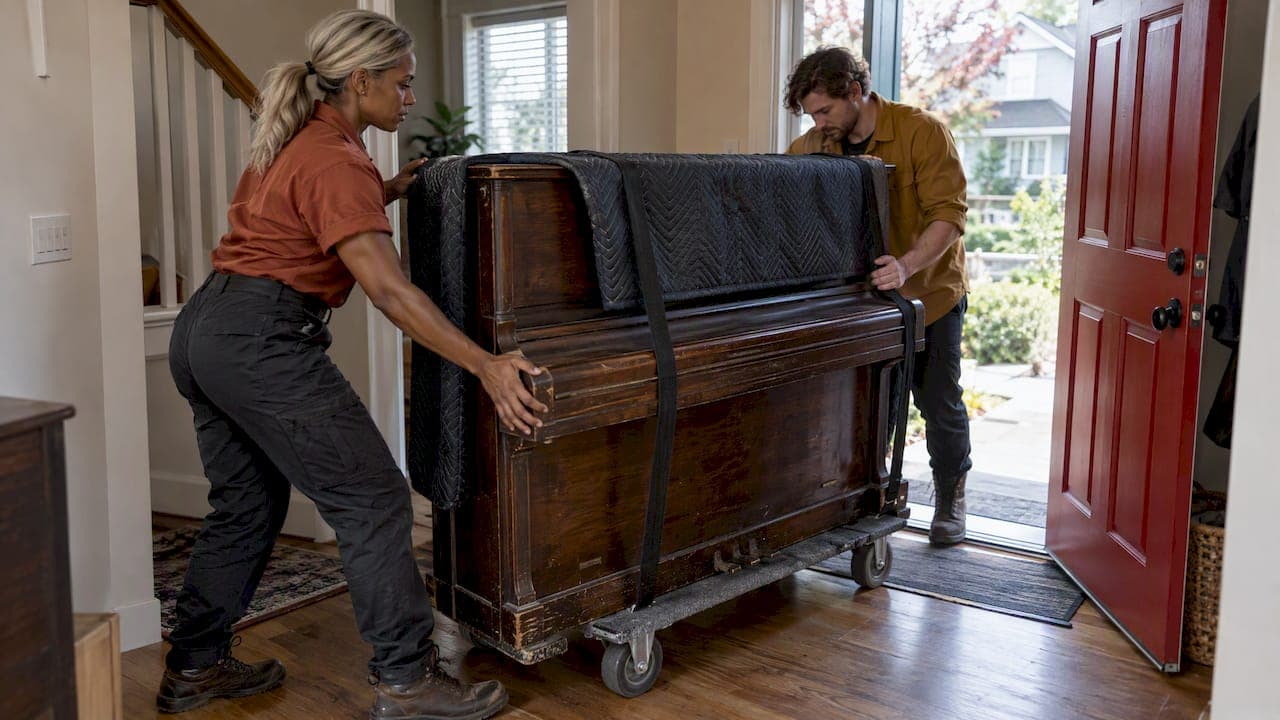
The safest way to move a piano is to have professional piano movers do it, and to prepare the route, the room and the instrument before they arrive. A piano is heavy, top-heavy at the back and full of delicate parts, so small mistakes with stairs, straps or a dolly can injure people, scar floors and knock the instrument out of tune. This guide walks through how a careful piano move works, what to prepare, how stairs and tight turns are handled, and how to look after the piano once it is in its new home.
TL;DR
- Professional piano movers are the recommended option for any piano, because an upright's weight sits toward the back and can make it dangerously unbalanced.
- Measure the whole route first: doors, hallways, turns, stairs and the spot where the piano will sit.
- Never roll an upright on its small castors. Use a proper dolly or trolley, pads and straps.
- Protect floors, secure the lid and loose parts, and keep the piano strapped for the whole trip.
- After the move, let the piano settle, keep humidity steady and book a tuning with a technician.
Table of Contents
- Why pianos are different from other furniture
- Can you move a piano yourself?
- What a safe piano move needs
- Before moving day: preparation that prevents most problems
- Moving day: how an upright piano is handled
- Stairs, tight turns and other obstacles
- Grand pianos, spinets and digital pianos
- After the move: settling and caring for your piano
- How to choose piano movers
- Moving a piano with us
- FAQ
- Sources
Why pianos are different from other furniture
A sofa or dresser is bulky. A piano is bulky, dense and fragile at once. Inside the case is a heavy iron frame holding strings under high tension, a keyboard, hundreds of moving action parts and a finished wooden exterior that marks easily.

The Pianoforte Tuners' Association explains that an upright's heavy iron frame puts its centre of gravity near the back, which is why uprights can be dangerously unbalanced during a move. The same body recommends hiring a professional piano mover for any piano, and says uprights should be lifted and moved on a trolley rather than wheeled on their small decorative castors.
That last point is the one most people get wrong. Those little wheels were designed for nudging a piano a few centimetres across a room, not for travelling down a hallway, over a threshold or across a driveway.

Can you move a piano yourself?
Sometimes, in a narrow set of cases. The Canadian Conservation Institute notes that keyboard instruments are heavy and awkward, with detachable or loose parts. For a move on the same floor or within one building, handling it without professionals may be possible if all loose or movable pieces are secured, the route has been checked in advance and a padded dolly with smooth-running wheels is used. The instrument's own casters should not be relied upon. For long-distance moves, the same guidance does not advise going without professional help.
That tells you where the line sits. If your piano has to go up or down stairs, through a tight turn, into a truck or across town, you are no longer in the "same floor" situation. A fall on a staircase is the worst outcome, and it can hurt the people lifting as much as the piano.
If you are weighing it up, ask yourself:
- Are there any stairs, steps, ramps or tight corners between the piano and the truck?
- Do you have enough capable people to lift safely, plus someone to guide and watch the route?
- Do you have a real piano dolly, straps and pads, not a household hand truck?
- Is the piano valuable, old or sentimental enough that damage would be hard to accept?
If any answer worries you, book piano movers. Our piano moving page explains how to request a quote for yours.
What a safe piano move needs
Whether professionals or a very experienced group handle it, the kit is similar. Better Homes & Gardens lists a measuring tape, a ramp or lift, a suitable dolly, floor protection, moving blankets, padding, tape, gloves, closed-toe shoes, lifting straps and ratchet straps.
Here is why each piece matters:
| Item | What it does |
|---|---|
| Measuring tape | Confirms the piano fits through every door, turn and landing |
| Piano dolly or trolley | Carries the load on proper wheels instead of the piano's castors |
| Moving blankets and padding | Protect the finish, corners, legs and pedals |
| Lifting straps | Spread the load and give the team secure hand positions |
| Ratchet straps | Hold the piano to the dolly and to the truck wall |
| Floor protection | Stops dolly wheels and heavy feet from scarring hardwood, tile or carpet |
| Gloves and closed-toe shoes | Keep hands gripping and feet protected |
| Ramp or lift | Handles steps and the truck height without lifting by hand |
The same article warns that a sudden stop can fling a piano off a dolly, and that dolly wheels can scar floors. So the answer is to protect the route and strap the piano to the dolly every time it rolls.
Before moving day: preparation that prevents most problems
Measure everything
Measure the piano's width, depth and height. Then measure every door frame, hallway width, stair width and landing on the route, plus the room it is going into. Pay particular attention to turns: a piano that clears a hallway may not clear it at a corner, especially where a banister or a door swing narrows the path.
Tell your movers what you found. Details about the type of piano, its approximate size and any difficult spots let them bring the right crew and equipment. It also helps to mention anything unusual, such as a spiral stair, a steep driveway or a condo elevator with booking times.
Clear the route
Remove rugs, floor lamps, shoes, plants and anything that could catch a foot or a wheel. Prop doors fully open. If it has rained, put down mats or sheeting so wet shoes do not make a smooth floor slick. For apartments and condos, ask your building manager about elevator reservations and loading zones in advance. Our guide on preparing for movers in Canada explains how blocked access can delay a move, and that applies doubly to something as slow to handle as a piano.
Secure the piano itself
- Close and lock the keyboard lid so it cannot swing open or slam on fingers.
- Remove loose items such as music books, metronomes, lamps and photo frames from the top.
- If the bench has a hinged lid, empty it and tape or strap it closed. Move the bench separately and pad it.
- Do not use tape directly on the finish. Tape holds blankets to blankets, not to varnish.
- Wrap the piano in several layers of blankets so the corners, which take most knocks, are well padded.
The Canadian Conservation Institute's advice to secure all loose or movable parts applies directly here. A lid that opens halfway down a flight of stairs is a real hazard.
Plan the destination
Decide in advance where the piano will sit. Moving it twice in the new home is a good way to scratch a floor. Keep it away from exterior doors, heating vents, radiators, fireplaces and direct sun, which we cover in the aftercare section below.
Moving day: how an upright piano is handled
An upright is moved in a specific order. The details vary with the model, but the sequence is consistent.
- Wrap and pad. Blankets go on first, secured so they do not slip. The lid is locked, and fragile parts such as pedals and legs are covered.
- Tilt and slide the dolly in. The piano is tipped slightly by a team, and a padded dolly is slid beneath it. Nobody should be lifting alone or using their back instead of their legs.
- Strap it down. The piano is strapped to the dolly before it moves, so a bump or stop cannot send it sideways.
- Roll with a spotter. One person steers, another watches the route and clearances, and a third handles doors. Move slowly and avoid sudden turns.
- Ramp or lift into the truck. Pianos should be rolled up a ramp or raised with a lift gate, not hoisted by hand.
- Secure in the truck. The piano rides upright against the truck wall, padded and strapped so it cannot shift. Good securing practice is general across transport. For a look at how drivers think about tie-downs and inspections, see this overview of load securement requirements, which is written around US fleets but shows the thinking behind checking straps and anchor points.
- Reverse at the other end. The same care applies unloading, with floor protection down before the piano comes off the truck.
An important detail: pianos ride with other cargo only if they have their own padded, strapped space. Loose boxes beside a piano can crush a pedal or scratch a side panel when the truck brakes.
Stairs, tight turns and other obstacles
Stairs are where piano moves go wrong. A few principles hold for any crew:
- Remove the dolly on stairs. Rolling stops being an option, so the piano is carried one step at a time by a coordinated team, with a person above and below. This is slow by design. Rushing is what causes drops.
- Use straps to share the load. Lifting straps spread the weight across shoulders and give the team a firm grip, instead of fingers under the case.
- Talk constantly. One person calls each step. Everyone moves on the call, and nobody moves if the call is unclear.
- Keep the heavy end in mind. An upright's weight is toward the back, so the team must know which side is heavier before they start.
- Do not stand downhill. Nobody should be positioned where they could be pinned if the piano slips.
- Pause at landings. Rest, reset footing, and check the next turn before moving.
For tight turns, pros may tilt the piano and pivot it on its dolly. If the turn is still too tight, the options are removing a door from its hinges, taking off a banister section, or sometimes using a window or balcony. Those are decisions to make with experienced movers on a walkthrough, not on the day with a piano half-way through a doorway.
Outdoor steps, steep driveways and wet weather add risk. The Fraser Valley gets a lot of rain in the cooler months, so plan for wet ramps and slippery steps, and ask your movers how they handle them. Sheeting, mats and extra hands all help.
Grand pianos, spinets and digital pianos
The advice above is about uprights, the most common home instrument. Grand pianos are a different job: the legs and pedal lyre are typically removed, and the instrument is moved on its side on a padded board. That is specialist work and a clear case for hiring professionals. Digital pianos are far lighter but still need a firm case, the stand disassembled and cables packed separately.
If you are unsure what your instrument needs, tell your movers the make, model and approximate age when you ask for a quote. Older or antique pianos can have more fragile finishes and parts, which is why our blog on antique furniture moving in Abbotsford is worth a read if yours has been in the family for decades.
Our perspective on piano moves
We treat a piano as a job in its own right, not as an oversized piece of furniture. The questions we want answered before moving day are simple: what kind of piano is it, where is it now, what is between it and the truck, and where is it going?
Most of the trouble we hear about comes from the same few places: stairs nobody measured, a piano rolled on its own castors, or a lid that was never secured. Planning the route and the crew ahead of time removes most of that risk.
For our customers across Abbotsford, Mission, Maple Ridge and Langley, we think the best piano move is a quiet one: a clear route, padded surfaces, straps on, no rush, and clear communication with the customer from quote to unloading. That is what we aim to deliver.
Jack W.
After the move: settling and caring for your piano
Getting the piano through the door is not the end of the job. Moving changes its environment, and pianos react to environment.
Yamaha Canada says 40 to 45% relative humidity is generally ideal and cautions against sudden temperature changes and excessive dryness. It also warns that sudden temperature swings can cause condensation on strings and other metal parts, rust and dampened felt action. That matters in a Canadian winter, when a piano coming off a cold truck into a warm house is exposed to exactly that swing.
A few practical steps:
- Let it acclimatize. Keep the piano wrapped for a short time after it comes inside on a cold day so the temperature changes gradually. Ask your movers how they handle winter moves.
- Choose its spot carefully. Keep it off exterior walls where possible, away from vents, radiators, fireplaces, drafts and strong direct sunlight.
- Watch the humidity. A simple hygrometer in the room shows whether you are near the recommended range. Dry winter air from forced heating is a common problem.
- Book a tuning. Yamaha says tuning and adjustment should be done by an expert and that strings should be tuned at least twice a year. A move is a good time to book a technician, though many suggest waiting a few weeks so the instrument settles first.
- Check the floor. Heavy pianos can dent soft flooring over time. Felt pads or cup casters spread the load.
How to choose piano movers
When you collect quotes, ask the same questions of each company:
- Do you have crews experienced with pianos, and with the type of piano I own?
- What equipment do you bring: piano dolly, ramp or lift gate, straps, pads?
- How do you handle stairs, tight turns and elevators?
- How will the piano be secured in the truck?
- What is covered if something is damaged, and what is the written process?
- How is the job priced: by distance, size, difficulty and services required?
Pricing for moves generally depends on distance, size and services such as packing or specialty items, so give as much detail as you can. Photos of the piano and the route help, and a short walkthrough call can prevent surprises on the day.
If you are also moving other heavy or fragile items, such as a pool table or artwork, mention them at the same time so the crew and truck can be planned properly. Our guides on moving a pool table and packing artwork for a move cover the preparation for those.
Moving a piano with us
We are an Abbotsford-based moving company serving Abbotsford, Mission, Maple Ridge, Langley and the wider Fraser Valley, with residential, commercial, local and long-distance moves within BC. Piano moving is one of the services we offer, and we plan it around your route, your piano and your timeline. If your date is close, last-minute help is available too.

To request a quote, start on our piano movers page, or visit our Abbotsford moving services to see everything we handle, from local moves to packing. Tell us the type of piano, where it is, where it is going and what the stairs look like, and we will take it from there.
FAQ
Can you move a piano yourself?
It is possible for a short move on the same floor, if loose parts are secured, the route is checked and you use a padded dolly with smooth-running wheels. The Canadian Conservation Institute does not advise long-distance piano moves without professional help. Stairs, tight turns and truck loading are the points where most people should hire piano movers.
What is the best way to move an upright piano?
Have professionals do it. They wrap the piano, lock the lid, strap it to a proper dolly, use a ramp or lift for the truck and secure it against the truck wall. The piano should never be rolled on its own castors, because an upright's weight sits toward the back.
Can you roll a piano on its own wheels?
Only for a very short nudge on a smooth floor, such as adjusting its position in a room. The Pianoforte Tuners' Association says uprights should be lifted and moved on a trolley, not wheeled on small decorative castors, because they can become unsafe and unbalanced.
How soon should you tune a piano after moving it?
Move it, let it settle in its new room, then book a technician. Yamaha says tuning and adjustment should be handled by an expert and recommends tuning at least twice a year. Ask the technician how long to wait, particularly after a move in cold weather.
What should I tell piano movers before the move?
Give them the type of piano, its approximate size, its current location, and every stair, turn, elevator or tight space between it and the truck. Photos help. The more detail they have, the better they can plan the crew and the equipment.
Sources
- Basic care – Keyboard instruments, Canadian Conservation Institute (Canada.ca)
- How to Move a Piano Safely and Without Damage, Better Homes & Gardens
- Piano moving, Pianoforte Tuners' Association
- Caring for your Piano, Yamaha Canada