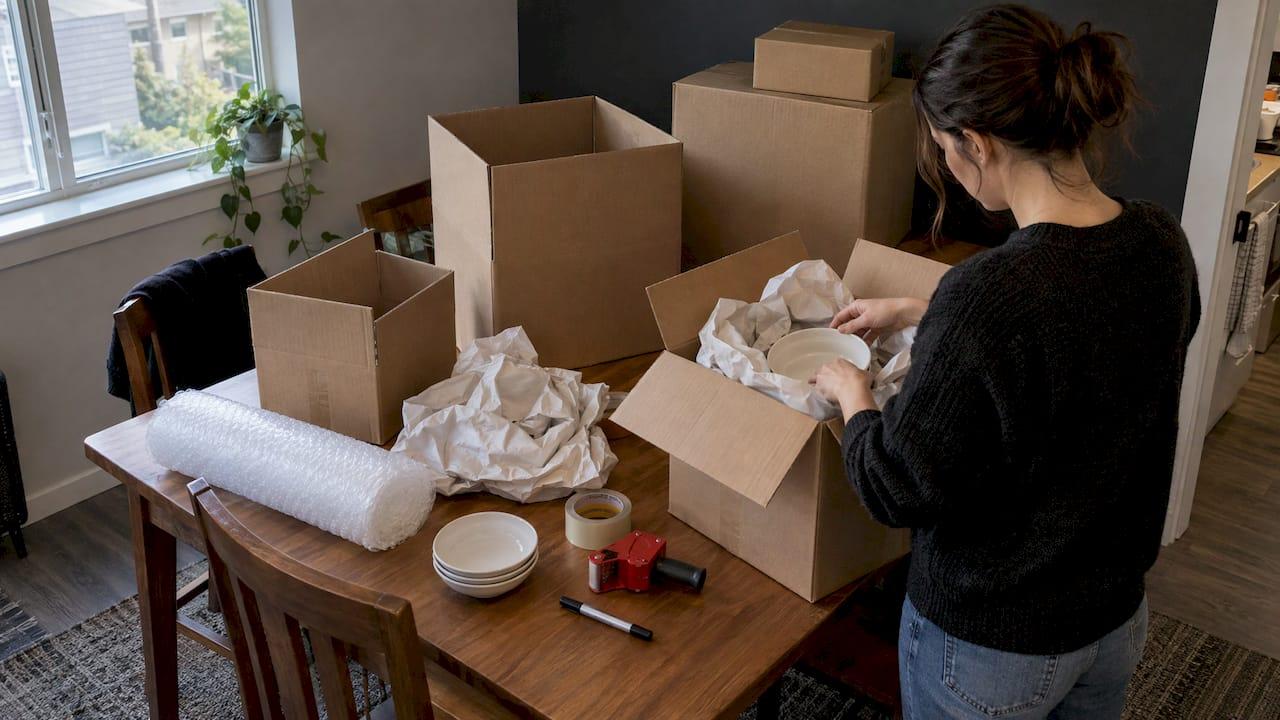
For most household moves you need five things: boxes in mixed sizes, strong packing tape, packing paper, bubble wrap and a marker for labels. Everything else on a longer list is optional or depends on what you own. If you would rather not buy, pack and carry it all yourself, our packing services in Abbotsford take the job off your hands.
This guide gives you the full list in order of priority, the box types and what goes in each, how to protect fragile things, how to avoid overbuying, and how to get materials without overspending in British Columbia.
TL;DR
- The must-haves are boxes, packing tape, packing paper or bubble wrap, and labels or markers. Add the rest only when your belongings call for it.
- Use small boxes for books and heavy items, medium boxes for kitchen and general goods, and large boxes only for light, bulky things.
- Wrap fragile items individually, fill every gap, and label each box on more than one side.
- Buy boxes in a mix of sizes, and expect to buy more tape than you think you need.
- If packing is the part you dread, we pack, load and unload for you across Abbotsford and the Fraser Valley.
Table of Contents
- The essential packing supplies list
- Moving box types and what goes in each
- Packing materials for different items
- Why Canadian weather matters for your boxes
- How many supplies do you need?
- How to pack fragile items
- What not to pack in boxes
- Where to get packing supplies affordably
- When it makes sense to let us pack
- Our view on packing supplies
- FAQ
- Sources
The essential packing supplies list
The short list comes from Move.org's supply guide, which names boxes, packing tape, bubble wrap or packing paper, and labels or markers as the must-haves. Optional items include furniture sliders, plastic stretch wrap, mattress bags and specialty boxes. If you are on a budget, start with the must-haves and add extras only when you really need them.
Here is the list in the order most households need it.
Core materials
| Supply | What it does | Notes |
|---|---|---|
| Moving boxes (small, medium, large) | Hold everything | Buy a mix of sizes, not one size |
| Packing tape | Seals boxes | Buy more than you think you need |
| Packing paper | Wraps dishes, glassware, ornaments | Cleaner than old newspaper |
| Bubble wrap | Cushions fragile and valuable items | Combine with filler so items do not shift |
| Markers and labels | Tell movers and you where each box goes | Label more than one side |
| Box cutter or scissors | Opens and trims | Keep one in your overnight bag for unpacking |
Useful additions
- Stretch wrap: keeps drawers shut, bundles loose items and secures trays and organizers.
- Moving blankets or furniture pads: protect wood finishes and corners.
- Mattress bags: keep bedding surfaces clean during transit.
- Wardrobe boxes: let you move hanging clothes without folding.
- Zip-top bags or small containers: hold screws, bolts and small hardware from furniture you take apart.
- Garbage bags: handy for soft items like towels and linens, and for the rubbish a move generates.
- Basic tools: a screwdriver, wrench, tape measure and utility knife for disassembling and reassembling furniture.
- Work gloves, a dolly or a hand truck: useful for heavy loads if you are carrying boxes yourself.
- Cleaning supplies: for wiping out cupboards and appliances at both ends.
That extended list matches what Canadian moving-supply retailers publish. One of them also adds floor protection or runners for wet, snowy or high-traffic conditions, which matters on a Fraser Valley winter move. If your hallway floors are a concern, our guide to protecting floors when moving covers the options.
Moving box types and what goes in each
Using the right box for the right contents is the single biggest factor in whether things arrive intact and whether you can lift the box at all. A good rule: the heavier the item, the smaller the box.
Small boxes: books and heavy items
Books, tinned food, tools, records and files go into small boxes. A large box of books becomes too heavy to lift safely and strains the cardboard. A typical small book box holds about 1.5 cubic feet. For example, one Canadian supplier lists a 1.5 cubic foot small moving box rated 32 ECT, about 16 1/2 by 12 5/8 by 12 5/8 inches, and priced at $2.79. The ECT number is the edge crush test rating, a measure of how much stacking pressure the cardboard can take. For books, choose a rated, double-walled or sturdy box rather than a flimsy free one.
Pack books flat, spine alternating, with spare space filled by paper, and tape the bottom with extra strips. Stop when the box is still easy to lift.

Medium boxes: the everyday workhorse
Kitchen items, small appliances, toys, shoes, pots and décor fit best in medium boxes. Most households need more of these than any other size.
Large boxes: light and bulky
Pillows, duvets, lampshades, cushions and stuffed toys belong in large boxes. Keep anything heavy out of them.
Specialty boxes
- Dish packs: thick-walled boxes, often with dividers, for plates, bowls and glasses. Our guide to packing glasses without breaking them goes into the technique.
- Wardrobe boxes: a built-in rail for hanging clothes.
- Mirror and picture boxes: flat, telescoping cartons for frames and glass. See our guide to packing artwork, canvas and mirrors.
- TV boxes: if you no longer have the original packaging, a purpose-made TV box is worth the cost.
- File boxes: for documents, which you should carry yourself if they are important.
Packing materials for different items
Different materials do different jobs. Here is how to use them well, based on Today's Homeowner's guide to packing materials.
- Packing paper: biodegradable and affordable. Plain paper is better than newspaper, which is thinner and can bleed ink onto your belongings.
- Bubble wrap: excellent for fragile items, but it works best combined with other materials so things do not shift inside the box.
- Packing peanuts: fill gaps and protect against humidity.
- Plastic stretch wrap: best for furniture with drawers, and for securing organizers and trays.
- Garbage bags: useful for clothes, linens, towels and anything that might leak, since the bag contains spills.
- Thick clothing: sweaters, hoodies and sweatpants make affordable, eco-friendly padding. Skip thin or delicate garments, and expect to need extra boxes because clothing takes more room.
If you want to reduce waste, our eco-friendly moving guide for Abbotsford has more ideas on reusing materials.
Why Canadian weather matters for your boxes
Box strength is not just about size. Custom Boxes Canada notes that cold temperatures can make cardboard brittle and humidity can weaken adhesives. That is a real consideration on a wet November or January move in the Fraser Valley.
Practical consequences:
- Store boxes indoors in a dry spot before packing day, not in a damp garage.
- Use enough tape, and apply it across the bottom seam and along both edges.
- Do not leave packed boxes sitting on a wet driveway or porch.
- Choose sturdier boxes for heavy loads rather than reused boxes that already look soft at the corners.
How many supplies do you need?
A household's needs depend on the number of rooms, how much you own and how much you plan to throw out first. Our room-by-room guide to how many moving boxes you need gives the estimates by home size. Some rules of thumb that hold across households:
- Declutter first. Every item you donate or discard is a box you do not buy.
- Count by room, then add a margin. Kitchens and storage areas always need more boxes than you guess, and books fill up small boxes fast.
- Buy tape for the whole move. Running out halfway through packing is the most common supply mistake, and one roll covers fewer boxes than you expect.
- Buy paper and bubble wrap in stages. Pack one room, see what you used, then top up.
- Keep a spare few boxes in each size. Last-minute items always turn up.
A simple order of work helps. Start with rooms you use least, such as the spare room and the basement, then do the kitchen, then bedrooms. Leave the daily-use items for last. Our house moving checklist lays out an eight-week plan to keep that order, and it also helps you log and protect your items.
How to pack fragile items
Fragile items need three things: individual wrapping, a firm box and no empty space.
- Line the bottom. Put a layer of crumpled paper or bubble wrap in the base.
- Wrap each piece separately. Plates, glasses and bowls should each get their own sheet of packing paper, with bubble wrap for anything valuable.
- Place heavy items at the bottom. Lighter, more delicate things go on top.
- Fill every gap. Items that shift will chip or crack. Crumpled paper, towels or soft clothing work as filler.
- Shake test gently. If you hear movement, add more padding.
- Seal and label. Mark the box as fragile on the top and at least one side, and write the room it belongs in.
Labels make unloading much faster. Mark each box on at least two sides and consider colour-coding by room, so whoever carries the box can see its destination from any angle.
What not to pack in boxes
Keep documents, passports, medication, jewellery, laptops and chargers with you. Do not pack flammables, propane or cleaning products that can leak. Keep a first-night box with toiletries, a change of clothes, basic tools, phone chargers and a kettle or coffee supplies. Also see our guide to how to prepare for movers in Canada, since clear access on moving day affects timing.

Where to get packing supplies affordably
New boxes are the most reliable, but you can save money without compromising protection. 1-800-GOT-JUNK reports that free boxes in Canada can turn up at local stores, big-box retailers, online community groups and recycling centres. It puts standard cardboard boxes at roughly $1.00 to $5.00 each and wardrobe boxes at $12.00 to $20.00. These are retail ranges that vary by supplier and size.
Tips for stretching your budget:
- Use free boxes for light items such as bedding and clothing, and buy rated boxes for books and kitchenware.
- Check that free boxes are clean, dry and uncrushed. Boxes from food stores can carry odours or pests.
- Use towels, blankets and cushions as padding, since you are packing them anyway.
- After the move, flatten and store boxes in a dry, cool place, or donate them locally so they get a second life.
When it makes sense to let us pack
Buying supplies, packing carefully and loading a truck takes days of effort, and it is easy to misjudge quantities. If you have a tight timeline, a large home, a lot of fragile items or heavy furniture, handing the packing to professionals can save the most time. At 2 Friends Trucking & Moving, packing, loading and unloading are part of what we do, alongside residential, apartment, condo, commercial and long-distance moves within BC. Pricing is set per move, based on distance, size and services such as packing or specialty items.
We also handle furniture moving and loading and unloading, and we move people in Mission, Maple Ridge and Langley as well as Abbotsford. If you are on a tight schedule, we also offer last-minute moves.
To get a plan for your move, contact us through the 2 Friends Trucking & Moving website.

If you are moving a piano, a storage unit or an office instead of a house, we have pages for storage moving and commercial and office moving.
Our view on packing supplies
Most of the damage we hear about at the end of a move traces back to the same few packing choices: boxes too big for what is in them, too little tape on the base, and gaps left inside the box so things slide around. None of those come from carelessness. They come from not knowing the rules, which are simple once you have them.
Our advice is to match box size to weight, wrap fragile things one by one, and label every box so it lands in the right room the first time. Good packing also makes the move faster, because loading goes quicker when every box is sturdy, closed and clearly marked.
We built our service around making moving less stressful, with careful planning and clear communication. Packing is often the heaviest part of that planning, and it is one we are glad to take on, so you can spend your time on everything else about the move.
Jack W.
FAQ
What packing supplies do I need for moving?
At minimum, you need boxes in a few sizes, packing tape, packing paper or bubble wrap, and markers or labels. Add stretch wrap, moving blankets and mattress bags if you have furniture or a bed to protect. Wardrobe boxes are worth it for hanging clothes.
What are the best boxes for books?
Small, sturdy boxes. Books are dense, so a large box becomes too heavy to lift and can burst at the seams. A 1.5 cubic foot box with a solid strength rating is a common choice, taped well along the base and filled so nothing shifts.
Where is the cheapest place to get packing supplies?
Free boxes can come from local stores, community groups and recycling centres, while new boxes are typically a few dollars each. Mix both: free boxes for light items, new rated boxes for heavy or fragile ones. Padding from towels and blankets costs nothing.
What is the most forgotten thing when moving?
People forget tape, a first-night box and the small hardware from taken-apart furniture. Keep screws and bolts in labelled zip-top bags, taped to the furniture piece they belong to.
What do I do with boxes after the move?
Flatten them and keep them dry, or pass them on to someone else who is moving. Recycle damaged ones through your municipal programme.
Sources
- Ultimate Moving Supply List, Move.org
- 7 Of the Best Packaging Materials and How To Use Them, Today's Homeowner
- How to Choose the Right Box Strength for Shipping in Canada, Custom Boxes Canada
- Small Moving Boxes 1.5 Cubic Book Box, Moving Boxes Ottawa
- Where to Get Moving Boxes for Free or Cheap, 1-800-GOT-JUNK