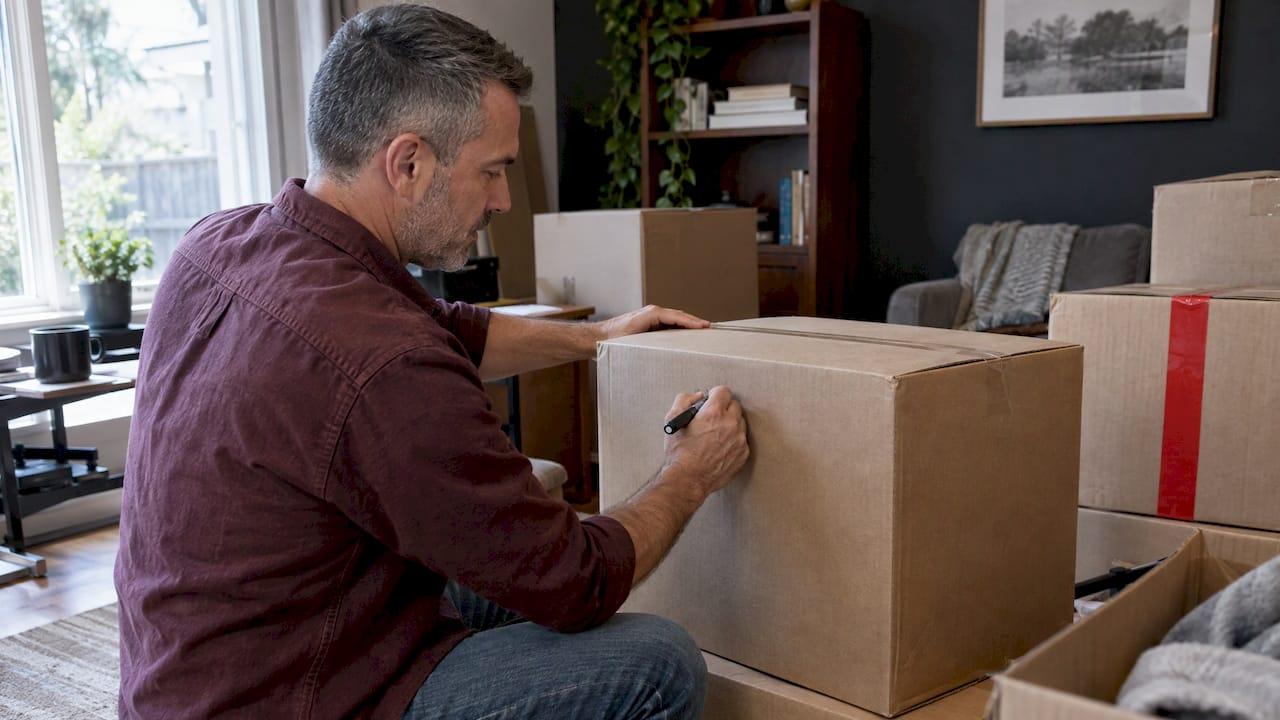
The best way to label moving boxes is to give every box three things: a room name, a short description of the contents and a handling note if it needs one. Add a colour for each room so anyone carrying a box can place it without asking. Do it as you seal each box, on the top and on at least two sides. Done this way, the crew at your new place can carry boxes straight to the right room instead of stopping to ask you about each one.
This guide covers what to write, how to set up a colour system, where labels stay put, and the mistakes that cause lost boxes and slow unloading. It is written for people moving in and around Abbotsford and the Fraser Valley, whether you are leaving a one-bedroom apartment, packing a family house or relocating an office.
TL;DR
- Write the destination room, a short contents line and any handling note on the top and at least two sides of every box.
- Give each room a colour, put that colour on every box in that room, and post the matching colour on the doorway of the room at the new place.
- Pack one clearly marked "Open First" box per person or per bathroom and kitchen, and keep it with you or load it last.
- Label after you seal the box, not before, and keep labels away from seams and corners so they do not peel.
- Number boxes by room (Kitchen 1, Kitchen 2) so you can tell at a glance when everything has arrived.
Table of Contents
- Why labelling decides how fast you unpack
- What to write on every box
- How to colour-code moving boxes by room
- The "Open First" box
- Labels that stay on and stay readable
- Special cases worth labelling differently
- Common labelling mistakes
- How many boxes, and in what order to pack
- Make the move-day handover simple
- Promo: let the crew handle the heavy part
- Our perspective
- FAQ
- Sources
Why labelling decides how fast you unpack
Once dozens of boxes are stacked in a hallway, they all look the same. A box marked "misc" tells nobody where it goes. A box marked "Bedroom 2, linens" goes to the right room in seconds, and the person carrying it never has to find you.
That matters most on move day. Movers are paid to move, not to guess, and every question you have to answer while standing in a doorway slows the whole job. A labelled box also protects the things inside: a crew that knows which box holds glassware loads and stacks it differently from one holding towels.
There is a second payoff after the truck leaves. Labels turn the first week in the new home from a treasure hunt into a sequence: kitchen essentials first, bedrooms next, the garage last.
What to write on every box
Keep it short and large. A label is read while someone is walking with a heavy load, so bold block letters beat tidy handwriting.
The four things worth writing
- Destination room. Write where the box goes in the new home, not where it came from. If you are moving from a three-bedroom to a two-bedroom, a "Den" box may need to become "Office" or "Bedroom 2" before you write it.
- Contents, in a few words. "Kitchen: pots and pans" is far more useful than "Kitchen". It lets you find the frying pan on night one without opening ten boxes.
- Handling note, only when it is true. "Fragile", "This side up" or "Heavy" should appear on the boxes that need them. If every box says "Fragile", none of them does. For glassware specifically, see our guide on how to pack glasses for a move without breaking them.
- Box number. Number boxes by room. If the kitchen has 15 boxes and you can see Kitchen 1 through Kitchen 15 inside the new house, you know the room is complete without a single recount.
Put it on more than one side
Boxes get stacked against walls, pushed into corners and turned in the truck. A label only on the top disappears the moment another box sits on it. Write the room name on the top and on at least two adjacent sides so it can be read however the box is stacked.
A simple example
Here is how one Abbotsford apartment move might read across six boxes:
| Box | Room name | Contents line | Handling | Colour |
|---|---|---|---|---|
| Kitchen 1 | Kitchen | Plates, bowls, cutlery | Fragile | Green |
| Kitchen 2 | Kitchen | Pots, pans, baking trays | Heavy | Green |
| Bedroom 1 - 3 | Bedroom 1 | Winter coats, sweaters | None | Blue |
| Bath 1 | Bathroom | Towels, shower curtain, toiletries | None | Yellow |
| Office 1 | Office | Books, binders | Heavy | Red |
| Open First 1 | Kitchen | Kettle, mugs, coffee, snacks, chargers | Top load | Green plus Open First sticker |
The format is the same for every box, which is the point: nobody has to learn a new code halfway through the day.
How to colour-code moving boxes by room
Writing is for people standing right next to a box. Colour is for people twenty feet away. A strip of coloured tape can be spotted across a room, while a marker word cannot, which is why colour-coding is such a good partner for written labels rather than a replacement.
A moving expert quoted by The Spruce recommends the same basic setup: give each room a colour, put coloured tape or a sticker on the box, make a colour key, and put the matching colour on that room's door or entryway. The same source notes that colour cues save time at unloading and help most when you have a lot of helpers.
Set it up in five steps
- List the rooms at the new place. Use the destination layout, not your current one.
- Pick one colour per room. Buy coloured packing tape, masking tape or sticker dots, one roll or sheet per room. Keep the colours easy to tell apart: red and orange look similar on a dim stairwell.
- Tape each box on a corner. Placing the colour on a corner makes it visible from more than one side, as Ottawa Property suggests. Long strips are easier to spot than small dots.
- Write the key once. One page listing colour, room and what it covers. Tape one copy by the front door and give one to whoever is leading the unload.
- Mark the doorways. On arrival, tape a sheet of the matching colour on each room's door frame or wall so a mover can match tape to door without reading anything.
Colour families for bigger homes
In a two-storey house, one colour per room can run out. Ottawa Property suggests using a colour family per floor, for example warm colours upstairs and cool colours on the main floor, and different shades of one colour for rooms that sit close together, such as a living room and dining room in two shades of green. If you try this, keep shades far enough apart that they look clearly different in poor light.
When colour is not enough
Colour tells a mover which room. It does not say whether the box is breakable, heavy or the one with your child's bedtime things. Keep the written line on every box. Colour is the fast sorting layer, and the words are the detail layer.
The "Open First" box
Every move has an evening where you are standing in a room full of boxes needing a toothbrush. The fix is to pack your everyday essentials separately and label them clearly as "Open First". The Spruce quotes its moving expert advising exactly this, and suggests carrying those boxes in your own car rather than putting them on the truck.
A good Open First box usually holds:
- toiletries, a towel and a change of clothes
- bedding for the first night
- a kettle or coffee maker, a few mugs, plates and cutlery
- phone chargers and power bars
- basic tools such as a screwdriver and a box cutter
- medications and important documents you need close at hand
If you are moving as a family or sharing with roommates, pack one per person or one per bathroom and kitchen. If the box does ride on the truck, tell the crew so it comes off first, and keep it out of the pile that gets stacked against a wall.
Labels that stay on and stay readable
A label that peels off or smears is worse than none, because you trust it.
- Use a thick permanent marker. Black on plain brown cardboard reads best. Skip gel pens and ballpoints.
- Write on the box where you can, or use adhesive labels. If you stick on paper labels, press the edges firmly and cover them with a strip of clear tape so they do not curl.
- Avoid seams and corners for the paper labels. Tape and labels over a seam or corner are the first to tear or peel as boxes are slid and stacked. Colour tape on a corner is fine, because it is a strip, not a label you rely on for words.
- Cross out old markings. If you reuse boxes, black out the old room names completely. A box that says "Garage" on one side and "Bedroom" on another is a guaranteed wrong turn.
- Label after sealing. Write the label once the box is packed and taped shut, not on flat empty boxes in advance. Contents change as you pack, and a label written early is often wrong.
Moves that include storage
If part of your move is going into storage first, labels need a longer life and a different focus. Humidity and time can blur ordinary marker or paper, so cover labels with clear tape and write the contents more fully than you would for a same-day move. Our guides on moving into storage and storage in transit between homes explain how to plan what goes where, and a clear label by room and by "needed soon" versus "not needed for months" is what keeps that plan workable.
Special cases worth labelling differently
Valuables and sentimental items. Jewellery, passports, laptops and family photos are best carried by you. If they must ride the truck, label them in a way that keeps them recognizable to you without announcing what is inside, for example a personal code or a coloured sticker only you know.

Artwork and mirrors. Flat items are easy to bury behind furniture. Mark the packaging with "Art, flat, do not stack" and the destination room. Our guide to packing artwork for a move covers the wrapping.
Items that cannot go on the truck. Some belongings are refused by movers altogether, such as certain flammables. Sort these before you start labelling so you do not pack and label boxes that cannot travel. See what movers will not move.
Pets. Set up one labelled room or corner for your pet's food, bowls, bedding and carrier so the "Open First" routine covers them too. More in our moving with pets plan.
Office moves. For a business, label by desk or workstation, not just by room. Give each team a colour, add a name or a desk number, and number the boxes for each person so a missing box is obvious on the first morning. The tidy-up rules are the same, only the unit is a workstation instead of a bedroom.
Common labelling mistakes
| Mistake | What goes wrong | Do this instead |
|---|---|---|
| Writing "misc" or "stuff" | Nobody knows where it goes or what is in it | Write room plus two or three items |
| Labelling only the top | Label is hidden when boxes are stacked | Top plus two sides |
| Labelling the room you are leaving | Boxes end up in the wrong room at the new home | Write the destination room |
| Marking every box "Fragile" | Crews cannot tell which boxes need real care | Use it only where needed |
| Too many colours that look alike | Orange and red get mixed up in dim light | Pick colours that are obviously different |
| No colour key | Helpers guess what each colour means | Post the key at the door and the doorways |
| Labels over seams and corners | Labels peel and tear | Place them on flat panels |
| Labelling before packing | Label does not match contents | Label after you seal the box |
How many boxes, and in what order to pack
Labelling gets easier when you know the scale of the job. Our room-by-room guide to how many moving boxes you need helps you set quantities, and the house moving checklist lays out an eight-plus-week plan that includes when to start packing. Renters can use the apartment moving checklist, which starts one to three months ahead.
A sensible order for labelling is to start with the rooms you use least: the garage, the basement, guest rooms and off-season clothing. Leave the kitchen and bathroom for last, since you use them until the final day. Number boxes as you go, so the numbers in each room run in the order you packed them.

Make the move-day handover simple
Labels do their best work when the crew has a clear way in and a clear way out. Before the movers arrive, give them what they need:
- A walk-through at the new place. Show where each colour goes before the first box comes off the truck.
- Clear paths. Keep halls, stairs and elevators free. Our guide to preparing for movers in Canada explains how blocked access can delay a move.
- One reference sheet. Your colour key and a room list taped by the door, so that nobody has to find you to ask.
- A short tick list. As boxes come in, tick off the numbers per room. If Bedroom 2 should have 8 boxes and you counted 7, you know before the truck leaves.
Promo: let the crew handle the heavy part
Labelling is easier when packing and carrying are not all on you. At 2 Friends Trucking & Moving we offer packing services and loading and unloading in Abbotsford and across the Fraser Valley, alongside local moving, long-distance moves within BC, apartment and condo moves, and office relocations. We also serve Mission and Maple Ridge.
If you want a crew that arrives knowing how your move is organized, tell us about your move and share your colour key and box numbering with us ahead of time.

Our perspective
A labelling system is only as good as the people who read it. We have seen that a move runs better when the plan is clear before the truck is loaded, and that is true whether we are moving a studio apartment, a family home or an office.
Our approach is built around dependable service, clear communication and careful planning. A colour key, room names and box numbers fit that approach, because they let us place your belongings where you want them without stopping to ask. When customers also ask us to handle packing, we can work from the same system from the first box to the last.
If you are moving within Abbotsford, to Mission, Maple Ridge or Langley, or across British Columbia, share your labelling plan when you book. It makes the day easier for you and for the crew.
Jack W.
FAQ
What should I write on a moving box?
Write the destination room, a short contents line such as "Kitchen: pots and pans" and a handling note if the box is fragile, heavy or must stay upright. Add a box number by room. Put it on the top and at least two sides so it can be read when boxes are stacked.
Is colour-coding moving boxes worth it?
Yes, particularly when several people are carrying. Colour can be read from across a room, so helpers can place boxes without asking you. It works best next to written labels, with a colour key posted at the entrance and matching colour on each room's doorway.
Should I label boxes before or after packing them?
After. Contents change while you pack, and a label written on an empty box is often wrong by the time the box is full. Seal the box, then label it immediately while you remember exactly what is inside.
How do I label boxes for storage?
Use a thick permanent marker, cover paper labels with clear tape and write fuller contents lists than for a same-day move. Mark boxes you will need soon so they can be reached first. Our storage guides above show how to plan the layout.
Can the movers do the packing and labelling for me?
We offer packing services as part of our moving work in Abbotsford and the Fraser Valley. Tell us the rooms in your new home and any colours or numbers you want, and we can plan around them when we book your move.
Sources
- Why You Should Always Label Your Boxes Before Moving, The Spruce
- Organized Moving System, Ottawa Property