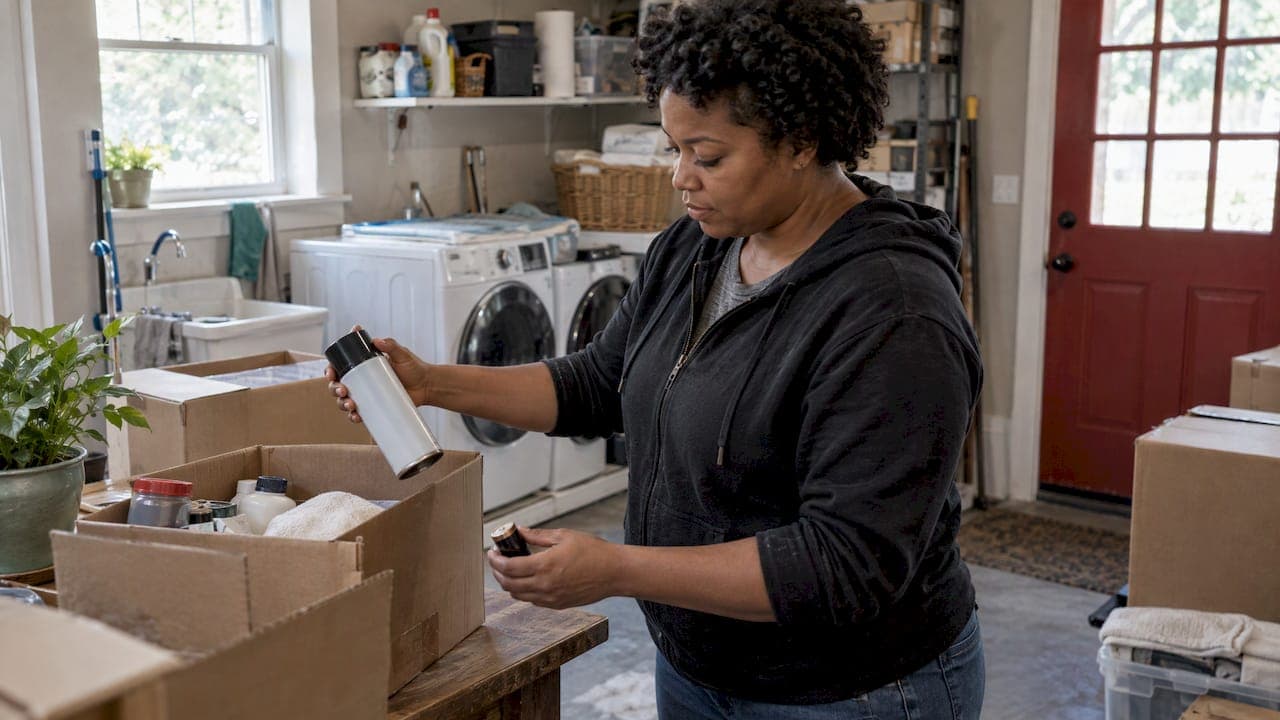
Movers in Canada generally won't load anything dangerous, such as flammable, corrosive, explosive or pressurized products, and they also turn away perishable food, live plants, pets, ammunition and firearms. Some other things, like cash, passports and medication, are usually left off the truck for safety reasons rather than by rule. Finding out on moving day is stressful. Sorting it out two or three weeks ahead takes about an hour.
This guide goes category by category, explains why each item is refused, and tells you what to do with it instead. It is written for people moving in Abbotsford and the Fraser Valley, so the disposal advice is local.
TL;DR
- Hazardous goods are the main exclusion: propane tanks, gasoline, aerosols, paint, pool chemicals, cleaning products, fire extinguishers and many batteries.
- Perishable food, open alcohol, live plants and pets travel with you, not on the truck.
- Ammunition and firearms need separate, legal arrangements, and valuables and documents should stay in your own vehicle.
- Ask your mover for its list in writing when you book, and use a room-by-room inventory to find problem items early.
- Leftover chemicals go to a stewardship drop-off or hazardous waste program, never down the drain or into the garbage.
Table of Contents
- Why movers refuse certain items
- Hazardous and flammable items
- Perishables, plants and pets
- Firearms, ammunition and other regulated items
- Valuables and documents movers advise you to keep with you
- Items that are heavy or awkward, not banned
- What to do with the items your movers won't take
- Get your mover's list in writing
- Our perspective on prohibited items
- Moving help in Abbotsford and the Fraser Valley
- FAQ
- Sources
Why movers refuse certain items
There are three reasons, and knowing them helps you predict the list for items nobody mentioned.
Safety. A moving truck is a closed box that heats up, vibrates and gets stacked tight. A leaking can of solvent or a failing battery is a fire or health risk for the crew and for everything else you own.

Law. In Canada, the Transportation of Dangerous Goods (TDG) rules apply to anyone moving regulated products. Transport Canada says the regulations apply to everyone, including people carrying gasoline, oxygen and propane for personal use, though exemptions exist. The well-known 150 kg exemption is limited to dangerous goods that are available to the public and carried by the user, purchaser or retailer. A professional moving carrier can't rely on it. That is why you may carry a small propane cylinder in your own car yet a mover still won't take it.
Practicality. Trucks aren't refrigerated, and a moving crew can't look after living things. Food spoils, plants wilt and animals panic.
Canada's own household-goods guidance for military families says the same thing in plain terms: goods regulated under the Transportation of Dangerous Goods Act or its regulations, including pressurized containers and fuel and propane tanks, must not be moved or stored with household goods. Ammunition and restricted firearms are also excluded there. Civilian movers follow the same logic.
Hazardous and flammable items
This is the category that catches people out, because many of these things live in the garage or under the sink and don't feel dangerous.
Fuel, propane and gas
- Propane tanks, including the small camping cylinders and the 20 lb barbecue tank
- Gasoline and diesel, including the fuel in a lawn mower, trimmer or snowblower
- Kerosene, lighter fluid, charcoal starter and butane
- Welding gas and oxygen cylinders
Drain the fuel from outdoor power equipment before moving day, and run the engine until it stops so little is left in the carburetor. Barbecues can move once the tank is disconnected and removed. Ask the retailer or a propane supplier about exchanging or returning the tank. If you are driving the tank yourself, keep it upright, secured and ventilated in the vehicle, and follow the transport guidance on the Transport Canada page above.
Paint, solvents and garage chemicals
- Oil-based and latex paint, stain, varnish and paint thinner
- Motor oil, antifreeze, brake fluid and windshield washer fluid
- Pool chemicals, including chlorine tablets and shock
- Pesticides, herbicides, fertilizer and weed killer
- Adhesives, turpentine and other solvents
Even a sealed can of paint can leak when it is tipped on a long drive. If you plan to touch up walls at your new place, buy a small can of the same colour after you arrive, or take one tin in your own car, upright in a box.
For the rest, the City of Abbotsford's recycling handbook explains that paint, batteries and similar products are handled through product stewardship programs at drop-off depots, and it points residents to the City's Waste Wizard search tool to find where each item goes. Health Canada is clear about pesticides: never burn them or pour them down the drain, follow the label, and contact local officials about partly used products.
Household cleaning products
Bleach, ammonia, oven cleaner, drain cleaner, glass cleaner and similar products are commonly refused, especially open or partly used containers. Two practical rules help:
- Use them up in the weeks before the move. Cleaning the old place is the perfect use for them.
- Never pack a leftover bottle with another product. Mixing bleach and ammonia produces toxic gas.
An unopened, sealed bottle may travel in your own car in a leak-proof bin. Buy basic cleaning supplies fresh for the new home rather than moving half-empty bottles.
Aerosols and pressurized containers
Hairspray, deodorant, air freshener, spray paint, cooking spray and canned air are all pressurized. Heat in a truck can make them burst. This also includes fire extinguishers, which many movers won't carry. Use up the aerosols, or carry the few you need in your own car.
Nail polish remover, hand sanitizer and other small flammables
Small bottles are easy to forget because they sit in a bathroom drawer. Alcohol-based sanitizers, nail polish and remover, rubbing alcohol, perfume and matches are flammable. Put them in a clear bag for your own car, or let the movers know they exist so they can tell you honestly whether they can go.
Batteries
Batteries are a growing source of surprises. Transport Canada explains that many batteries, including lithium batteries, are dangerous goods because of the risks of fire, short-circuit and leakage, and that unless an exemption applies, shipments must meet the TDG requirements. In practice:
- Car batteries and large lead-acid batteries: remove and handle separately, since they contain acid.
- Loose lithium and spare power tool batteries: carry them in your own vehicle, with the terminals taped or in the original packaging.
- Batteries installed in devices such as laptops, phones and cordless drills are normally fine in the device, but ask your mover about e-bikes and scooters, which have large lithium packs.
- Dead household batteries belong in a battery recycling bin, not the garbage.
How do you recognize a hazardous product? Transport Canada says dangerous goods marks identify the goods and the nature of the danger, so people can react quickly in an emergency such as a release. On household labels, look for the warning symbols: a flame, a corrosive hand and surface, an exploding canister, or a skull. If the label has one, assume the mover will ask you about it.
Perishables, plants and pets
Food and drink
Frozen and refrigerated food can't stay safe in an unrefrigerated truck, so movers decline it. Open pantry items are commonly excluded too, as spilled flour and sauces ruin other boxes and attract pests.
A simple food plan:
- Start eating down the freezer about three weeks out.
- Donate unopened, in-date non-perishables to a local food bank.
- Pack a cooler for the last day's meals and for the essentials you need on arrival.
- Open bottles of alcohol and wine are usually refused. Sealed bottles may be accepted, but valuable bottles are better carried with you because of the risk of breakage and temperature swings.
Live plants
Plants are on many movers' do-not-move lists. The truck gets too hot or cold, there is no light, and soil spills. Plants also raise a separate issue on longer moves, since some jurisdictions restrict moving soil and plants. We have a full guide on how to move plants safely in the Fraser Valley, including which ones to take in your car and which to give away to friends or neighbours.

Pets
Pets are never cargo. Cats, dogs, birds, reptiles, fish and small animals travel with you or with a trusted person. Plan their transport, food, medication and a quiet room at the new home. Our guide to moving with cats, dogs and small animals covers the day itself. Fish tanks must be emptied before the move, and the fish need their own container.
Firearms, ammunition and other regulated items
Ammunition is excluded in the Canadian government guidance quoted above, and restricted firearms are too. Ammunition is also a dangerous good. Many movers won't transport firearms at all, and where one does, the transport must follow federal and provincial storage and transportation rules. If you own firearms, contact the firearms office or your licensing authority about moving them legally, and tell your mover about them early rather than leaving them in a closet.
Other regulated or sensitive items follow the same principle: if there is a licence, a rule or a special container for it, the standard moving truck is probably not the right vehicle. Think of fireworks, flares, ammunition reloading powder, and medical oxygen.
Valuables and documents movers advise you to keep with you
This is not a legal ban in most cases, but it is the advice you will hear from every experienced crew:
- Passports, birth certificates, wills, property and lease papers, and mortgage documents
- Cash, jewellery, watches and loose gemstones
- Laptops, hard drives and phones with irreplaceable data
- Prescription medication, glasses and chargers
- Keys to the old and new home
- Anything sentimental that can't be replaced, such as an heirloom or photo album
Put them in one bag or box labelled "with me" and keep it in your own vehicle. It also saves you from rummaging through sealed cartons on the first night.
Items that are heavy or awkward, not banned
Some things sound like they should be on the "won't move" list but are really planning questions:
| Item | Usually refused? | What to do |
|---|---|---|
| Piano | No, but needs specialists | Tell your mover before booking so the right crew, equipment and stair plan are in place |
| Large safe or gun safe | Often needs special handling | Mention the weight, and any stairs, up front |
| Hot tub or pool table | Depends on access and disassembly | Arrange disassembly and tell the mover the route |
| Large appliances | No | Disconnect, drain and defrost fridges and freezers the day before |
| Mattresses and furniture | No | Cover or bag them; furniture movers handle them routinely |
| Boxes of books | No | Use small boxes, as heavy ones are the likeliest to break |
When a job includes a piano or other awkward item, it changes how the move is crewed and quoted, so describe it honestly when you ask for a quote.
What to do with the items your movers won't take
Work through them in this order:
- Use it up. Cleaning products, cooking spray, fuel in a mower tank, food from the freezer.
- Give it away. Sealed, unopened paint or garden products may be welcomed by a neighbour, a community garden or a local reuse program. Give food to a food bank.
- Carry it yourself. Only for things that are legal and safe to transport in a private vehicle, upright and secured.
- Dispose of it properly. Use the City of Abbotsford's Waste Wizard and depot information to find the right place for paint, batteries, electronics and household hazardous waste. Mission, Maple Ridge and Langley residents should check their own municipality's waste pages.
Never put chemicals in the garbage, the storm drain or the sink. If you are not sure whether something is hazardous, the product label and your municipality's waste service will say.
Get your mover's list in writing
The Office of Consumer Affairs advises consumers to check what their moving company cannot transport or store and to make a room-by-room inventory of everything being moved. Combine the two:
- Ask when you book. Request the company's list of items it cannot take, in writing or by email, so there is no argument later.
- Walk the house with a list. Start in the garage, then the kitchen, bathrooms, laundry area, basement, shed and balcony. These are where most banned items hide.
- Check the lists for different moves. Local, long-distance and storage moves may have different handling rules, particularly when the load sits on a truck for days or goes into storage. Say what kind of move you are doing.
- Sort three piles. "Use or dispose", "carry myself" and "movers load".
- Do it early. Our house moving checklist puts this inventory in the first weeks of an eight-week plan. For apartments and shorter timelines, use the apartment moving checklist.
- Clear access on the day. Boxes for the "with me" bag and the "don't load" pile should be somewhere obvious so they don't get loaded by mistake. Our piece on preparing for movers explains how blocked access can delay a crew.
It is also a good question to add to your quote conversation. Our list of questions to ask movers shows how to compare quotes properly, so a low number doesn't come with surprises.
Our perspective on prohibited items
In our experience, the items that cause trouble on moving day are almost never the obvious ones. People don't forget the piano. They forget the half-full propane tank by the shed, the paint cans in the crawlspace and the freezer full of food.
That is why we think of clear communication as the real service. A good move starts with a plain conversation about what is going on the truck, what is staying behind and what you will carry yourself. We would rather have you sort the awkward items out a week before the move than meet them on the driveway with the crew waiting.
For Abbotsford and Fraser Valley households, we recommend a short walk-through of the garage, kitchen and laundry area when you ask for a quote, and a clear split between the "with me" bag and the loaded boxes. Careful planning keeps a move calm, and it protects your belongings too.
Jack W.
Moving help in Abbotsford and the Fraser Valley
We are an Abbotsford-based moving company serving homes and businesses in Abbotsford, Mission, Maple Ridge and Langley. Our services include local moves, long-distance moves within BC, apartment and condo moves, office moves, furniture moving, packing, loading and unloading, and storage moving. Tell us about anything unusual when you ask for a quote and we will plan the move around it.

If you want to get the packing done properly, our packing services cover the sorting and boxing of the household. For a move within the area, see our local moving page, or request a quote and describe your home and your list.
FAQ
Will movers take cleaning products if the bottles are sealed?
Policies vary, and many movers decline cleaning products entirely because bottles can leak or react with each other. Ask your mover before booking. If they won't take them, use the products up before the move or carry sealed bottles upright in a sealed bin in your own car.
Can movers move a barbecue?
Yes, the barbecue itself is a normal household item. The propane tank has to be disconnected and removed first, because propane cylinders are on the list of items movers won't carry. Clean the grill and let it cool fully before moving day.
Do movers move frozen or refrigerated food?
Generally no, because a moving truck is not refrigerated. Plan to eat down the freezer in the weeks before, donate unopened non-perishables, and bring a cooler for the last day and the first night at your new home.
What should I do with paint I don't want?
Use it up, give it away sealed, or take it to a paint stewardship drop-off. The City of Abbotsford's recycling handbook explains that paint is handled through product stewardship programs, and its Waste Wizard search tool shows the location for each item. Never pour it down a drain.
Do I tell movers about items that are not on the banned list?
Yes. Pianos, safes, hot tubs, and large or fragile pieces are not refused as a rule, but they change the crew, the equipment and the plan. Mention them when you request a quote so the price and the day run smoothly.
Sources
- Safety awareness materials and FAQ, Transport Canada
- Pre-move information booklet, National Defence, Government of Canada
- Transporting batteries, Transport Canada
- Dangerous goods marks, Transport Canada
- Use pesticides safely, Health Canada
- Residential recycling drop-off handbook, City of Abbotsford
- Moving advice, Office of Consumer Affairs