
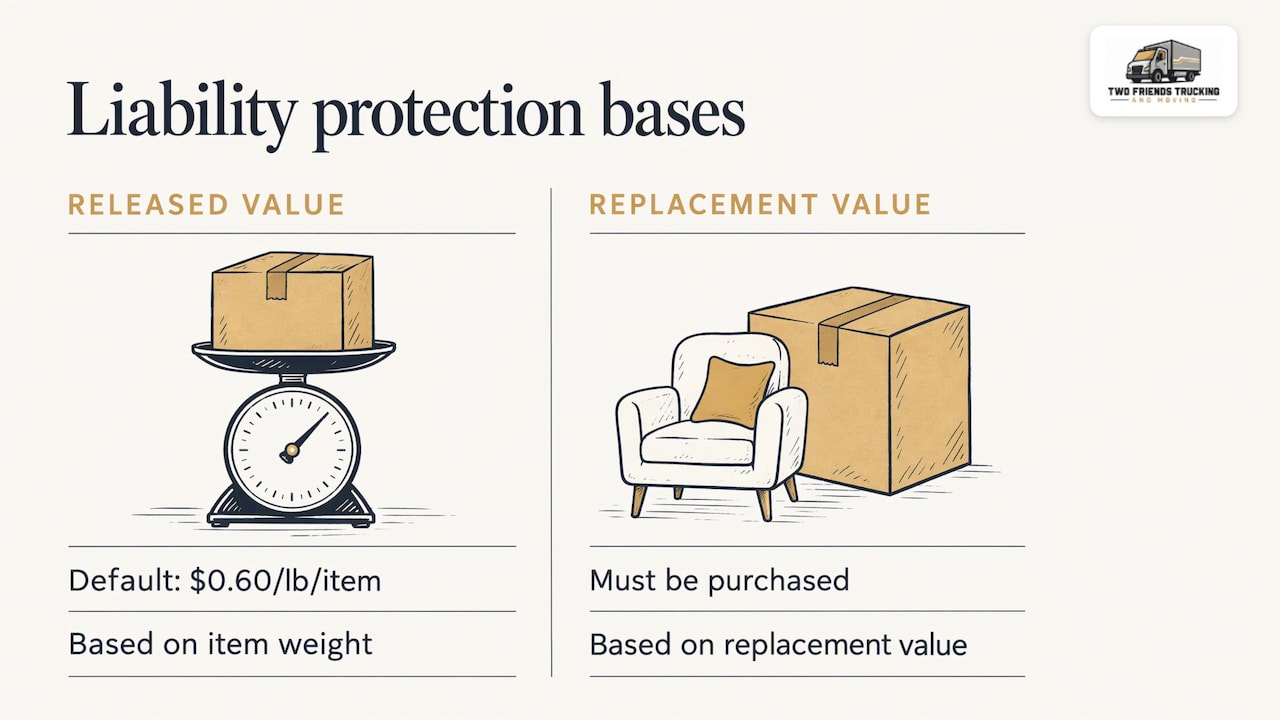
In Canada, a mover's default liability for damaged household goods is generally $0.60 per pound ($1.32 per kg) per item, unless you buy higher protection. That is the amount a mover may owe you for a broken piece of furniture. It is rarely what the piece cost. Before you sign, you need three things in writing: the liability level, who is responsible if the job involves anyone else, and the deadline for reporting damage. We are a Fraser Valley moving company, and this guide shows you how to read the policy, what to ask for and what to do if something arrives damaged.
TL;DR
- The default coverage, usually called released value protection, is generally $0.60 per pound per item. It is included in the cost of the move.
- Replacement value protection is the higher option. It is set by the value you declare and the terms you choose.
- Items you pack yourself, items of extraordinary value that you have not declared, and fragile goods often fall outside normal liability.
- Claim deadlines can be short, often around 30 days for local moves and 60 days for long-distance moves. Photograph everything and note damage before you sign.
- Home or tenant insurance and the mover's coverage do different jobs. Ask your insurer how your goods are treated in transit.
Table of Contents
- What a mover's damage policy actually is
- Released value protection: how $0.60 per pound works
- Replacement value protection: the higher level
- What is usually excluded or limited
- Does your home or tenant insurance cover moving damage?
- What a good moving contract says about damage
- Before the move: protect your claim
- After delivery: how to report damage
- Our perspective
- Moving with 2 Friends Trucking & Moving
- FAQ
- Sources
What a mover's damage policy actually is
A damage policy is the part of your moving contract that says what the mover owes you if your belongings are lost or broken. For household goods, the rules sit in provincial conditions of carriage, which are standard terms attached to the bill of lading (the receipt and contract the mover gives you for your shipment). Because they are provincial, details such as claim windows can differ between provinces. The contract you sign is what binds the mover, so the written wording matters more than anything said on the phone.
The federal Office of Consumer Affairs explains the default in its moving advice page: unless you purchase replacement value protection, the mover's liability is generally $0.60 per pound per item. Many people assume that a licensed, insured mover will replace whatever breaks. In practice, "insured" often describes the mover's own minimum liability, not the value of your things.
Released value protection: how $0.60 per pound works
Released value protection is included in the price of every household-goods move. According to the Canadian Association of Movers, it limits liability to $0.60 per pound ($1.32 per kg) per article. The weight of the article, not what you paid, sets the payout.
Their own examples show the effect:
| Situation | Weight | What you paid or its worth | Payout at $0.60/lb |
|---|---|---|---|
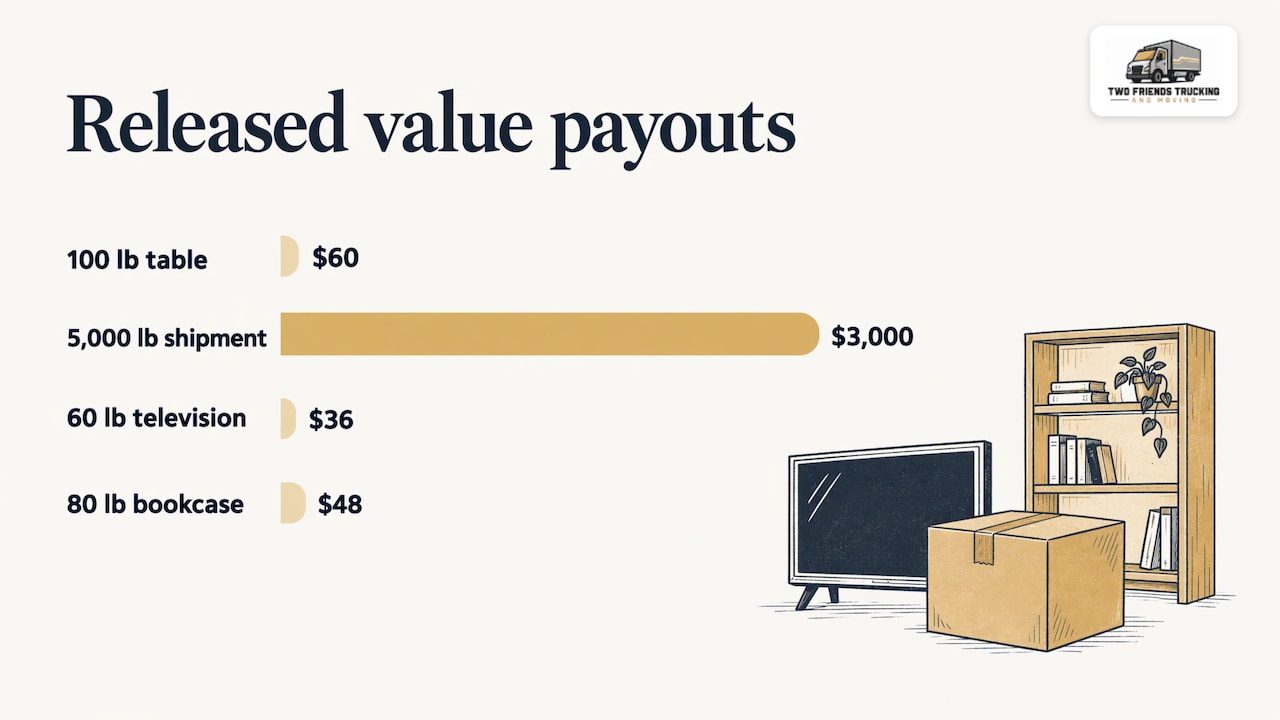
| Table damaged beyond repair | 100 lb | $1,000 | $60 |
| Total loss of a shipment | 5,000 lb | Far more than $3,000 | $3,000 |
Now apply it to your own home. A 60 lb television worth $900 would settle at $36. A heavy, cheap bookcase of 80 lb would settle at $48, about what it cost. Light, valuable items are the ones the default protects worst: electronics, small appliances, musical instruments and decor.
This is why we suggest you list your ten most valuable or hardest-to-replace items before you collect quotes. You can then ask each mover what it would pay for each one.
Replacement value protection: the higher level
Replacement value protection is the optional upgrade. The Canadian Association of Movers describes it as replacing an item that cannot be repaired at today's market price, limited by the valuation you select, and subject to a minimum of $10 per pound. It costs extra and its terms vary by mover, so ask for these points in writing:
- The declared value you are choosing and how it is calculated (per pound, or for the whole shipment).
- Any deductible you would pay on a claim.
- Whether damaged items are repaired, replaced or paid out in cash.
- Which items are excluded.
- Whether it covers items the mover packed, and items you packed.
For a sense of what a fuller model looks like, the Department of National Defence's pre-move booklet describes Replacement Cost Protection of $120,000 per shipment for military households. It runs from packing at origin to unpacking at destination, including storage in transit. That is a government contract, not what an ordinary consumer move includes, but it shows the questions worth asking: where coverage starts and ends, and who is responsible at each stage.
If you are comparing moves, our guide on comparing three quotes for coverage, not just price shows how to line up the protection level next to the price.
What is usually excluded or limited
The Office of Consumer Affairs lists several situations where the mover's liability shrinks or disappears:
- Extraordinary value. Under transportation law, a mover is not responsible for goods of extraordinary value, such as works of art, unless you declare the value. Our guide to packing artwork for a move covers paintings, canvas and mirrors.
- Inherent vice. Items that are fragile by their construction, such as fibreboard furniture, may trigger a waiver of liability.
- Owner-packed goods. A mover is generally not liable for loss or damage to goods you packed yourself. Special-care items should be packed "at owner's risk".
- Brokers and sub-contractors. A moving broker that hands your job to others is a major source of consumer complaints. Many brokers do not take responsibility for lost or broken items, so confirm that the company you hire is responsible from start to finish.
The Canadian Association of Movers also notes that homeowner policies may exclude marring, scratching and breakage of fragile articles unless an insured peril caused it. Neither the mover's default nor your own policy fully covers every scratch, so compare them before moving day.
Some items are not carried at all. Our list of what movers won't move helps you sort those before the truck arrives.
Does your home or tenant insurance cover moving damage?
Often partly. The Office of Consumer Affairs describes the split this way: household insurance usually covers catastrophic loss, such as a truck fire or collision, while the mover's coverage deals with mishandling in transit. It advises you to call your insurance provider before the move to clarify what is covered for goods in transit.
Three questions to put to your insurer or broker:
- Are my belongings covered while in a moving truck, and does that depend on who is driving?
- Does my policy cover breakage or scratching of fragile items, or only damage from named perils such as fire?
- What is my deductible? If a claim is smaller than the deductible, filing may not pay.
If you do file, act promptly. One Canadian home policy wording, for example, requires a proof of loss within 60 days of the loss, stating the amount, place, time and cause. Your own policy may differ, so read yours. For a fuller walk-through, see our guide to moving insurance in Canada.
What a good moving contract says about damage
Before you sign, the document should name the mover and give a contact address, list the services and prices, and state the liability level in plain terms. Ontario's rules, set out on ontario.ca's hiring a mover page, are one example of what provinces require. Contracts over $50 must be in writing and include the mover's name, address and contact information, an itemized price list, the total price, start and end dates and payment terms. The same page says a mover cannot charge more than 10% above the estimate without your agreement to added supplies or services. These are Ontario rules. In British Columbia, check your bill of lading and the conditions of carriage attached to it.
A useful contract also answers these:
- Which protection level applies, and what the price difference is for the next level up.
- The claim deadline and how to submit a claim.
- Who is responsible if a sub-contractor or another carrier handles part of the move.
- How owner-packed boxes are treated.
Our questions to ask movers list covers these in detail, and the guide on verifying a certificate of insurance shows how to read the document a mover gives you as proof of cover.
Before the move: protect your claim
Most damage disputes turn on evidence. Do this before the truck arrives:
- Make a home inventory. Photograph or film each room and note the make, model and condition of valuable items. Keep receipts for expensive belongings. Our house moving checklist has an 8-week plan for logging items.
- Declare high-value items. Put the value of art, instruments and electronics on the paperwork. Without a declaration, extraordinary-value goods are not covered.
- Decide who packs what. Items the mover packs are generally within its responsibility. Boxes you pack are generally at your own risk. Our packing supplies list shows what protective materials you need if you pack some items yourself.
- Clear access. Blocked driveways, narrow stairways and unreserved elevators cause scrapes and delays. See how to prepare for movers.
- Ask your insurer what your home or tenant policy does in transit.
If you live in an apartment or condo, book the elevator and loading zone ahead. Our apartment moving checklist starts one to three months early for good reason.
After delivery: how to report damage
The steps below follow common practice. The Department of National Defence's pre-move booklet sets a model claims process, and your own contract sets the real deadlines.
- Inspect before you sign. Do not sign the inventory until you have examined your goods. Note damaged or missing items on both copies.
- Photograph the damage with the packaging and the item's location in the house.
- Do not repair or dispose of the item before the mover has a chance to inspect it.
- Report in writing, quickly. The Office of Consumer Affairs says claims often must be made within 30 days for local moves and 60 days for long-distance moves. Check your contract for its own window.
- Send supporting proof: the inventory, photos, receipts or replacement quotes.
- Keep records of every reply. In the DND model, the contractor must provide a settlement offer within 45 business days of a properly documented claim. Ask your mover what its timeline is.
If you also plan to claim on your own insurance, contact the insurer early even if you are unsure whether to proceed. A BC-based insurer, Square One, advises reporting a potential claim so an adjuster can help you decide what to do. It also notes that a claim smaller than your deductible likely does not make sense to file.
If your mover disputes the claim, a provincial consumer protection office or your insurer is the authority to contact, and a lawyer if the amount is significant. Quebec's consumer protection office notes in its moving tip sheet that a professional assessor can be called on to evaluate damage.
Our perspective
Most moving disputes we hear about start with a misunderstanding about coverage, not with bad intentions. People hear "insured" and assume everything is covered. Then a $900 television comes back damaged and the cheque is for $36.
We think the fix is simple: talk about coverage when you get the quote, not after the move. Tell us which items matter most, and we can plan the packing, loading and handling around them. Clear communication and careful planning are what we aim for on every residential, commercial, local and long-distance move.
Packing is part of this. When we pack your belongings, the packing stays within one team's responsibility and nobody has to guess whose box it was. For furniture, pianos and awkward items, careful handling on the truck and at the door is what keeps claims from happening.
Ask us your coverage questions before you book. A mover who is happy to explain the paperwork is usually a mover who plans the job well.
Jack W.
Moving with 2 Friends Trucking & Moving
We are an Abbotsford moving company serving Abbotsford, Mission, Maple Ridge, Langley and the wider Fraser Valley. We handle local moves, long-distance moves within BC, apartment and condo moves, office relocations, furniture moving, loading and unloading, storage moving and packing services. Each move is priced by distance, size and the services you need, so tell us about the items you most want protected when you ask for a quote.

To plan your move and talk through coverage, start at our moving services page.
FAQ
Are movers responsible for damaged items in Canada?
Yes, a mover is generally liable for loss or damage to goods it accepts, but within limits. The default is generally $0.60 per pound per item unless you buy replacement value protection. Items you packed yourself and undeclared goods of extraordinary value are often excluded.
How long do I have to file a moving damage claim?
It depends on your contract and province. The Office of Consumer Affairs says claims often must be made within 30 days for local moves and 60 days for long-distance moves. Photograph damage on delivery day and report it in writing as soon as you can.
Does my home insurance cover moving damage?
Sometimes. Household insurance usually covers catastrophic loss, while the mover's coverage addresses mishandling in transit, according to the Office of Consumer Affairs. Call your insurer before the move to find out how your goods are treated in transit and what your deductible is.
Should I buy replacement value protection?
If your belongings are worth much more than their weight times $0.60 per pound, it is worth pricing. Televisions, instruments, electronics and good furniture are typical examples. Ask your mover for the cost, the deductible and the exclusions in writing.
Sources
- Moving advice, Office of Consumer Affairs (ISED)
- Liability, Canadian Association of Movers
- Pre-move information booklet, Department of National Defence
- Hiring a mover, ontario.ca
- Tip sheet: Moving, Office de la protection du consommateur (Quebec)
- Residential Broad Form policy wording, L'Amutual
- Common home insurance questions, Square One