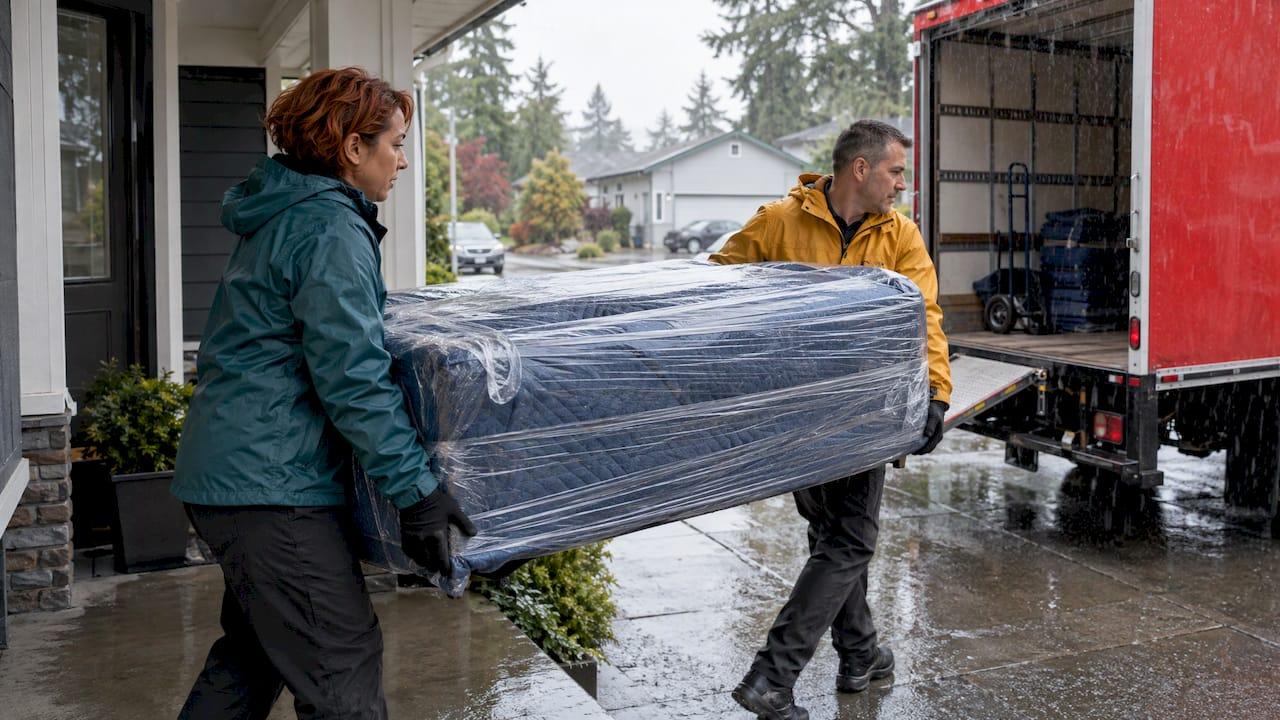
Yes, you can move in the rain, and most moves go ahead as planned. Light to steady rain is a handling problem, not a reason to cancel: wrap what can soak, protect the floors and keep the path from door to truck short and dry. The work is in the planning, and a crew that loads, carries and unloads for a living, like ours at 2 Friends Trucking & Moving, takes the heavy, slippery part of a wet day off your hands.
This guide is for people moving in Abbotsford and the Fraser Valley who wake up to a forecast of rain, or who are booking a date in a wet season and want to know what to do about it.
TL;DR
- A rainy day rarely cancels a move. Movers are expected to make reasonable efforts to keep your pickup and delivery arrangements and to tell you about any delay.
- Wrap mattresses and upholstered furniture in sealed plastic before they leave the house, and pack electronics, papers and photos in lidded plastic bins, never cardboard.
- Protect the floors at both homes with runners and mats, and keep the truck as close to the door as parking allows.
- Wear waterproof layers and footwear with soft rubber soles. Wet ramps, steps and tile are where people slip.
- Unwrap and dry anything damp the same day, so trapped moisture does not turn into mildew or warping.
Table of Contents
- Will the move go ahead if it rains?
- Plan B before the day
- Protect your belongings from the rain
- Protect the floors and the doorways
- Staying safe: clothing and footwear
- What to do with anything that gets wet
- Rainy-day moves for different readers
- A rainy-day checklist
- How we handle wet-weather moves
- Our view: rain is a planning problem
- FAQ
- Sources
Will the move go ahead if it rains?
In almost every case, yes. Rain on its own is not a reason a professional crew stops work. What matters is how heavy it is and whether the site is safe. A drizzle in November is different from a storm with high wind or a flooded driveway, and your mover decides with you, on the day, whether it is still safe to carry furniture across wet ground and up a ramp.
You also have a baseline of good practice on your side. The Good Practice Guidelines for Canadian Movers, published by the Canadian moving industry's professional body, say movers should make reasonable efforts to fulfil pickup and delivery arrangements and should keep you advised of any service delays, including when service can be expected and who to contact at the company. So if weather does push the schedule, you should hear about it from your mover and get a new time, not silence.
When a delay is the sensible call
A move is worth rescheduling or staging differently when:
- Wind or lightning makes carrying large pieces or working on a ramp unsafe.
- Water is pooling at the door, on stairs or on the truck ramp and cannot be controlled.
- The street or driveway is flooded or blocked, so the truck cannot get close.
- Someone at the site cannot walk the path without a real risk of falling.
If you see any of these the night before, call early. Moving the start time by a few hours, when rain often eases, can be enough. A move that is only a few hours off is far easier to fit in than a full rebooking.
Plan B before the day
The Government of Quebec's consumer protection office, in its official moving tip sheet, recommends a plan B in case it rains. It also advises wrapping every item carefully, moving valuables and important documents yourself, reserving the building's elevator, confirming that the truck has a place to park, and having one person at the departure point and another at the destination. That list suits any Canadian move, and each point matters more when the weather is wet.
Turn it into a short plan for your own move:
- Check the forecast three days out and again the night before. Rain that is certain is easier to plan for than rain you are hoping to dodge.
- Pick your covered staging spot. A garage, carport, porch or the building's lobby gives you a place to hold items between the house and the truck.
- Reserve the elevator and the loading zone if you live in an apartment or condo. Ask the building about moving hours, floor protection rules and where the truck may stop.
- Decide who stands where. One person at each address makes sure the right boxes go to the right rooms and that nobody is wiping up behind the crew.
- Keep valuables with you. Documents, jewellery, laptops and medications travel in your own vehicle, in a sealed bin or bag.
If you are moving from an apartment, our guide on getting ready for movers in Canada explains how blocked access can delay a job, which is the last thing you want on a wet day.
Protect your belongings from the rain
The rule is simple: anything that can absorb water is wrapped before it goes outside, and anything that can be ruined by water goes in plastic rather than cardboard. Cardboard loses its strength when it gets wet, and a box that has softened at the bottom can give way when it is lifted.
Mattresses and upholstered furniture
A wet mattress is slow to dry and can hold a damp smell for a long time. Slide it into a sealed plastic mattress bag and tape the opening shut. Wrap sofas and armchairs in stretch wrap, then put moving blankets over the wrap for padding. Pillows, cushions and soft items go into plastic bags. Take care that the plastic goes on dry fabric, because wrapping a damp item only holds the moisture in.
If you are moving a bed frame, a sectional or a large sofa through a tight stairwell, read our guide on moving heavy furniture safely before the day. Wet hands and wet floors make awkward pieces harder to control.
Wood furniture
Blankets go on first, plastic goes over the top. The blanket cushions the piece and soaks up any moisture that gets past the plastic. When the furniture arrives, wipe it dry before you take the wrapping off so that drops from the plastic do not mark the finish.

Electronics, papers and photos
These go in lidded plastic bins or sealed heavy-duty bags. Keep original boxes for screens and computers only if they are dry and sturdy, and put the box inside a bin or bag for the walk to the truck. Photos, passports, tax papers and anything irreplaceable should travel with you instead.
Boxes, books and linens
Books are heavy and linens soak up water, so both are safer in plastic bins or in boxes lined with a garbage bag. Reinforce the bottom of every cardboard box with extra tape. Our packing supplies list shows what to buy and in what quantity, including the extra stretch wrap, mattress bags and tape a wet-weather move calls for.
Art, mirrors and kitchen items
Frames and mirrors need padding and a waterproof outer layer. Our guides on how to pack artwork for a move and pack a kitchen go through the steps. If you would rather not spend the evening before wrapping glass and china, our packing services handle that for you.
Protect the floors and the doorways
A rainy move is won or lost at the thresholds. Every trip carries water in on shoes, dolly wheels and the bottoms of boxes, and a wet hardwood or laminate floor is both a slip risk and a repair bill.
- Lay runners from the door to each room the crew will use: plastic sheeting, cardboard, or old rugs. Tape the edges down so they do not slide or bunch up.
- Put mats and towels at every entrance so feet and wheels get wiped on the way in.
- Keep a mop or a pile of towels at the door and use them between trips, not at the end of the day.
- Open doors fully and prop them so nobody has to turn a corner with a heavy load while stepping over a wet sill.
- Do the same at the new home. Runners and mats should be down before the truck arrives, not after the first wet footprints.
We go further on this in how to protect floors when moving, including which materials work on which flooring.
Keep the truck close
The shorter the walk, the less time anything spends in the rain. Ask whoever is parking the truck to get as near the entrance as the street, the driveway or the building allows. In an apartment or condo this is where booking the loading zone and the elevator ahead of time pays off. If the truck has to park farther away, that is worth telling your mover when you book, so the crew can plan for it.
Staying safe: clothing and footwear
Belongings are replaceable. People falling on a wet ramp are not. Everyone who is carrying, guiding or helping should be dressed for the weather and for the floor.
The Government of Alberta's occupational health and safety guidance on boots and traction aids (May 2022) states that for wet conditions soft rubber soles give the best slip resistance, and that a boot rise of 38 cm (15 inches) helps keep water out. It recommends waterproof or water-resistant materials such as rubber, polyurethane or leather. It also warns that traction aids can create a new trip hazard on indoor surfaces like tile if they are used incorrectly, so take off any strap-on grips before walking across a hard indoor floor.
A practical kit for you and any friends or family helping:
- A waterproof jacket with a hood, so your hands stay free. An umbrella is no use when you are carrying a box.
- Footwear with a soft, textured sole. Leave smooth-soled shoes and flip-flops at home.
- A towel and a full change of clothes, including socks, kept in a bag you will open first.
- A phone charger and your mover's contact details in the same bag.
Stay out of the crew's way while they work. The most useful thing you can do is hold the door, direct traffic and keep the paths clear, not carry boxes down a slick ramp yourself.
What to do with anything that gets wet
Some dampness is possible even with good preparation. What you do in the first few hours decides whether it becomes a problem.
- Unwrap damp items the same day. Plastic that stays sealed around wet fabric or wood traps moisture, which can lead to mildew and warping.
- Open wet boxes first and pull out their contents so they can air.
- Set up a fan or dehumidifier in rooms where damp items are drying.
- Wipe down wood and let it dry in the open before you put anything on top of it.
- Check floors and carpets that took on water from wet footprints, and dry them straight away.
Health Canada's flood clean-up guidance on indoor air quality advises keeping indoor humidity between 30 and 50% while drying out. Its advice for serious flooding, such as removing water-soaked flooring or finished walls that stayed wet for 48 hours or more, applies to real water damage rather than a damp doormat, but it shows why drying quickly matters. A cheap hygrometer, which shows humidity, tells you whether a room is drying properly.
If something valuable is damaged, take photos before you move it, and note it with the crew. Our guide to moving insurance in Canada explains what protects your belongings and what to ask about before moving day.
Rainy-day moves for different readers

Apartment and condo renters. Your biggest variables are the elevator, the loading zone and the lobby. Book them, lay protection in the hallways and ask the building what it expects. Students moving out of small apartments often have fewer items but narrower hallways, which makes wet floors more of a concern.
Families and homeowners. More rooms means more trips and more floor to protect. Pick one covered staging area at each house and keep kids and pets away from the wet paths. Pack a first-night box with towels, bedding and chargers so you are not digging through wet boxes at night.
Long-distance moves within BC. A longer route means the load sits in the truck longer, and weather can change along the way, from rain in the Fraser Valley to different conditions on a mountain route. Wrap properly at the start so the load stays protected for the whole trip. Our long-distance moving service covers moves within BC.
Businesses and offices. Protect computers, files and furniture with plastic and keep carpeted lobbies covered. If your staff are involved, give them clear zones so the move does not interrupt the rest of the building. Our commercial and office moving team handles office relocations in the area.
Moving into storage. Anything going into storage should be fully dry first. Damp items shut in a unit can develop mildew. Our guide on moving into storage covers how to plan and pack it.
A rainy-day checklist
| When | What to do |
|---|---|
| Three days before | Check the forecast, confirm elevator and parking, buy plastic, stretch wrap and mattress bags |
| Day before | Wrap mattresses and sofas, load bins with electronics and papers, set aside your valuables |
| Morning of | Lay runners and mats at both homes, set up towels, confirm the start time with your mover |
| During the move | Keep doors propped, mop between trips, stay out of the crew's way, have one person at each address |
| After the move | Unwrap damp items, open wet boxes first, run a fan or dehumidifier, take photos of any damage |
How we handle wet-weather moves
We are an Abbotsford-based moving company serving Abbotsford, Mission, Maple Ridge, Langley and the surrounding Fraser Valley. We do residential and commercial moves, local and long-distance within BC, apartment and condo moves, furniture moving, packing, loading and unloading, and storage moving.
If rain is in the forecast, tell us when you book or call. Our local movers in Abbotsford can take over the lifting and carrying, and our loading and unloading services put trained hands on the heaviest and most slippery part of the day. You can start with our Abbotsford movers page, which offers a guaranteed quote in 15 minutes.

We also serve Mission, Maple Ridge and Langley, so a wet-weather move across the valley is a route we plan for.
Our view: rain is a planning problem
Most people dread a rainy moving day because they picture ruined furniture and a cancelled booking. In practice, the stress comes from not having a plan. When you know where the truck will park, how the floors will be covered and which items are wrapped, rain stops being the main event.
We build our service around careful planning and clear communication, and that matters most on a wet day. Tell us about the stairs, the parking and the elevator at both addresses and we can plan the job around them. Packing, loading and unloading, and furniture moving are the parts of a move where weather does the most damage, and they are the parts we do every day for customers across Abbotsford and the Fraser Valley.
Our advice is to book the date you need, wrap what can soak, and let us deal with the ramp and the doorway. A move in the rain is still a move.
Jack W.
FAQ
Can you move when it's raining?
Yes. Movers work in rain, and a move is normally only rescheduled when conditions turn unsafe, such as strong wind, flooding or a ramp you cannot make safe. Your mover should tell you about any delay and when to expect the service, as the industry's good practice guidelines say.
What is the best way to move a mattress in the rain?
Put it in a sealed plastic mattress bag and tape the opening closed before it leaves the house. Carry it straight from the door to the truck with as little time outside as possible. At the new home, take it out of the bag only once it is indoors and dry.
Should I move on a rainy day or reschedule?
Keep your date if the rain is light to steady and you have prepared the wrapping, floors and parking. Consider a different time or day if the weather makes the paths unsafe. If your date is fixed because of a lease or a closing, a good plan is more reliable than waiting for dry weather.
What should I wear when moving in the rain?
Wear a waterproof jacket and footwear with soft rubber soles, ideally waterproof, with a higher boot rise to keep water out. Keep a towel and spare clothes in an open-first bag. Take care on ramps, steps and indoor tile, which are the slipperiest places.
What if my belongings get wet?
Unwrap them the same day, open wet boxes first and dry the room with a fan or dehumidifier. Keep indoor humidity between 30 and 50% while drying, according to Health Canada. Photograph anything that is damaged before it is moved again.
Sources
- Good Practice Guidelines for Canadian Movers
- Tip Sheet: Moving, Office de la protection du consommateur (Quebec)
- Slip, trips and falls: Boots and traction aids, Government of Alberta
- Infographic: Flood clean up and indoor air quality, Health Canada