The safest way to move heavy furniture is to plan the route first, work as a team of at least two, use straps and wheeled equipment instead of muscle, and hand over the pieces that are too heavy or too awkward to carry. For a whole-home move, a fridge, a sectional or anything that has to go up a staircase, the simplest answer is a crew that does this every day. Our furniture movers in Abbotsford take on furniture moving, loading and unloading so you do not have to carry the heavy pieces yourself.
This guide covers the full routine, step by step, for people moving within Abbotsford and the Fraser Valley: homeowners, renters, students leaving an apartment and families relocating. It also shows where each step tends to go wrong.
TL;DR
- Walk the whole route first, measure the item and every doorway, and clear the path before anyone lifts.
- Never move heavy furniture alone: work in pairs, agree on commands and use straps that spread the load.
- Use the right glide surface for your floor: hard sliders on carpet, felt pads on hardwood and other hard floors.
- Fridges stay upright, shelves and drawers are taped in place, and they travel on a padded hand truck.
- Stairs, pianos, large appliances and anything over about 50 lb (23 kg) are the point to bring in professional movers.
Table of Contents
- Plan the route before you lift anything
- How much is too much to lift?
- Gear that does the work for you
- Using moving straps the right way
- Moving a refrigerator
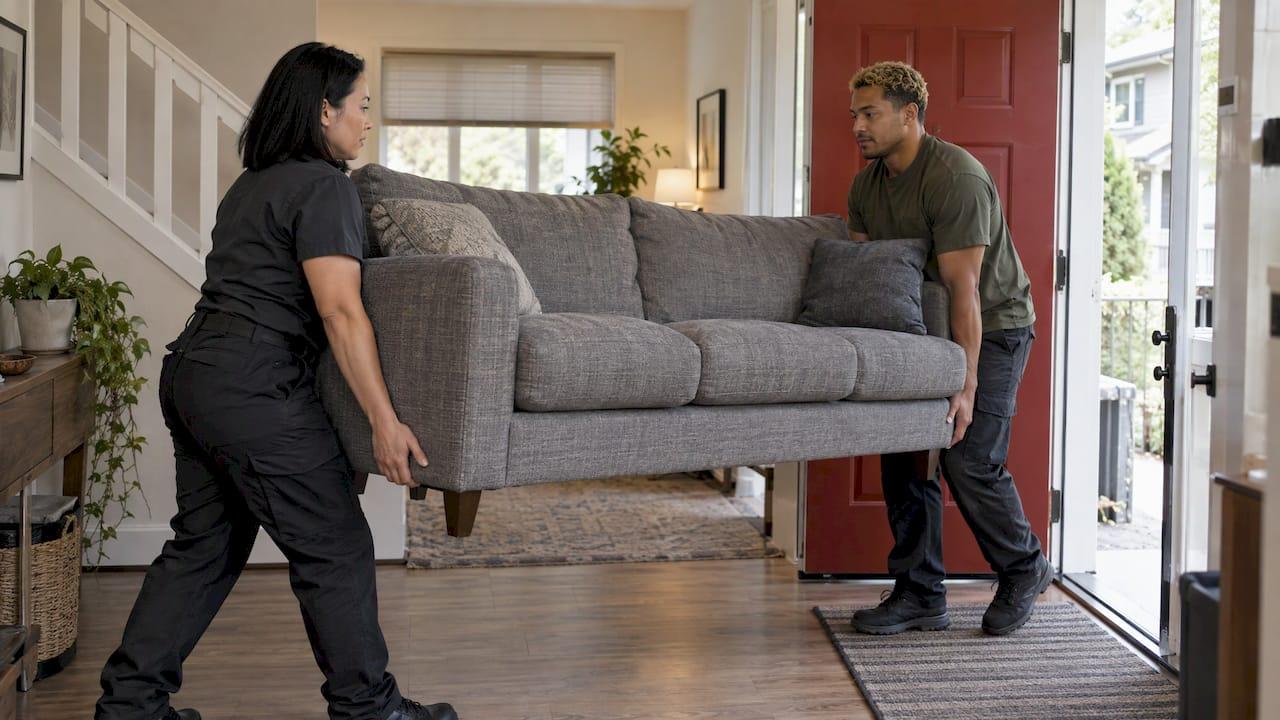
- How to move a couch, and get it through a doorway
- Moving furniture upstairs and downstairs
- When to stop and call movers
- What we do for heavy furniture
- Our view on moving heavy furniture
- FAQ
- Sources
Plan the route before you lift anything
Most injuries and gouged walls happen because people pick up the item first and look for the path second. Spend ten minutes on the route instead.
- Measure the piece. Height, width and depth, plus the diagonal for tall items such as bookcases and wardrobes.
- Measure the exits. Door frames, hallways, stair landings, elevator doors and the turn at the bottom of the stairs. Condo and apartment buildings often have narrow service corridors and booked elevator windows, so check with the building manager.
- Clear the path. Remove rugs, shoes, boxes and pets. The Quebec workplace safety board, the CNESST, advises keeping passageways clear before the move begins, and the same rule applies in a living room as on a loading dock.
- Decide where it lands. Know exactly where the item goes in the new place so nobody holds a 90 kg dresser while deciding.
- Empty it. Drawers, shelves and cabinets come out or get emptied. Weight drops, and contents stop shifting.
Where this goes wrong: people measure the item but not the turn. A sofa that clears a door on its own may not clear the hallway beyond it. If the route is tight, say so when you ask movers for a quote, so the crew arrives with the right plan. It also helps to give them unobstructed access on moving day, since blocked driveways and elevators are a common cause of delays.
How much is too much to lift?
There is no single legal number for a household move, but the Canadian Centre for Occupational Health and Safety (CCOHS) publishes a recommended weight limit calculator that starts from a load constant of 23 kg and reduces it for reach distance, height, twisting, frequency and grip. In practice, a bulky couch held away from your body at an awkward angle is far heavier on your back than its label suggests.
A useful rule: if an item is more than about 50 lb (22.7 kg), treat it as a two-person lift at minimum. Brandon University's safe work procedure for moving furniture requires two people above that weight and bans moving heavy objects on stairs without help or sliding heavy materials downstairs.
Two people is the minimum, not the target. Dressers, solid wood tables, sectionals, mattresses and sleeper sofas are often better with three or four, and that is when a crew pays for itself.

Gear that does the work for you
Good equipment changes a hard lift into a controlled push. The basics:
- Moving blankets and stretch wrap protect finishes and keep drawers and doors closed.
- Furniture dolly or platform truck for dressers, wardrobes and boxes. CCOHS recommends dollies, furniture movers or platform trucks to help when a team moves heavy furniture.
- Hand truck with a strap for appliances and tall, narrow items.
- Lifting or moving straps to share the weight between two people (see below).
- Sliders for short moves across a room.
- Ramps for the truck. The CNESST suggests walk ramps and platforms at least 60 cm wide with the lowest possible gradient.
For inclines, CCOHS also recommends carts with hand brakes, or powered hand carts for stairs, because control matters more than strength when a load starts to roll. Renting or buying all of this for one move adds up, and using it well takes practice. Our crews handle the loading and unloading, so the equipment question is off your list.
Sliders: match them to your floor
Sliders are the cheapest way to move a bookcase or couch across a room without scratching anything, but the wrong type does damage. According to one manufacturer's guidance, hard teflon or polyethylene sliders suit carpet, while felt pads suit hardwood, laminate, tile, vinyl and similar surfaces, and hard sliders are not recommended for hardwood. Many Fraser Valley homes mix carpet in bedrooms with hardwood or laminate in living areas, so check the floor under each stage of the route.

To get a slider under a heavy piece, tilt it slightly or lift one end with a partner until a leg comes off the floor, then slide the pad underneath. Never lift it alone, and never drag a piece with metal or bare wood feet. For a full floor plan, including runners and hard floor covering for the whole route, see our guide on protecting floors when moving.
Using moving straps the right way
Forearm and shoulder straps turn two people into a lifting system. They hold the item at the right height, keep your back straighter and free your hands for doors and corners. The guidance from CCOHS and the CNESST agrees on the key points:
- Adjust the strap to each person's height. CCOHS advises adjusting strap length to your height and using webbing so the straps do not slip.
- Match your partner. The same guidance says team members should be of similar height and strength.
- Choose a leader and agree on commands before lifting, such as lift, walk, stop and down.
- Cross the straps at the back. The CNESST recommends working in pairs with straps that intersect at the back when carrying heavy furniture.
- Lift with your legs, keep the item close to your body and do not twist. Turn your feet instead.
- Set it down on the command, not when one person tires.
Where it goes wrong: mismatched partners, a strap that has slipped halfway through a lift and silence. If nobody says stop, nobody stops.
Moving a refrigerator
A full-size fridge is one of the most common reasons people call movers. It is heavy, top-heavy and full of parts that move.
- Empty it completely and unplug it ahead of time.
- Secure loose parts. One manufacturer's installation instructions say to tape shelves and drawers securely in place before moving.
- Tape or tie the doors shut so they do not swing open mid-move.
- Use a padded hand truck. Centre the fridge on it and run the strap around the appliance without overtightening.
- Keep it upright. Handle it by the sides, and get help with the doors, since lifting one alone can cause injury.
- Measure the path out, including the kitchen opening and any turn, because fridges are deeper than they look.
For stairs, the CNESST says very heavy items such as a large refrigerator or a piano call for specialized equipment. If your fridge is on the second floor or the route has a tight turn, that is the moment to book a crew. Pianos are a separate skill again, and we cover them in our upright piano moving guide.
How to move a couch, and get it through a doorway
Couches are awkward more than heavy, and most doorway failures come from trying to push them straight through. Work through this order:
- Remove what comes off. Legs, cushions and any detachable back. Our guide on furniture disassembly before a move explains what is worth taking apart.
- Take the door off. Interior door openings are usually about 29 1/4 inches wide and exterior ones about 35 inches, and leaving the door in place can cost you up to 1 1/4 inches. Tap the hinge pins out from the bottom with a nail and a hammer.
- Choose the orientation. The same source notes that a couch under 80 inches wide is a good candidate for going through vertically, since door openings are typically 80 inches high, and one that is about 29 inches high or deep can often go through horizontally.
- Stand it on end for tight spots, with one person leading and one guiding the back.
- Pivot, do not push. Angle one end in, then walk the other end around so the couch rotates through the opening.
- Protect walls and frames with a blanket draped over the door jamb.
If it still will not fit, stop. Forcing a couch through a frame tears the upholstery and splits the frame. For a sectional or a piece that needs disassembly, a crew with the right tools is faster and safer.
Moving furniture upstairs and downstairs
Stairs are where a manageable load becomes a dangerous one, because gravity works against you and there is nowhere to put the item down.
- Inspect the stairs. Look for loose treads, worn carpet, poor lighting and anything on the steps.
- Clear the route and open every door in advance.
- Remove drawers and secure movable parts.
- Work in pairs with straps that cross at the back, according to the CNESST's moving safety guidance.
- Stay below the item on the way up and let the stronger person take the downhill end on the descent. One person guides, one carries.
- Never slide heavy pieces down stairs and never take them on stairs without help, as the Brandon University procedure puts it.
Where possible, avoid stairs by using a ramp or wheeled equipment. In walk-up apartments, three-storey townhouses and older Abbotsford homes with steep basement stairs, the sensible answer is a trained team. Our apartment, condo and local moving services include loading and unloading, so the stair carry is ours.
When to stop and call movers
Hand the job to professionals when any of these apply:
- The item is over about 50 lb and you do not have a capable partner of similar size.
- The route includes stairs, a narrow turn or an elevator booking window.
- It is a fridge, freezer, piano, safe, large wardrobe or sectional. For safes, see how weight, gear and crew shape the job.
- You are moving a whole home, not one piece, and a lifting injury would derail the move.
- You are on a tight timeline, which is where a last-minute mover is more reliable than hoping friends turn up.
If you have any back, joint or heart condition, check with your doctor before lifting heavy items yourself.
What we do for heavy furniture
We are a moving company based in Abbotsford, serving the Fraser Valley with residential, commercial, local and long-distance moves within BC. Furniture moving, loading and unloading, packing, and apartment and condo moves are all part of the service, and we also offer piano moving. Pricing depends on distance, size and the services you need, such as packing or specialty items, so a quote starts with the details of your route.
If you are planning a household move, start with the House Moving Checklist, then contact us about your move and tell us what the heaviest pieces are and what the stairs look like. We serve Abbotsford, Mission, Maple Ridge, Langley and nearby communities.

Businesses moving desks, filing cabinets and server racks can look at our commercial and office moving service, or read our office furniture moving plan.
Our view on moving heavy furniture
The most common mistake we see in a heavy furniture move is treating it as a strength problem. It is a planning problem. The route, the order of loading, who takes which end and what happens at the first turn decide whether a dresser arrives intact.
Our approach to a move is careful planning, clear communication and careful handling of your items. That means asking about stairs, elevators and tight doorways before moving day, not on it. When you tell us the heaviest pieces up front, the plan is better and the day is calmer.
Furniture moving, packing, loading and unloading, and piano moving are part of what we offer, because these are the jobs that hurt backs and scuff walls when they are rushed. We would rather you arrive at your new home with a working back and your furniture in one piece.
Jack W.
FAQ
What is the easiest way to move heavy furniture?
The easiest way is to have a crew that does it daily. If you are doing it yourself, empty the piece, use a dolly or sliders matched to your floor, and work with a partner using straps. Plan the route before you lift.
What can I put under heavy furniture to move it?
Use felt pads on hardwood, laminate, tile and vinyl, and hard plastic sliders on carpet. Manufacturer guidance says hard sliders are not recommended on hardwood. Lift one end with a partner to place them, never alone.
How do I move a heavy couch up stairs?
Two people, straps and a cleared staircase. Remove legs and cushions, stand the couch on end if it fits, keep the stronger person at the lower end going up and move slowly on the command of one leader. For a sectional or a narrow stairwell, book movers.
Can a refrigerator be laid down to move it?
It is best moved upright. One manufacturer's instructions say to keep it upright, handle it from the sides and use a padded hand truck, with shelves and drawers taped in place.
How much weight can one person safely lift?
There is no single safe number, since it depends on reach, height, twisting and frequency. CCOHS's calculator starts from a 23 kg load constant and reduces it for real conditions. Treat anything above about 50 lb as a team lift.
Sources
- Moving safety, CNESST
- CCOHS: Calculating Recommended Weight Limit (RWL)
- CCOHS: Hoisting and Moving Heavy Objects
- CCOHS: Team Handling (HTML)
- CCOHS: Team Handling (PDF)
- Brandon University: Moving Furniture and Heavy Lifting procedure
- Smart Surface FAQ
- Refrigerator installation instructions
- How to Move a Couch Through a Narrow Door, The Spruce