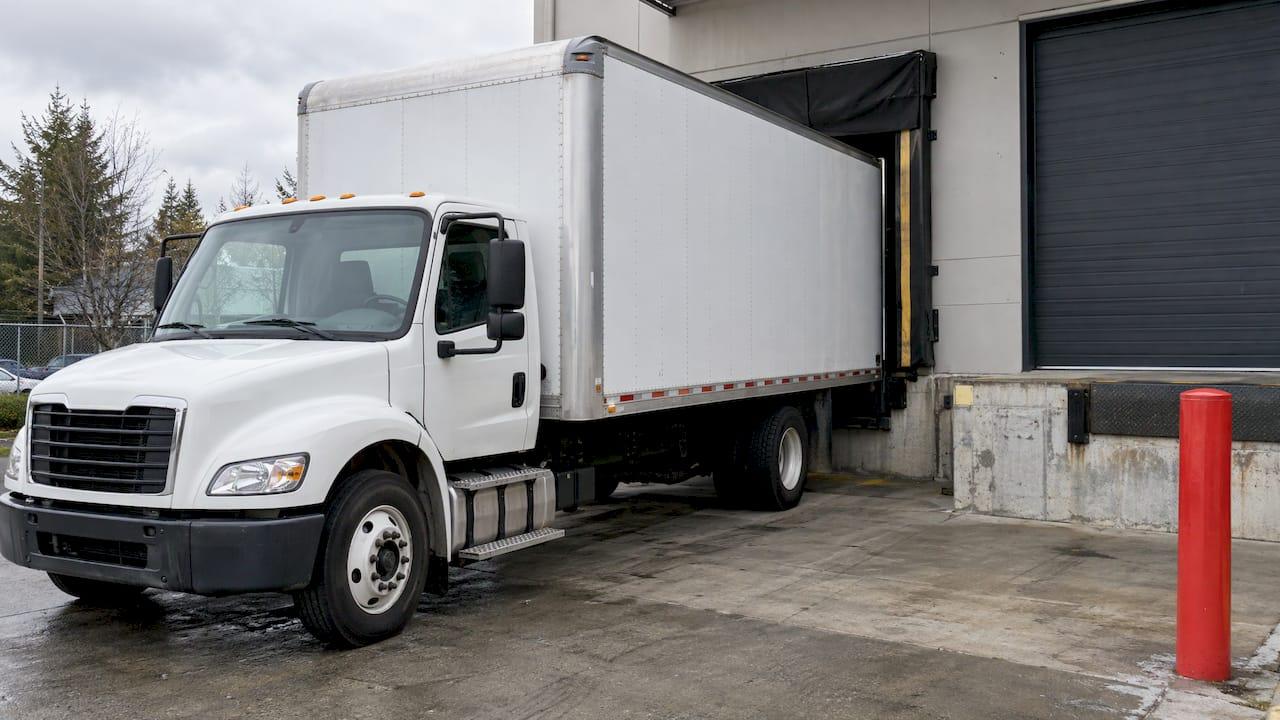
Loading dock access is the right to bring a moving truck to a building's dock or loading bay at a set time, and to use it safely. If you are moving a condo, apartment or office in the Fraser Valley, sort it out with the building before moving day, because a blocked or unbooked dock is one of the quickest ways to lose paid hours. We plan for dock and building access as part of every apartment, condo and commercial move we do in Abbotsford, Mission, Maple Ridge and Langley.
TL;DR
- A loading dock is a recessed bay where trucks are loaded and unloaded. Many condo towers and office buildings have one, and the building decides who may use it and when.
- Ask the building manager four things: booking window, dock or bay height and clearance, elevator availability, and any insurance or deposit requirement.
- Truck size and dock type must match. Dock-height bays suit tall box trucks, while ground-level doors suit smaller ones.
- A safe dock has chocks, marked walkways, good lighting and no one standing behind a reversing truck.
- Give your movers the building's details in advance so the crew arrives with the right truck and a plan.
Table of Contents
- What loading dock access means for a move
- Why it matters more for apartments, condos and offices
- Questions to ask your building before you book
- Dock types and what they mean for your truck
- Planning the truck's approach
- What a safe loading dock looks like on moving day
- A moving-day dock plan, step by step
- Office and commercial moves
- Storage and long-distance moves
- Why a professional crew handles dock access better
- Book a move that is planned around your building
- Our perspective
- FAQ
- Sources
What loading dock access means for a move
A loading dock is, in the words of a Canadian workplace safety association, a recessed bay in a building where trucks are loaded and unloaded. It can sit outside the building, flush with the wall, or be fully enclosed. You find them in offices, hospitals, warehouses and many larger residential towers.
"Access" has three parts:
- Permission. The property manager, strata council or landlord controls the dock. Many buildings only allow use at set times.
- Physical fit. The truck has to reach the bay, fit under any overhead clearance and line up with the door or platform.
- Safe handling. The area has to be clear, lit and free of vehicle and pedestrian conflicts while carts, dollies and furniture cross it.
If any one of these fails, the crew waits, carries items further than planned or switches to a smaller truck. All three cost you time.
Why it matters more for apartments, condos and offices
A house move needs a driveway. A tower or office move needs a plan for the dock, the elevator and the path between them. Renters in apartment blocks, students leaving shared buildings and businesses relocating offices all run into the same few questions: where does the truck stop, how long can it stay, and how far do items travel inside?
The building may also set rules about moving hours, protective coverings for walls and floors, or proof of insurance. Those rules differ from building to building, so the only reliable source is your own property manager or strata office. Ask early, in writing, and keep the reply.
Questions to ask your building before you book
Send these to the property manager, strata or building office as soon as you know your move date:
| Question | Why it matters |
|---|---|
| Is there a dock or loading bay, and can I book it? | Some buildings require a reservation, and slots can fill up on weekends and at month end. |
| What are the permitted moving hours? | It sets how many hours the crew has and whether an early start is possible. |
| What is the height clearance and bay type? | It decides which truck can enter. |
| Is a service elevator available, and can it be reserved? | Elevator time often limits the whole move more than the truck does. |
| Is a damage deposit or certificate of insurance required? | It can take days to arrange, so ask first. |
| Where does the truck wait if the bay is occupied? | It avoids circling or blocking other residents. |
| Who meets the crew and unlocks doors? | A missing contact can stall a move before it starts. |
Share the answers with your movers when you request a quote. A crew that knows the dock height, hours and elevator rules can pick the right truck and staff the job properly. Our guide on picking the right moving truck size explains how the load drives that choice.
Dock types and what they mean for your truck
Not every dock is built the same. Knowing which type you have tells you what to ask for.
Dock-high bays
These are raised platforms so that goods roll straight off a truck floor. The Whole Building Design Guide notes that typical docks are built about 55 inches above grade to suit most trucks. A tall box truck lines up well with this height. A smaller truck or cargo van may sit lower than the platform, and then a dock leveller or ramp has to bridge the gap. The same guide says a ramp from dock to truck parking should have a maximum slope of 1:12, which is why steep improvised ramps are a hazard for loaded dollies.
Ground-level or drive-in doors
These sit at ground height. They suit smaller box trucks and vans, and they are common in light commercial buildings and some mixed-use properties. For a move, ground-level access is simple: items travel at one level with no step up or down. The main question is door width and the clearance for the truck.
Enclosed and flush docks
An enclosed dock lets the truck pull inside, out of the rain, which matters through the Fraser Valley's wet months. A flush dock sits level with the exterior wall. Both usually have rules about how long a truck may stay and who must supervise.
No dock at all
Many older low-rise apartment buildings and townhouse complexes have no dock. Then access means a front entrance, a stretch of curb or a visitor parking area. The same questions apply: where does the truck stop, can it stay long enough, and is the path clear?
Planning the truck's approach
Planners of commercial sites design for truck movement: waiting areas near the docks, turning room and one-way or two-way lanes. One dock planning guide suggests one-way access roads at least 13 ft wide and two-way roads at least 26 ft wide, plus space for trucks to wait. You do not need to measure your building, but the principle helps you spot trouble:
- Tight turns. A long truck needs room to swing. Look at the entrance from the street, not just the dock.
- Overhead limits. Parkade ceilings and awnings can rule out a tall truck, so confirm the clearance rather than guess.
- Slopes. A steep driveway or ramp matters when a truck is loaded. Planning standards from a dock equipment maker give maximum grades of 10% with electric equipment and 15% with gas or diesel for loading equipment, which shows how seriously slope is treated.
- Waiting space. If the bay is shared, there needs to be a place for the truck to wait without blocking others.
If you are unsure, ask the building for a photo or a quick description of the entrance. Send it to the movers with your address.
What a safe loading dock looks like on moving day
A moving crew is working in someone else's space, often next to residents, delivery drivers and staff. Safe access has a few visible signs. They come from workplace safety guidance used in Canadian facilities.
Truck secured. The University of Ottawa's loading dock safety sheet requires wheel chocks for larger vehicles when trucks are sloped, being loaded or unloaded, or when motorized lifting devices are in use. It also calls for engines off and the driver out of the cab during loading. A truck that creeps away from the dock while someone crosses the gap is one of the main dangers.
Backing controlled. The same guidance calls for a signal person to direct vehicles that reverse. The University of Guelph's checklist adds that no pedestrians should be in the area when vehicles are reversing, and that a working backup alarm should be in place. Keep children and pets well away from the dock.
Surfaces in good shape. Under the federal Canada Occupational Health and Safety Regulations, docks and ramps must be free of surface irregularities that interfere with safe operation of mobile equipment and must have side rails, curbs or rolled edges on non-loading sides. Those regulations apply to federally regulated workplaces, and provincial rules cover most Fraser Valley buildings, but the standard shows what good looks like. Dock plates should be marked with their maximum safe load and fixed so they cannot slide.
Enough light. The same federal regulations set 150 lux at docks, indoors and outdoors, where packages are loaded or unloaded. For an early or late move in the dark months, a dim dock is a real hazard for a crew carrying furniture.
Edges marked. Guelph's guidelines call for visual indicators such as chains or gates at open dock doors, and for receiving lanes to be marked with painted lines.
No one trapped in the trailer. Workplace safety guidance warns that loads can shift inside a trailer and pin a worker, which is why people should stay out while powered equipment enters or leaves.

If you see a hazard in your building's dock, such as a loose plate, a damaged edge or poor lighting, tell the property manager before the move. They own the fix.
A moving-day dock plan, step by step
- Two to four weeks out: contact the building. Ask the questions in the table above. Get the booking confirmed in writing, with the date, the time window and the contact name.
- Share the details with your movers. Dock type, clearance, elevator rules and any insurance requirement. This lets us choose the truck and crew size. If you want the loading and carrying handled for you, see our loading and unloading services.
- A few days out: reconfirm. Buildings change schedules. A short email avoids a surprise.
- Prepare the path. Clear the hallway, prop or reserve doors where allowed and have your own building fob or key ready.
- On the day: meet the crew. Show them the dock, the elevator and the unit. Agree where the truck waits if the bay is taken.
- Keep the dock tidy. Stack boxes by room, with heavy items near the door, so the crew loads in one flow without crossing the dock repeatedly.
- Finish and check out. Return fobs, let the building manager inspect the elevator and dock if required, and keep any deposit paperwork.
The seven steps are simple, but each is a point where moves slip: a booking missed, a truck too tall, an elevator already taken. Planning them in advance is what separates a smooth move from an expensive one.
Office and commercial moves
Businesses face dock access more often than households, and the stakes are higher: staff downtime, shared freight elevators and neighbouring tenants. Many office towers set aside specific after-hours windows for moves. The Whole Building Design Guide notes that docks are normally located for service vehicle access, away from public entrances, and near freight elevators, so building owners tend to keep tight control of them.
For an office move, ask the building about tenant move procedures at lease signing, not at the last minute. Agree the dock schedule for both the old and the new premises, since the two buildings will have different rules. Our commercial and office moving service covers business relocations, and our article on office furniture moving for Abbotsford businesses lays out a practical plan. If your move involves large desks, cabinets or equipment, moving heavy furniture safely shows how weight changes the way a crew uses the dock.
Storage and long-distance moves
If part of your move goes to storage, the storage facility has its own access rules, with loading bays or drive-up units and often set hours. The same questions apply on that end. See moving into storage for how to plan and pack for it, or our storage moving page.
For long-distance moves within BC, you deal with two buildings in two cities. Confirm access at both ends, because a delivery that arrives after the destination dock's closing time may have to wait.
Why a professional crew handles dock access better
A mover who has worked many apartment, condo and office jobs knows what to ask, which truck to bring and how to run a crew through a shared space without blocking it. Your job is to get the building's answers. Ours is to turn them into a plan. When the dock window is short, the work has to be sequenced: loaded in the right order, carried on the shortest route and finished within the slot.
Doing it alone adds problems. A rental truck may be too tall for the bay. Friends may not know the building's rules. Nobody is responsible if the schedule slips. With a crew, one team owns the plan from the first call to the last box.

Book a move that is planned around your building
We provide residential, commercial, local and long-distance moving across Abbotsford and the Fraser Valley, including apartment moves, condo moves, office relocations, packing, and loading and unloading. We focus on careful planning and clear communication, which is exactly what dock access needs. Tell us your address, your building's rules and your date, and we will plan the move around them. You can start on our moving services page or go straight to local moving in Abbotsford.

We also serve Mission, Maple Ridge and Langley, where buildings come with their own access rules.
Our perspective
Most delays we see on apartment and condo moves are not about the furniture. They come from access: a bay nobody booked, an elevator in use, a truck that does not fit the entrance. The fix is not complicated, but it has to happen before moving day.
Our advice is to treat the building as part of the move. Ask early, get it in writing and tell your movers everything. When a crew knows the dock, the hours and the route, it can plan the load order and the staffing to match, and the move runs on the schedule you expect.
That is how we like to work: careful planning, clear communication and a crew that respects the building and your belongings.
Jack W.
FAQ
How far ahead should I book the loading dock?
As soon as your move date is fixed, ideally two to four weeks ahead. Buildings differ, so ask your property manager or strata office for their booking process. Weekends and the end of the month are the busiest times, so earlier is safer.
Can a moving truck use the loading dock in a condo or apartment building?
Often yes, but the building decides. Some require a reservation, set hours, a deposit or proof of insurance. Check the height clearance too, because a tall truck may not fit under a parkade or awning. Tell your movers the details so they bring the right truck.
What if my building has no loading dock?
Then the truck uses the front entrance, a visitor stall or the curb. Ask the building where a truck may stop and for how long, and confirm any municipal parking rules for the street. A crew can plan carrying distance around that.
What is the difference between a dock-high and a ground-level door?
A dock-high bay is a raised platform, typically about 55 inches above grade, that matches the floor of a tall truck. A ground-level door sits at the ground and suits smaller trucks and vans. Your movers need to know which one you have to match the truck to it.
Is a loading dock dangerous for a household move?
It can be if it is poorly lit, cluttered or if trucks are reversing. Keep children and pets away, stay out of the truck's path and let the crew handle carrying across the dock. Report loose plates or damage to the building manager beforehand.
Sources
- PSHSA, Loading Dock Safety (2025)
- Whole Building Design Guide, Loading Dock
- Nova Technology, Design The Site
- Nova Technology, Dock Planning Standards
- University of Ottawa, Safety Sheet 16: Loading Dock Safety
- University of Guelph, Loading Dock Safety Checklist
- University of Guelph, Material Handling and Loading Dock Safety Guidelines (2022)
- Canada Occupational Health and Safety Regulations, SOR/86-304
- SOR/86-304 on CanLII