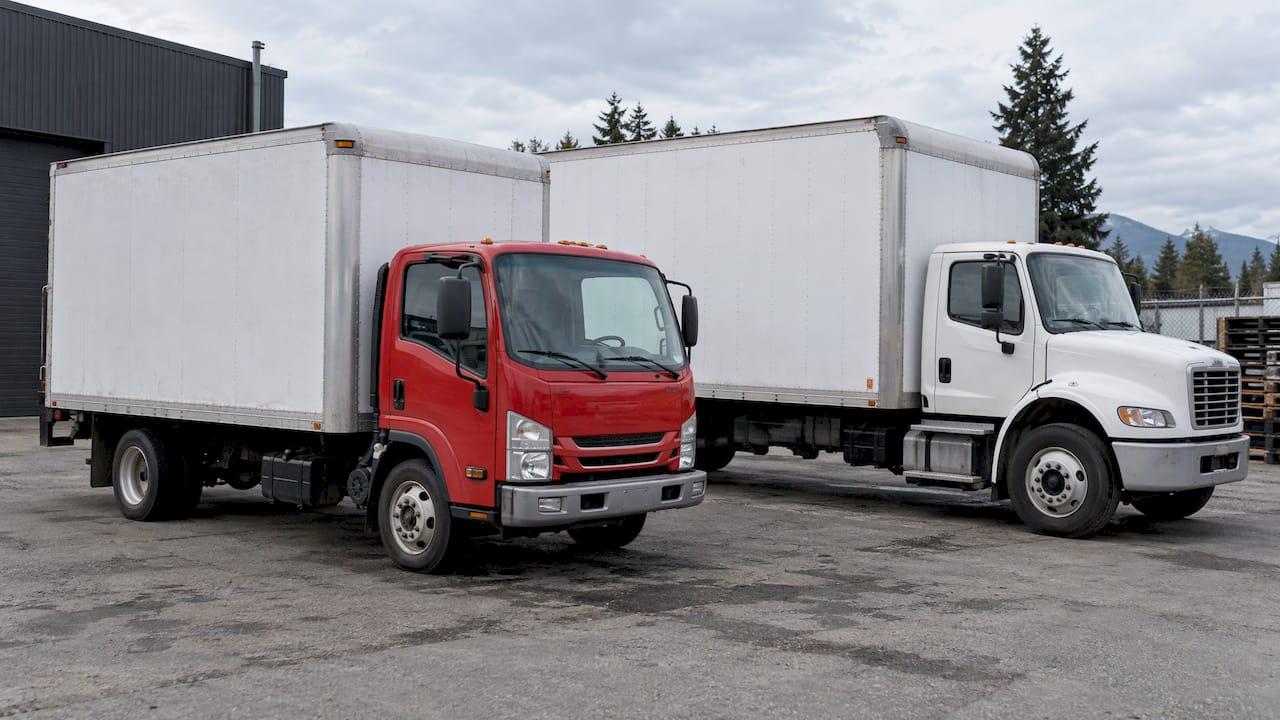
For most Canadian moves, the answer comes down to home size: a 10 to 15 ft truck for a studio or one-bedroom, a 20 ft truck for two to three bedrooms, and a 26 ft truck for a three- to four-bedroom house. Those are starting points. The truck that suits you also depends on how much furniture you own, how far you are going, who is loading, and how much weight the truck can legally and safely carry. This guide gives you the numbers, the checks that matter, and a simple way to avoid the two classic mistakes: a truck that is too small (a second trip) and one that is too big (wasted money and a harder drive).
TL;DR
- Studio or one-bedroom: about a 10 ft truck. Two-bedroom apartment: about 15 ft. Three-bedroom apartment or two-bedroom home: about 20 ft. Three- to four-bedroom home: about 26 ft.
- Cubic feet are only half the story. Payload (weight) and interior dimensions decide whether your belongings actually fit.
- Distance, stairs, helpers and your inventory can move you up or down a size. For a long move, extra space beats a second trip.
- Small trucks seat two or three people in the cab, so plan how the rest of your household travels.
- If you would rather not do the maths, a mover can size the truck and crew from your inventory.
Table of Contents
- Moving truck sizes at a glance
- What actually fits in each truck
- Weight matters as much as space
- Five numbers to check before you commit
- Factors that can change your truck size
- Who rides in the cab
- Common mistakes
- A worked example
- Our perspective
- Let us size your move for you
- FAQ
- Sources
Moving truck sizes at a glance
Rental fleets across North America use similar categories, though the exact box volume differs a little by manufacturer. This table pairs one national chart's home-size recommendations with the cargo figures published by Canadian rental fleets.
| Truck length | Typical home | Cargo space (published examples) | Cab seating |
|---|---|---|---|
| 9 to 10 ft | Studio or small one-bedroom | A 9 ft cargo van lists 260 cu ft and a 2,400 lb payload | 2 |
| 15 to 16 ft | One-bedroom home or two-bedroom apartment | A 16 ft truck lists 735 cu ft and a 3,500 lb payload | 3 |
| 20 ft | Two-bedroom home or three-bedroom apartment | A 20 ft box truck lists 6.1 m long, 259 cm wide, 246 cm high, up to 4,535 kg payload | 3 |
| 24 to 26 ft | Three- to four-bedroom home | A 24 to 26 ft truck lists 1,125 cu ft and a 13,000 lb payload; a 26 ft box is 7.92 m long and 259 cm high | 3 |
| 29 ft | Four- to six-bedroom home | Largest common size | 3 |
The home-size pairings come from a national chart that maps each bedroom count to a truck length: studio or one-bedroom apartment to 10 ft, one-bedroom home or two-bedroom apartment to 15 ft, two-bedroom home or three-bedroom apartment to 20 ft, three- to four-bedroom home to 26 ft, and four- to six-bedroom home to 29 ft.
Two things to notice. First, published volumes are not identical between fleets, so treat any single number as a ballpark. Second, a 16 ft and a 20 ft truck can list the same box volume in one lineup, which tells you length alone does not decide capacity. Always compare interior length, width, height and payload together.

What actually fits in each truck
Bedroom count is a shortcut. A better method is to think in terms of the big items, because they are what leave you stuck at the kerb.
Small trucks (10 to 16 ft)
A 10 ft truck suits a studio or a student move: a mattress and frame, a small sofa, a desk, a dresser and perhaps thirty boxes. A 15 or 16 ft truck handles a full one-bedroom apartment or a modest two-bedroom, including a sofa, a dining table with chairs, a queen bed and appliances if you take them.
If you are torn between a 15 ft and a 20 ft, ask yourself one question: do you own a lot of boxes or a lot of bulky furniture? Bulky furniture (sectionals, armoires, large dressers) eats floor length quickly. In that case, go up a size.
Mid-size trucks (20 ft)
The 20 ft truck is the workhorse for two- and three-bedroom apartments and small houses. It has room for a full set of bedroom furniture, living room pieces, a washer and dryer, and a few dozen to a hundred boxes, depending on how well it is packed. Because the cab seats three and the truck is still manageable in tight apartment-complex lots, it is the usual middle path.
Large trucks (26 ft and up)
A 26 ft truck is built for three- to five-bedroom homes. One widely used model lists 1,682 cu ft of volume and a maximum load of 12,859 lb, with a maximum gross vehicle weight of 25,999 lb. In practice that is enough for the full contents of a family home: multiple bedrooms, a dining set, a living room, a garage's worth of boxes and several large appliances.
It is also a big vehicle. It is harder to park in a townhouse complex, harder to turn on narrow Fraser Valley residential streets, and a lot of truck to pilot if you have never driven one. That is why many families who own a large home choose to have a professional crew and driver handle it.
Weight matters as much as space
People fixate on cubic feet. The limit that often bites first is weight. A truck has a maximum gross vehicle weight (the truck plus everything in it). Rental-fleet guidance explains that if two trucks share the same maximum weight, the bigger one gives more room but not more total capacity, because the larger truck itself weighs more and may leave less for your belongings.
That has real consequences when you load heavy things: books, tools, a gun safe, a piano, stone-top tables, a freezer full of food. Boxes of books look small and weigh a lot. You can fill the payload long before you fill the space.
Overloading is a safety issue, not just a paperwork one. The same guidance notes that an overloaded truck may take longer to stop, be harder to steer and put extra stress on brakes, tires and suspension, and that items can shift during the drive. On the Coquihalla or the Sea to Sky, where you are climbing and descending, that is exactly what you do not want. The principle of staying inside payload and loading low and tight applies to any vehicle, from vans to car roofs; weight limits and safe loading are worth reading about before you stack anything heavy.
A practical rule: load the heaviest items first and place them against the front wall of the cargo box, near the cab, then build lighter items on top and behind. Keep weight centred and strapped so nothing shifts when you brake.

Five numbers to check before you commit
When you are close to a decision between two sizes, work through these, which are the details that decide nearly every fit question:
- Your largest piece of furniture. Measure its length, width and height. A six-foot sofa fits any truck, but a deep sectional may need to stand on end.
- How many of each large item you have. Count mattresses, dressers, bookcases, appliances and desks, then estimate boxes by size (small, medium, large).
- Anything that must stay upright or cannot be stacked. Mattresses, mirrors, flat-screen TVs, fridges and glass tabletops all use space awkwardly.
- Interior dimensions, not just advertised volume. Check length, width between the wheel wells, height and the door opening.
- Payload limit. Add rough weights for heavy items and compare with the truck's listed capacity.
A quick shortcut: sketch your home room by room and list the major items. If the list looks like the contents of one bedroom plus a living room, you are in 15 ft territory. If it fills three or more rooms with big furniture, think 20 ft and up.
Factors that can change your truck size
Distance
For a short local move, a slightly smaller truck is workable because a second trip is possible: you load, drive across Abbotsford, unload and return. For long distance, the logic flips. One national rental guide notes that on long moves multiple trips are not an option, so extra space is better than too little. If you are heading from the Fraser Valley to the Interior or Vancouver Island, size up.
Who is helping
The same guide points out that with help loading and unloading, a larger truck is easier to manage, while a solo mover may find a smaller one more practical. A bigger truck with a fast, organised crew can be loaded efficiently and packed tightly. A bigger truck with two tired friends and a lot of stairs is slow.
Stairs, elevators and access
A third-floor walk-up and a tight condo loading dock affect which truck you can bring and how long loading takes. Book the elevator and loading zone early, and make sure the truck can actually get close. Our guide on preparing for movers and keeping access clear explains how blocked access can delay a move, and how long movers take helps you plan the day.
Disassembly and packing
Beds, wardrobes and desks that come apart pack far more efficiently than assembled ones, which can save you a whole truck size. Read what to expect from furniture disassembly movers. Likewise, uniform boxes stack; mixed bags and loose items do not. Proper packing is the cheapest way to gain usable space.
Storage in the mix
If some belongings are going into storage first, you may split the move into two loads. Our guides on moving into storage and what size storage unit you need will help you plan both ends.
Who rides in the cab
Small trucks have small cabs. According to one national rental company, pickup trucks, cargo vans and 10 ft trucks seat two, while 15 ft and larger trucks have a front bench for three. If your household is four people plus a driver, someone follows in another vehicle. Kids and pets are best placed in the second vehicle rather than squeezed in beside you.
Common mistakes
- Choosing by price per day. A smaller truck that forces two trips costs more in time, fuel and stress than the size up.
- Forgetting heavy items. Books and tools hit the weight limit before the volume limit.
- Ignoring the driving. A 26 ft truck on a narrow street or in a tight underground lot is a real challenge.
- Not counting your garage, shed and storage. These are the areas that most often get left out of the estimate.
- Skipping inventory. Walk the house with a notebook or phone. Our house moving checklist shows how to log items so nothing is forgotten and you have a record for moving insurance.
A worked example
Say you are leaving a two-bedroom condo in Abbotsford for a three-bedroom townhouse in Langley. You have a queen bed, a double bed, a sofa and loveseat, a dining table with six chairs, two dressers, a washer and dryer, a desk and about 60 boxes. That is more than a 15 ft truck wants to hold, and exactly what a 20 ft truck is designed for. If you also own a sectional, a chest freezer and a lot of garage items, a 26 ft truck starts to make sense, or you accept two trips in the same day because the distance is short.
Now take a student moving out of a one-bedroom apartment with a bed, a desk, a small couch and 20 boxes. A 10 ft truck or even a cargo van works, as long as the stairs and elevator are sorted.
Our perspective
In our experience, the best truck is the one that fits the move and the access, not just the home. We plan a move around the inventory, the building, the route and the crew, because those are what decide whether the day runs smoothly.
That is why we recommend starting with a clear list of what is moving: major furniture, box counts, specialty items and anything going to storage. With that, the truck size, the number of movers and the loading order follow naturally. It is also why we ask about stairs, elevators, parking and distance up front.
Our goal is dependable service and clear communication for local moves in Abbotsford and the Fraser Valley, as well as long-distance moves within BC. Careful handling and good planning are what make moving less stressful, and getting the truck size right is the first step.
Jack W.
Let us size your move for you
If you would rather not calculate cubic feet and payload, talk to us. We handle local moves, long-distance moves within BC, apartment and condo moves, office relocations, furniture moving, packing and loading and unloading for customers in Abbotsford, Mission, Maple Ridge and Langley. Tell us what you are moving and we will plan the rest.

Get started on our Abbotsford moving page, or see how we work with commercial and office moves and furniture moving.
FAQ
Do I need a 15 ft or 20 ft truck?
A 15 ft truck suits a one-bedroom home or a two-bedroom apartment. A 20 ft truck suits a two-bedroom home or a three-bedroom apartment, according to one national size chart. If you have bulky furniture or lots of boxes, or you cannot make a second trip, choose the 20 ft.
How much fits in a 26 ft moving truck?
A 26 ft truck is designed for three- to five-bedroom homes, with a listed volume of 1,682 cu ft on one popular model. That covers multiple bedrooms of furniture, a living and dining room, appliances and many boxes. Check payload too, since heavy items can reach the weight limit first.
Can three people fit in a small moving truck?
Not in the smallest ones. Ten-foot trucks, cargo vans and pickups seat two, while 15 ft and larger trucks seat three. Plan a second vehicle for larger households.
Does a bigger truck carry more weight?
Not necessarily. If two trucks have the same maximum gross weight, the larger one has more space but not more total capacity, since it weighs more empty. Always compare payload, not just length.
Sources
- Rental Trucks in Canada
- Personal Comparison Guide
- Moving Truck Sizes
- 26ft Moving Truck Rental
- How to Choose the Right Size Moving Truck Rental
- How Many Seats Are in a Moving Truck?
- Moving Truck Weight vs. Size: What Really Matters?